The New York Times top 100 TV shows and the always slippery TV canon
In: Exit Party, Forgotten Island. Out: the idea that it should be easy to build a TV canon!!


Happy Monday, Episodes pals! This week, we've got takes on the New York Times' top 100 TV shows of the century and Emily St. John Mandel's Exit Party, as well as our usual collection of other bibs and bobs. Remember: If you subscribe, you'll get this newsletter in your inbox every Monday!
There will never be a good "best of TV" list built by consensus
People still really love The Wire, which finished second.
For much of the past week, my various social media feeds have been taken over by discussion – mostly angry discussion – of the New York Times' top 100 TV shows of the 21st century list. (See the list here.) While, yes, some of the results were specious, to my mind, I found it hard to get too worked up about any of it. The results of the NYT's list – both the good and the ridiculous – are part and parcel of the difficulties with building the TV canon.
As I wrote all the way back in 2015, TV is a particularly hard medium to construct a canon around because of how much work it is to immerse yourself in every good show ever made. For instance, American films of the 1970s have established a deep, robust canon through which you can argue the decade as the best ever for that medium in the United States. American television from the 1970s would have a similarly persuasive argument for having been the best the medium ever was – I would give the 2000s the edge, but I wouldn't get too upset if you picked the 1970s. But once you get past a handful of famous shows, particularly All in the Family, The Mary Tyler Moore Show, and MASH, how many more '70s shows would you be able to list? More, how many more '70s shows would I be able to list? And I'm, in theory, a student of the medium. I've never seen, for instance, Paul Sand in Friends and Lovers, a show that people of that era would have acclaimed as essentially its version of, like, Party Down – a short-lived comedy that did something no other comedy quite had.
Then consider this: How many episodes of the most famous 1970s shows have you actually seen? MASH has been running in syndication for forever, so it seems a safe bet you've ambiently absorbed at least some of it. But both All in the Family and Mary Tyler Moore have had spottier syndication records. Unless you were the exact right age to watch all of them on Nick at Nite or TV Land – and, hi, I am – the odds are good you mostly know them by reputation.
Thus, "best TV" lists almost always namecheck a few shows from a particular era, then fill up the rest of the list with then-contemporary shows people have immediately on their minds. When you couple that tendency with the fact that NYT just counted every time a TV show was listed in somebody's top 10 and the fact that the list was voted on by TV professionals and celebrities who probably aren't watching Rectify or whatever, you end up with a list that, yes, ranks The White Lotus – a show I've loved seasons of – absurdly high. Recency bias will always hold sway in TV lists because most people's personal TV canons have a few unquestioned classics, a few personal favorites, then a bunch of shows that just happen to be airing as the person is thinking about it.
The NYT list is pretty good by the standards of these things, especially because by limiting itself to shows that debuted since the year 2000, it slices off a narrower cross-section of TV history than usual. (I would hate to see how an attempt to list all of TV history would have worked out!) Thus, I would view it less as some sort of definitive snapshot and more a suggestion of which shows are probably canonized and which are in danger of falling off. Like I don't know that I would have ever guessed 30 Rock would be so enmeshed as "the best sitcom of the 21st century" back when it ended, but here we are. Similarly, it feels like Community is slowly fading from the cultural imagination a little bit.
How much of that is streaming? Less than you'd think, probably. Ten years ago, sure, something being readily available on streaming would have been explanation enough, but by now, everything has sort of made its way on and off various platforms. So I don't know that that explains it.
This continues to be a topic of interest to me, so I look forward to revisiting it in a few years when some other publication does exactly this to juice their stats for a week. Also: I would have sworn Gilmore Girls debuted in 1999, but you know what? It debuted in 2000! The past is a foreign country!
(By the way: Deadwood, The Leftovers, Lost, Mad Men, Mr. Robot, Nathan for You, The Office (UK), Slings and Arrows, Twin Peaks: The Return*, The Underground Railroad.)
(*-If we argue this doesn't count – and I think we should! – then I would slide Halt and Catch Fire or The Americans in there. But since NYT declared it eligible, what am I going to do? Not vote for it?) –Emily St. James
The only NYT ballot with the guts to tell the truth
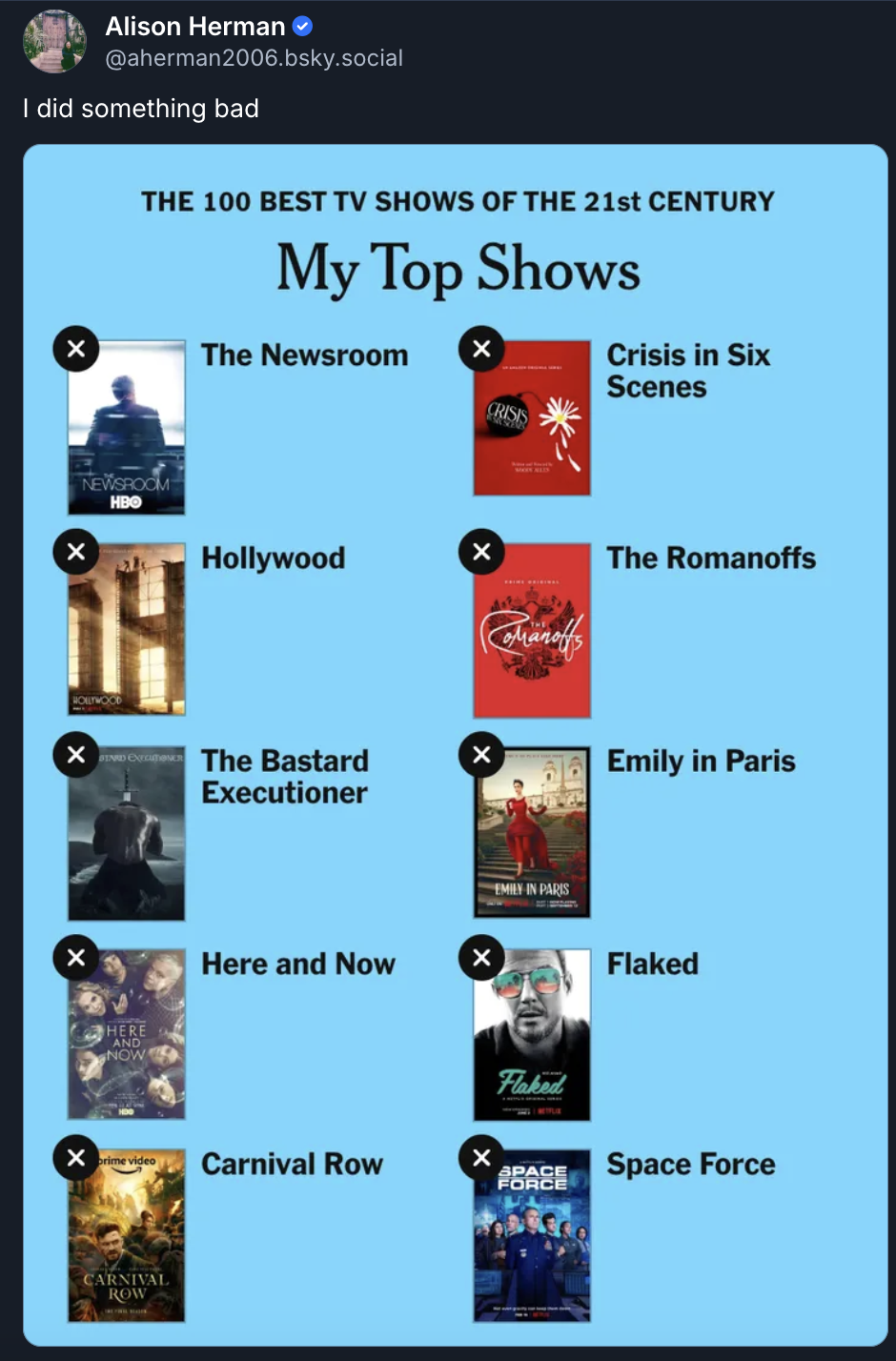
Only Variety's Alison Herman would be brave enough to speak up for the 21st century's true best. (From here.)
Exit Party and feeling homesick for dystopia
Spoilers for Emily St. John Mandel's Exit Party! Which you should read!
When I arrived at my MFA program in 2022, my default answer to "what's your favorite book published in the last ten years?" was Emily St. John Mandel's Station Eleven. I'd read it, like many people, during the height of the covid pandemic, but it had stuck in my brain for reasons beyond its immediate relevance to the lockdown we were all stuck in. It captured the strange, sad feeling of being haunted by a past you can never return to, which is something I think about, like, a lot. It doesn't hurt that the book is gorgeously written, too — I memorized a passage from it for class once as an example of prose I wish I knew how to emulate.
Exit Party, Mandel's latest, works with many of the same themes even as it builds on them in ways I find fascinating. It concerns a handful of guests at its titular party — a celebration of the end of citywide curfew in a near-future Los Angeles — who, through means the novel leaves inherently ambiguous, get transported between parallel universes. In the universe in which the party takes place, called Side A in section headers, the United States of America has dissolved following a coup. (It's implied, but not stated, that the coup was the result of Trump trying to stay in power post-2028.) Breakaway nations on the coasts are more or less stable, but the interior of the country is largely controlled by violent militias. In the other universe, Side B, the US is a surveillance state that many readers would consider dystopian. There are some scientific advancements over our own world — cars are largely self-driving and cancer has been cured — but speaking ill of the state can get you sent to a black site in the desert.
As she did in Station Eleven, Mandel takes a relatively common sci-fi premise — in this case, the multiverse trope that's become ubiquitous in the genre — and grounds it in deeply-felt emotional reality. People from one universe tend to find the other one unnerving in ways they can't fully articulate; the social conventions and subconscious reflexes they've learned over the years are no longer applicable. And travel between universes is a one-way affair. Throughout the novel, characters search for ways to go back to their home universe, but, at least as far as we can see, no one ever finds one. If you were one of the unlucky guests at Kareem's party in 2031, you'd better start finding things to like about the timeline you've found yourself stuck in. For some characters, like Side-A Kareem himself, it's a matter of finding people you love enough to navigate the homesickness. For others, like the Side-B version of Kareem's partner Nico, no amount of community can overcome the loss of a world that felt like your own.
What's most interesting to me about this premise is that natives of Side B — the authoritarian one — tend to find Side A just as disorienting as the other way around. Side-B Nico eventually emigrates to Paris, far from the ongoing disorder in North America, and serves as a surrogate mother to her Side A doppelganger's son. Back in Side B, she was a member of the resistance who hoped her work on quantum teleportation could help spirit dissidents away from the US. But now that she's out of not just the US but her timeline entirely, she finds even talking about Side B painful beyond description. She is full of homesickness for what she once would have readily labeled a dystopia.
I do, too, sometimes. The covid pandemic is a trauma few people even want to acknowledge these days. And yet it was a formative time for me: I was fresh out of undergrad and learning how to be an adult in a world that felt hauntingly empty. I am immensely grateful for covid vaccines and the other measures that made it safe for the world to open back up, but I still sometimes miss the lonely life I led during lockdown. Exit Party argues that homesickness is central to what it is to be human even as it's irrational and often poisonous. For that reason and more, it's Mandel's best novel since Station Eleven and well worth a read this autumn. —Lily Osler
Buy Emily's It's a Wonderful Life book!
Believe it or not, we're just a few weeks away from the publication of Every Time a Bell Rings, the book about It's a Wonderful Life that I cowrote with Defector's Lauren Theisen! It is — I say with some pride — a very strange book that is less a making-of or a historical document and more an attempt to consider the film from a variety of angles, major character by major character. There are essays about World War II PTSD, whether Bedford Falls had any gays in it, and Donna Reed's impossible standard for womanhood. Buy it today, and if you're in Los Angeles, come to our launch event at Village Well in Culver City! —ESJ
Last week in Episodes...
- On Monday, Emily felt quite glad that Zach Cregger's Resident Evil made the game's fans mad, while Lily defended Widow's Bay's odd comedic tone.
- Lily and Emily named 15 fictional small towns they'd love to live in, in celebration of Emily's aforementioned It's a Wonderful Life book.
I love the comics of renowned "good duck artist" Carl Barks, who toiled away in the Disney trenches for much of his life to little notice or acclaim, turning out surprisingly thrilling adventure comics about Donald Duck, his nephews, and (most famously) his uncle Scrooge McDuck. While, yes, they go off to have adventures all around the world, they always come back home to Duckburg, USA. Barks's whole deal was adapted for the much better-known animated series DuckTales, but it's the artist's original conception of Duckburg as a kind of Everytown, USA, that offers a brief respite from the horrors of the world that I'd like to move to. Provided I don't have to become a cartoon duck. Which I maybe would? Should I rethink this?
- Our Infinite Jest book club hit its penultimate week with a consideration of just how self-indulgent the novel is – and whether it's fine if the answer to that is "quite a bit."
- And Lily argued that Cregger's take on Resident Evil is one of the best cosmic horror movies in a long, long while, creating a world that fundamentally does not care about anyone within it, not even the protagonist.
[The film] changed the way I see video game horror movies. It's proof that horror movies based on games can adapt the experience of playing those games for a mainstream audience. It's a movie that not only doesn't lore-dump most of the time, but also manages to make the times it does vomit proper nouns at you actually interesting. And, despite long odds, it may have changed my mind about the value of cosmic horror.
This week at the newsletter, we've got the final Infinite Jest book club! We've got Emily's 26 Episodes feature reaching Twin Peaks: The Return (gotta light?)! We've got (most likely) a take on Primetime! Want to read all of that great stuff? The only people who have access to all of it are our paid subscribers! Why not upgrade your subscription today?
Some pop culture things we're into
- Dropping an animated family movie in theaters in late September is rarely a recipe for enormous success, but it usually results in at least a solid double or triple. Not so with Dreamworks Animation's Forgotten Island, a winning, moving, slightly too frenetic story of teen girl friendship and Filipino mythology that is paced slightly like a soda can stuck in a paint shaker. Directed by Joel Crawford (Puss in Boots: The Last Wish) and Januel Mercado, Forgotten Island plays around with the shifting and crumbling memories of our youths do as we age, even as we exit high school and head off into adulthood. The core friendship between wild child Jo (H.E.R.) and responsible kid Raissa (Liza Soberano) holds the movie together even when it's become a little exhausting – Crawford and Mercado throw every idea they have in here – and I loved the various monsters and creatures drawn from a mythological tradition that has scant representation in pop culture. One of the unfortunate stories of the 2020s has been the slow gutting of Dreamworks, right as it's doing some of the best work of the studio's history, and while I might quibble with some of Forgotten Island's choices, I don't know that the upcoming CoCoMelon movie (coming from Dreamworks in March) is going to, y'know, pay homage to Charlie Kaufman's oeuvre. Alas! –ESJ
- I finished Ponies just in time! Despite a couple of moments in the middle of the season when I could feel just how much the story was being compressed – few eight-episode shows I've seen recently could have more evidently used 10-to-12 episodes as this one – I found the finale tremendously effective. Boo to Peacock for canceling this one! I want to know what happens to Bea and Twila! And if Twila gets a girlfriend! –ESJ
- My Guillermo Del Toro revisitation continued with both Hellboy films, and I was reminded all over again that Hellboy II ends with one of the closest things modern franchise filmmaking has ever had to what amounts to a show canceled on a cliffhanger. I hope Del Toro and Mike Mignola someday do a comic or something to let us know how the story would have wrapped up. Did I mention I love Del Toro's take on Hellboy? I love it! –ESJ
- I also finished 'Salem's Lot! My verdict is: really fucking good, if you can tell Stephen King is still figuring out how to develop his own voice and not lean on his influences. The last section, as the town slowly empties out of human beings and fills with vampires, is suitably apocalyptic, and I love, love, love the final confrontations with Barlow, the main vampire. –ESJ
- This week's "Emily listens to girls who scream" selection is Brazilian punk rocker Karen Dió, who speaks to my inner 15-year-old who is really fucking mad at her parents. I have yet to hear a song I don't like by this woman! –ESJ
- My big achievement this week was that, at last, I have finished Infinite Jest. We'll talk about this more on Thursday, but, God, what a sad, sad book. Still my favorite of all time, despite it all. —LO
- Despite having been something of a #gamer since the pandemic started, I only just played my first Metroid game this week! I needed something to play in, like, fifteen minute increments in between tutoring appointments, and 2002's Metroid Fusion fit the bill. I'm not going to pretend that it was my favorite game or anything like that, but I spent the whole thing going, like, "Oooh! I see where that concept from Celeste came from! Oh, this is like that thing in Hollow Knight!" (The SA-X encounters, in particular, are very proto-Badeline.) My primary issue here is that the game (like, I'm led to believe, most Metroid games pre-2010s) really invites you to leer at Samus, putting her in her underwear every single time you die, which did make me feel a little like vomiting. Still, what an absurdly influential game! —LO
- Finally, in honor of the album's 30th anniversary, I listened to Pinkerton a bunch. Israel Daramola at Defector has all the correct takes on Pinkerton in our Good Links section below; my only humble addition is that the guitars on it sound like what a teenager feels when they scream into a pillow. I don't like what it says about me that this is easily my favorite Weezer record and maybe one of my favorite albums of the '90s. —LO
Let's watch Bug Mission: Impossible, shall we?
Discuss
Okay, fine, what are your top 10 shows of the century? Play by New York Times rules as much as you can, so no Sopranos, okay? Talk about it in comments or the Discord!
Some good links
- Problem Child: The Creative Crisis at Pixar [The Baffler]
- How do you solve a problem like the paywall? [Boxed Whine]
- Idaho officials solved a cold case that may have a connection to the infamous 1982 'Tylenol murders' [Spokane Spokesman-Review]
- Transformer: Velvet Goldmine [Jude Doyle]
- Revisiting Weezer's Cringe Masterpiece at 30 [Defector]
A Good Song
The free edition of Episodes is published every Monday and every other Wednesday. Premium subscribers get those newsletters, plus extra ones every Tuesday, Wednesday, and Friday. Our editor-in-chief is Emily St. James, and our managing editor is Lily Osler. If you have suggested topics, please reply to the email version of this newsletter or comment (if you are a paid subscriber).