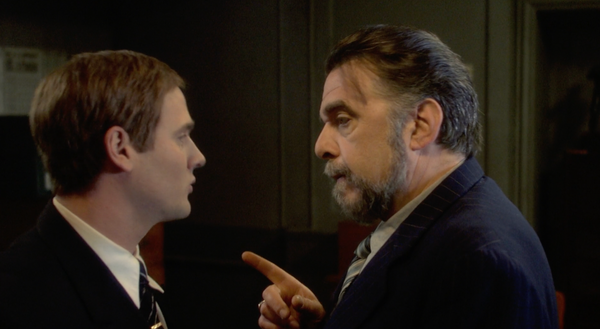
What happens when Godzilla's subtext becomes text?
Plus: Blexas, Gangs of New York, and Olivia Rodrigo's new Christmas track!



Happy Monday, Episodes pals! This week, we've got takes on Godzilla and Blexas, as well as our usual collection of other bibs and bobs. Remember: If you subscribe, you'll get this newsletter in your inbox every Monday!
Godzilla Minus Zero touches the monster franchise's third rail – and has a great time doing it
"Godzilla is a metaphor for Japan's unprocessed national trauma around being the only nation attacked with atomic weapons to date" is one of the four or five most famous examples of "this movie monster equals this real-life thing" in movie history. That connection to one nation's history remains present even in the big guy's more ridiculous outings – and it also explains why even the best American Godzilla movies (like the elegiac 2014 film) never quite feel right. At their best, the Godzilla films of Toho, the studio behind all Japanese Godzilla entries, feel a little like this very serious core doing battle with the inherent campiness of a big monster stomping around and fighting other giant monsters.
In 2023's Godzilla Minus One, director Takashi Yamazaki flirted with touching the third rail of all Godzilla movies by very directly saying, "No, this movie is about a nation trying to put itself back together after decisively losing a war." For much of its runtime, that movie simply follows a group of people trying to find purpose in a world that has been cataclysmically altered by war, like William Wyler's The Best Years of Our Lives paused every so often for monster attacks. Minus One achieved a real synthesis between its realism and its fantastical elements in its final act, where "can we stop Godzilla?" becomes a stand-in for a bunch of characters asking if they deserve to live. It was bracing and beautiful. It made a ton of money. It won an Oscar for Visual Effects.
So, of course, a sequel was inevitable. Yamazaki returned, as did the cast and crew that made the 2023 film so indelible. It's obvious Godzilla Minus Zero (somehow an even more ridiculous title) had a much larger budget, and the scenes of monster carnage are among the best in the franchise's history, particularly a fight between Godzilla and three-headed alien dragon King Ghidorah that goes for broke. Yamazaki's skill with eerie images that add just a touch of unearthly horror to the blockbuster proceedings also returns intact, especially in scenes where Ghidorah levitates buildings into the sky and lets them hang before dropping them.
What's fascinating about this sequel, however, is how Yamazaki doesn't just flirt with touching the third rail of Godzilla movies but grabs hold of it and starts laughing. There are flashbacks to the aftermath of the nuclear attack on Hiroshima here, and the presence of the US military's non-occupying occupying force is much more pointed this time around.
The coup de grace comes when one character revels in a fantasy sequence of Godzilla attacking New York that comes as close as any movie ever has to making me feel like, fuck yeah, it's time to nuke the United States of America! That it exists in a movie that broke the American box office record for a live-action non-English language film's opening weekend makes it all the more potent. When I saw Minus Zero in downtown Los Angeles, I could feel the way my audience locked in for this sequence, ridiculous as it was.
"Let's make the subtext text" is often a really terrible strategy for genre storytelling, which is often at its best when it maintains a sheen of plausible deniability. And it's perhaps no mistake that the human story in Minus Zero is weaker than the comparable one in the prior film. Yamazaki makes a valiant effort to tell a story about a young family hoping its love is enough to win out in a world where giant monsters exist, but the emotional core just doesn't have the same immediate tie to our favorite mega-lizard as Minus One offered.
Yet I found myself sort of charmed all the same by the way that Godzilla Minus Zero wanted me to know this was a story about unprocessed trauma and grief. In some ways, that reduced the more human elements of the story to kitsch, but the beauty of Godzilla is that he's already a little bit kitsch by simple fact of him having existed for over 60 years. The metaphor of Godzilla is so elastic that it has survived for decades; that it can even survive ceasing to be a metaphor is quite impressive. –Emily St. James
Now playing: A video game that feels like Blexas
As someone who voted in her first federal election in 2014 — the year Democrats lost control of both houses of Congress, the election that heralded the beginning of the 2016 presidential cycle and, with it, the Trump era — Tuesday night was a legitimately surreal experience. Democrats will control Congress with commanding majorities; Democratic trifectas may well spell the end of the Electoral College; my home state of Minnesota defied predictions of doom and elected a progressive senator by double-digit margins. Even the night's few bitter losses, namely a handful of anti-trans ballot measures in Western states, are likely to quickly fall to court challenges. It was, on the whole, an amazing midterm cycle.
And nothing about it felt nearly as good to me as Blexas.
While I tend to tell people that I'm from Minnesota, that's only true in the sense that it's the place I feel most at home. I lived in Waco, TX, from age four to 14, a decade spanning my most formative years. Waco was, in many ways, an awful place to grow up as a queer kid; I was bullied terribly. In retrospect, I am beyond glad that my family chose to move to the Twin Cities.
And yet, thinking about the massive change in Texas' governance that will come about as a result of this week's elections, I've been thinking about the people my family befriended in Waco. The city sat in a blood-red county, yes. But it was far from homogeneous. My parents were part of a bubble of progressives and environmentalists in the city, people who brought me to protests against coal-fired power plants. We attended one of Waco's handful of liberal Baptist churches, where aging hippies and Old Testament professors taught me and my friend about the historical Jesus in Sunday School classes. I was raised and loved by people who spent decades working toward the seemingly impossible goal of turning Texas a little less cruel; above all else, I'm happy for them this week.
The whole thing has also had the odd effect of reminding me how much I love Night in the Woods, a 2017 video game about trying to make peace with your fucked-up hometown. I wouldn't go so far as to say that Night in the Woods is a game you should play to understand Blexas: For one thing, it's set in western Pennsylvania, and for another, Scott Benson, the game's primary designer, is a socialist who likely wouldn't like his game's radical politics reduced to the still-painfully-moderate Democratic Party. But I can think of no other media that does as good a job as NITW at capturing that sense of a community of progressives and outcasts making a home for themselves in an unaccepting place.
The game's setting, the town of Possum Springs, is run by an arch-conservative town council obsessed with appearances and the prosperity of the business class. Near the game's end, it's revealed that they've taken their politics to a violent, Lovecraftian conclusion, but for most of a playthrough, they're just imposing a conservative worldview on the town in the ordinary ways: sneering at queer kids and harassing the homeless. You get the sense in Night in the Woods that the town council enjoys broad support in Possum Springs. But broad support does not mean a unanimous mandate, and Mae, the game's protagonist, is at home among the dissenters: her union-supporting father, a local liberal pastor who's trying to convince the council to let her house a homeless man in her church, a burnout friend who reads an anticapitalist poem at a library poetry slam.
The game's moral, such as it is, is summed up in its most famous quote: "I believe in a universe that doesn't care and people who do." It's a line with immense resonance in a country where Blexas, unbelievably, is real: even in the most conservative places, there are plenty of people who care too much about each other to give up on their neighbors or their home. — Lily Osler
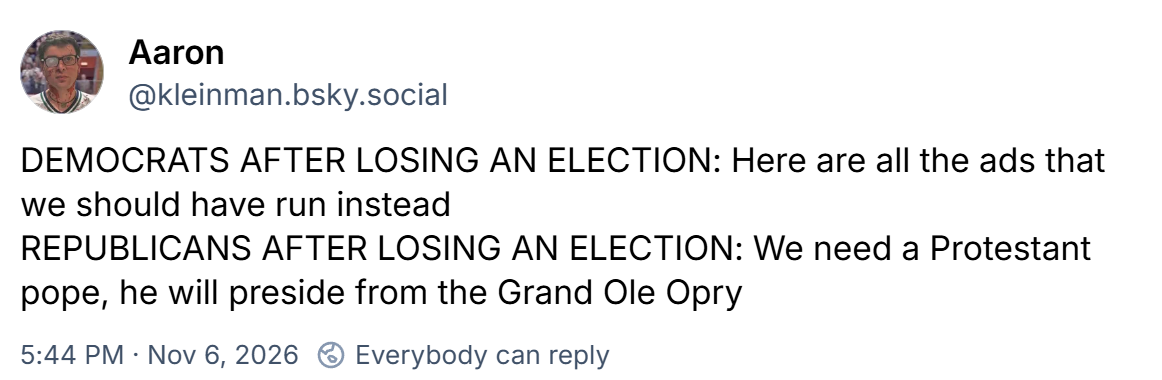
Let the post-election blame game begin
Buy Emily's It's a Wonderful Life book!
Every Time a Bell Rings, the book about It's a Wonderful Life that I cowrote with Defector's Lauren Theisen, is out now! Less a making-of or a historical document, it's more an attempt to consider the film from a variety of angles, major character by major character. There are essays about World War II PTSD, whether Bedford Falls had any gays in it, and Donna Reed's impossible standard for womanhood. And it's an incredibly beautiful holiday gift, with a gold foil cover and festive seasonal endplates. Buy it today! —ESJ
Last week in Episodes...
- In our Monday Digest, Emily eulogized Patrick Stewart, a humble titan of stage and screen, while Lily wrote about how Wildwood's flaws are an important part of what makes the movie great.
Yet if Stewart felt the strain of those early, terrible episodes, he never let it show onscreen. Watch him in any episode of the show, and you'll see the same level of commitment to the truly disastrous scripts as you do to the all-time TV sci-fi masterpieces. The same proved true of his work in the X-Men franchise where he, again, was on the early side of actors having to lash themselves forever to superhero material. Yes, the role of Professor X seemed tailor-made for him (even though the character predates Stewart's fame), but whether Stewart was starring in a good X-Men film or a bad one, he brought the gravitas.
- Wednesday brought us another 26 Episodes from Emily, this one on Bluey, motherhood, and the things we cannot see.
The events depicted in "Sleepytime" are so unmemorable because they are fundamental. When she is an adult, Bingo probably won't remember this specific night when she wanted, more than anything, to wake up in her own bed — though Chilli and Bandit might — but she will surely remember the love and comfort her mother extends her, the warmth she exudes toward her child, less as anything specific and more as the dense core at the center of every other memory. We are not seeing one of Bingo's core childhood memories; we're seeing all of them.
- On Thursday, Lily kept our A French Village recaps going with a pair of episodes that brought Villeneuve's cops to the forefront and showed the French Resistance building unexpected power even under the Nazi occupation.
- And on Friday, Emily was back with an essay about Wildwood, AI, and the value of human imperfection and unpredictability in a world increasingly dominated by sycophantic machines.
We need not even look just at generative AI to see this process at work. What is the ongoing job of the Ellison family at the now massive Skydance but creating a media bubble impervious to anything that might make reality seem slightly more unpleasant to the very rich? Our oligarch class has gotten so close to creating its own reality for itself that it has come to believe it can get all of us to live there too. And yet if you know human beings at all, it simply will not work.
Want to read all of that great stuff? The only people who have access to all of it are our paid subscribers! Why not upgrade your subscription today? If you do, you can take part in Friday's upcoming mailbag!
Some pop culture things we're into
- In honor of the late Tim Curry, my wife and I are making our way through the 1990 It miniseries, and it's quite fun! All the complaints I've heard about it before — that it's cheaply produced and often very badly acted, especially on the part of the adult versions of the Losers' Club — are entirely true. On the other hand, though, consider: Tim Curry plays Pennywise the Clown, and he does so with the sense of camp and legitimate menace you'd expect. That, for me, is enough to knock this into "definitely recommend" territory. —LO
- I read Alexis Hall's A Lady for a Duke, which Emily wrote up in our February inventory on love stories that could use adaptations. I thought it was pretty decent! Unfortunately, I am allergic to many of the prose conventions of romance novels — discussions of someone's "truths," page counts inflated by descriptions of every micro-expression a character has, and (sigh) the use of the verb "to quirk" to describe said expressions — all of which Hall uses with some frequency in the novel. That said, I was deeply impressed by how Hall manages to tell a story where a trans woman's transition is a plot device and a means of characterization without overwhelming the book's themes. Viola, our protagonist, is neither incidentally trans nor a character whose transness constitutes her entire character; she is both defined by her transition and is so much more than it. —LO
- Rolling Stone's recent list of the top 200 rock songs of the 21st century made me realize that I'd never listened to much of the Yeah Yeah Yeahs beyond "Maps." You guys will never believe this, but the Yeah Yeah Yeahs? Really good band! I will have "Y Control" stuck in my head for the next 18 months. —LO
- For some reason, I was possessed by the urge to watch Martin Scorsese's blank check passion project Gangs of New York, a movie I have always liked more than the general consensus. And... I still like it more than the general consensus! It was also a wonderful thing to watch on Election Day. I think that I love movies about characters whose actions do not matter in the grand sweep of history, and so it goes with Gangs, a movie about people who think themselves tremendously important and are eventually forgotten. It's Scorsese's Barry Lyndon, and it also proves that he is the Dave Filioni of the Ken Burns Cinematic Universe, and his Glup Shitto is Horace Greeley. If you understood that sentence, I owe you a soda pop. –ESJ
- I honestly don't mind the new Olivia Rodrigo Christmas song, which seems to be a minority opinion. Like, yes, it feels like she's wearing The Waitresses' "Christmas Wrapping" as a sweater, in a way that doesn't really negate the "she just copies her influences" line of criticism against her. But I like that song, and I like that we have a Christmas song about getting drunk with your partner's parents. –ESJ
- I've been working my way through GennaRose Nethercott's Thistlefoot, which is sort of a modern retelling of Baba Yaga and sort of a Baba Yaga legacyquel, but either way, I'm finding the nimble way Nethercott leaps among points of view to be extremely my shit. Also? She writes beautiful prose that stays just on the right side of purple (most of the time). Like there's a whole section where a character considers how it would feel to be a rock that is gorgeous. –ESJ
- I also finished The Amulet of Samarkand, the first Bartimaeus Sequence book, and, yeah, this series rocks. The class war, but for kids. –ESJ
Let's watch Gorillaz, but it's bossa nova, shall we?
Discuss
Are there other movies that have skillfully taken a metaphor and made it concrete? Talk about it in comments or the Discord!
Some good links
- Republicans Got Ruinously High on Their Own Supply [The New York Times]
- Not In My Wildest Dreams Did I See A Texas This Blue [Defector]
- El-Sayed proves pro-trans platforms can win [Assigned Media]
- Anti-trans ballot measures passed, even as trans candidates won in Tuesday's blue tsunami [Law Dork]
- Nemesis – The Great Balancing [Unpopular Front]
- Listen to Emily on the Christmas Past podcast [Christmas Past]
A Good Song
The free edition of Episodes is published every Monday and every other Wednesday. Premium subscribers get those newsletters, plus extra ones every Wednesday, Thursday, and Friday. Our editor-in-chief is Emily St. James, and our managing editor is Lily Osler. If you have suggested topics, please reply to the email version of this newsletter or comment (if you are a paid subscriber).