Zach Cregger's Resident Evil made the game's fans mad. Good.
Widow's Bay is a comedy?! (Yes.) Pan's Labyrinth is good?! (Yes.) Plus: Meet Derek!


Happy Monday, Episodes pals! This week, we've got takes on Zach Cregger's Resident Evil, Widow's Bay's status as a comedy, as well as our usual collection of other bibs and bobs. Remember: If you subscribe, you'll get this newsletter in your inbox every Monday!
Resident Evil and the waning power of the outraged fan
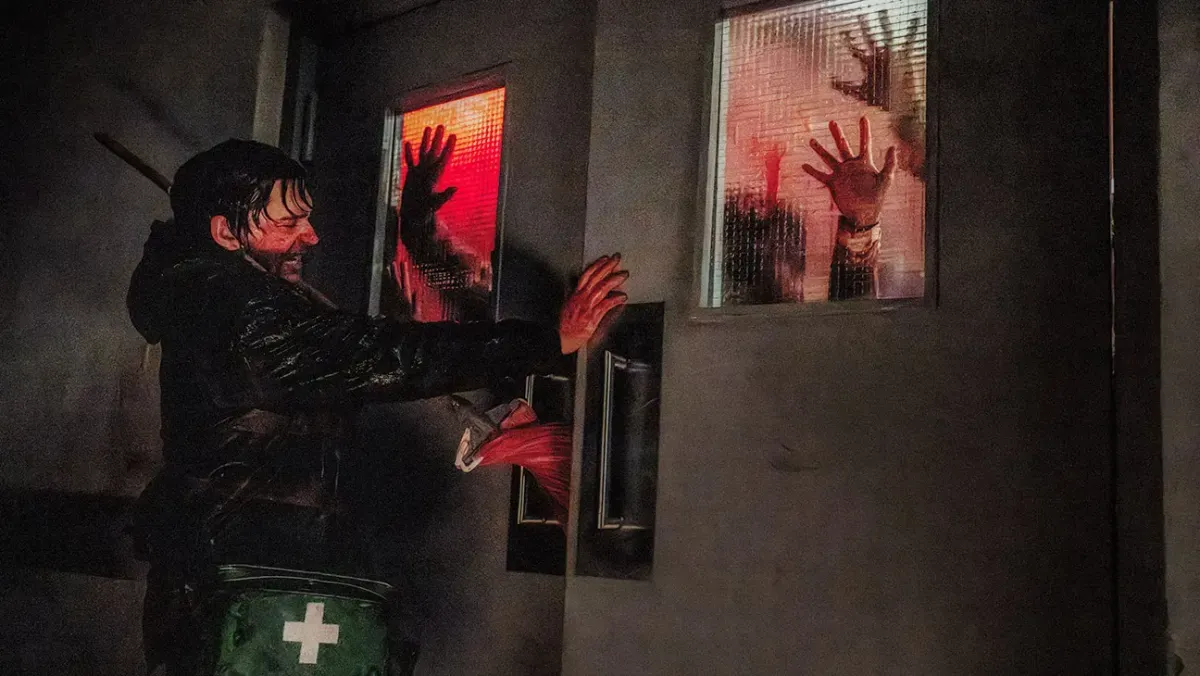
I quite enjoyed Zach Cregger's take on Resident Evil, a real step back in terms of the director's ambition when compared to Weapons and even Barbarian but in a way that makes clear he just wanted to make a funny, gory zombie movie. I particularly enjoyed Austin Abrams's work as the utter shitbag who finds himself wandering into hell on the single worst night of his life as well as the escalating tension of the various set pieces on the farm around the half-hour mark. Does every storytelling choice in the movie work? Not necessarily for me, but at 95 minutes long, it never has time to dwell in any one place where I might otherwise nitpick. There is something to be said for just getting on with it!
Anyway, the overwhelming emotion I felt after watching Resident Evil was a desire to play the video games. Cregger made the film as a genuine fan of the Capcom series, and it shows throughout, even though I have next to no idea how the movie intersects with the games' lore, beyond having been informed it's not adapting any game in particular and is, instead, telling a new story in that universe. In general, I have found this a more creatively fruitful approach to adapting video games than more straightforward attempts to translate a game's story to the screen. Like I quite enjoy the Fallout TV show, which takes games I actually have played and sets a new story that plays to the strengths of the TV medium in and around their world.
Resident Evil borrows enough camera tricks from first- and third-person shooters for me to know that Cregger is likely adapting some of the visual grammar of the games. (Check out all those insert shots of our hero checking his ammo in his gun, which feel lifted directly from a PlayStation screen.) But by and large, it is interested in telling a story that is meant for a movie screen. However you feel about that, his intent is clearly moviegoers first, game fans second.
This approach, of course, has driven some portion of the internet nuts with many fans of the games furious that Cregger isn't directly adapting the "story of Leon," whatever that means. The movie's a big enough hit that it doesn't seem like the fan uproar has affected much of anything – similar to the right-wing outrage around The Odyssey earlier this year – but it's still something that Cregger has been asked about many, many, many times.
The guy who owns my favorite coffeeshop has been watching the Lord of the Rings movies in the late afternoons when it's often just him and a few diehards in the shop. As I've ambiently revisited those films over the past week, I have been struck by how they arrived in the earliest days of an approach that did everything it could to appeal to "the fans," perhaps because it was adapting something several orders of degree more popular than Resident Evil and something more straightforwardly cinematic too. Even then, director Peter Jackson and his team were lambasted for, like, cutting Tom Bombadil from the story to make it move more. This desire to cater to fans has only grown more central to Hollywood marketing, and its power only very recently seems to have lost some of its hold, though generally only when a director with some amount of cachet like Cregger, Christopher Nolan, or James Gunn is adapting a property beloved by nerds.
Certainly there have been films I've loved in the era of catering to the geeks, including the Lord of the Rings trilogy. And some part of me wonders if the fact that studios are still so willing to play fast and loose with video games stems from the relative lack of pop cultural soft power gamers have, if we're about to see a sea of game adaptations that slavishly promise to "get it right" in the manner of the Last of Us TV show. But I hope not. If I were a Resident Evil fan, wouldn't I rather have a movie that got more people into the fandom tent? Or would I just want a movie that catered only to me?
Wait, don't answer that. I already know. –Emily St. James
Was Widow's Bay a comedy? Obviously! But also...
I've been informed on good authority that the perennial "but is it actually a comedy??" discourse that seems to plague every single recent winner of the Emmys' comedy awards has come for awards juggernaut and 2026 Best Comedy winner Widow's Bay. (To be fair, this is reheated discourse from Threads, the gas leak social network, so, you know, grain of salt.) As Emily mentioned in the linked Bluesky thread, this is a patently ridiculous question to throw at Widow's Bay, an extremely funny show that's simultaneously a parody of a good half-dozen Stephen King novels and a great comedy in its own right. Like, sure, fight about whether The Bear counts or whatever, but leave the show that brought us Daddy's Home! out of it.
And YET! Widow's Bay is a comedy, yes... but it's not the kind of comedy you think it's going to be. One thing I love about the show, and also one that I know has put off a good handful of people I've tried to get into it, is its fluidity in shifting genres and tones. The show's pilot sets up a very funny but slightly limited comic tone: This is going to be a comedy about the incompetent mayor who refuses to help the residents of the haunted coastal town until it's too late. And until the show's fifth episode, that's how it goes: each episode uses its main plot to put mayor Tom Loftis (or his poor deputy Patricia) in another goofy, obviously supernatural predicament. There are hints that the show will take a turn — most episodes have very horror-forward cold opens — but it feels more like a comedy with some legitimately freaky horror bits than the reverse.
Suddenly, though, the balance shifts. The show's fifth episode, "What to Expect on Your Trip," starts out as a very funny "oh no, someone gave the mayor drugs!" caper before lurching into something far darker. By the sixth installment, the 17th-century-set flashback episode "Our History," the show's tonal balance is completely inverted: There are good jokes, but this is horror. Even when the laughs come back in earnest in the show's last third, they're still tempered by a legitimate sense of dread that was missing from the season's first few outings. I would call the entirety of Widow's Bay a comedy without question; I also kinda sorta get why someone who dug the first few episodes' tone would find the places the show goes a little discombobulating.
Why does Widow's Bay do this tonal switcheroo? For one thing, starting with a lighter tone helps us get invested in these characters more quickly than we would if we thought they were in the kind of show where they might get killed off. For another, it builds viewer empathy with Mayor Loftis: Even though, unlike him, we know the island is cursed from the start, we only learn to start taking that curse seriously around the same time he does. I also find that the season's brief but harrowing turn toward largely-unalloyed horror makes the late season's jokes hit harder. Regardless, it's nice to see a horror-comedy that isn't afraid of setting one of its genres to the side for a bit to give the other one some time to shine.—Lily Osler
Hey, everybody, it's Derek!
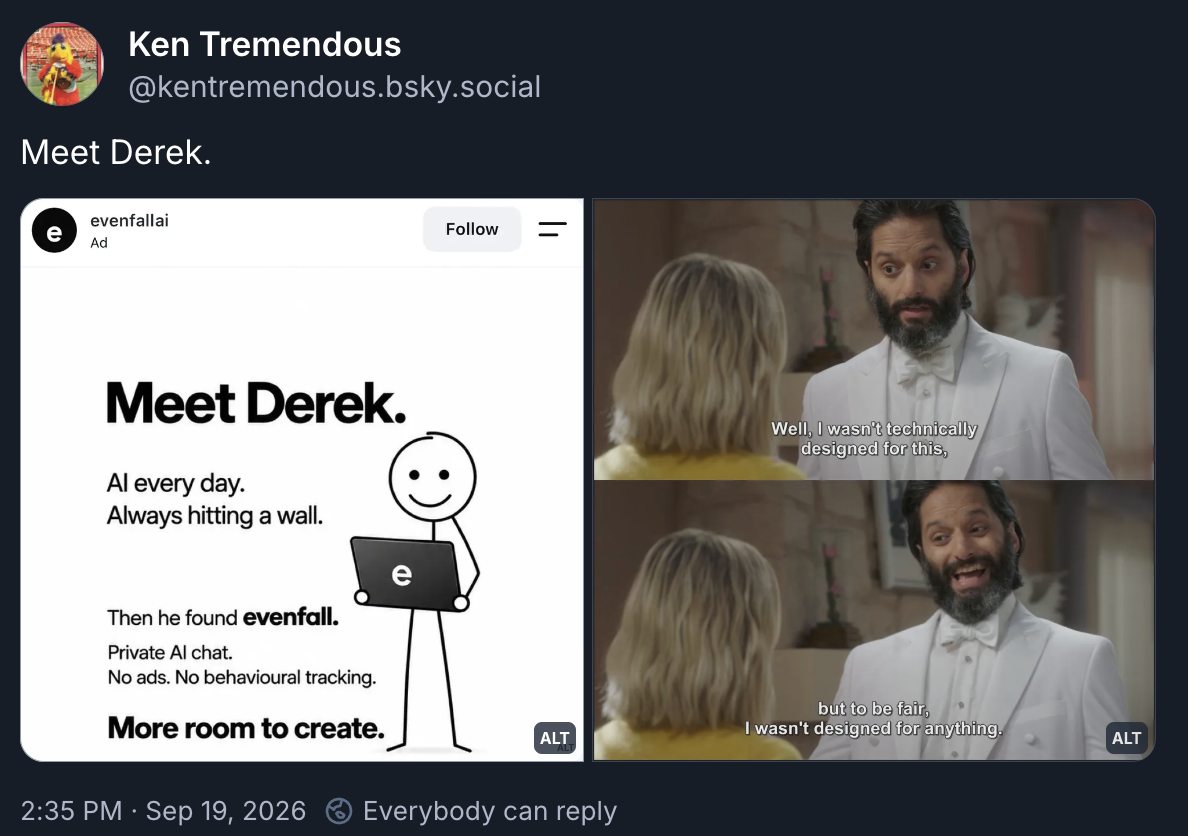
(From here.)
Buy Emily's It's a Wonderful Life book!
Believe it or not, we're just a few weeks away from the publication of Every Time a Bell Rings, the book about It's a Wonderful Life that I cowrote with Defector's Lauren Theisen! It is — I say with some pride — a very strange book that is less a making-of or a historical document and more an attempt to consider the film from a variety of angles, major character by major character. There are essays about World War II PTSD, whether Bedford Falls had any gays in it, and Donna Reed's impossible standard for womanhood. Buy it today, and if you're in Los Angeles, come to our launch event at Village Well in Culver City! —ESJ
And if you enjoy listening to me on podcasts, Lauren and I dropped by Guide for the Film Fanatic to chat about the book, and then I made a solo stop on Cows in the Field to discuss The Shawshank Redemption.
Last week in Episodes...
- We discussed the ways streaming TV has taken away something that made real TV great and looked at Hokum director Damien McCarthy's debut feature.
- Emily and Defector's Lauren Theisen talked about their upcoming It's a Wonderful Life book and all the cool stuff they learned in working on it.
My love of It’s a Wonderful Life has always been tied to a self-identification with George that is, frankly, a little strange. As you might expect, the characters in film I most “identify with” (a concept I always find a little odd) are almost always women, and they’re almost always women who are separated from their true selves in some fundamental, if metaphorical, way. Chihiro in Spirited Away, Dani in Midsommar, Laura Palmer in Twin Peaks — all are fighting through some severe dissociation. There’s a reason I glom onto Furiosa in Furiosa so much more than in Mad Max: Fury Road!
- Our Infinite Jest book club got so very close to the end of the book with some thoughts on David Foster Wallace's dialogue writing skills and his occasionally conflicting beliefs on sincerity.
- And we tackled so many amazing questions in our monthly mailbag, including thoughts on which old ladies we want to grow up to be and whether the Oscars should add comedy acting categories.
I would like to be Billy Presley from Teenage Sex and Death at Camp Miasma. Do I think I could pull it off? Absolutely not! No one in my life has ever described me as "cool." But I do think it would be neat to get to live all alone at an abandoned summer camp and spend my days making unnerving art. That would rock.
Want to read all of that great stuff? The only people who have access to all of it are our paid subscribers! Why not upgrade your subscription today? If you do, you can take part in Friday's upcoming mailbag!
Some pop culture things we're into
- It's been at least 10 years since I've seen Pan's Labyrinth, and the last time I watched it, I enjoyed it but found it a little hollow. Its human monsters were simply too one-dimensional and monstrous for my tastes at that time. Well, I revisited it earlier this week, for the first time since transition, since trauma therapy, since becoming a mom, since the global rise of the far right, and guess what? It hit me like a ton of fucking bricks. Literally all of my issues with the film persist, but they now strike me as so endemic to the whole that it's not worth complaining about them. I can't wait to watch this one with my kid when she's, like, 14. –ESJ
- Speaking of my child, her love of Stella and Marigold got us to check out the Ivy and Bean series, which first brought Annie Barrows and Sophie Blackall to broader attention. And my kid loves these even more! They're about a couple of second-grade girls who don't think they'll be fast friends but who find that they possess similarly fanciful imaginations despite their other differences in personality and temperament. The Child is just starting to understand how humor functions, and she laughs a lot at these. I suspect it helps that the titular characters' relationship is so similar to her friendship with her new preschool bestie. –ESJ
- In my ongoing quest to read middle-grade novels, I quite liked T.C. Kemper's The Ginghams, which is in a pretty standard mode for a middle-grade dystopia – the conformist small town that forces the iconoclastic kids into cookie-cutter molds – but in a way that speaks to any number of current issues. Like I was surprised that AI slop got a passing mention in there. I do find it odd how 1950s America tends to be one of the standards for a deeply conformist society. Like, I get it, but surely we could come up with an example that's less than 70-some years old? Still, I recommend. –ESJ
- Resident Evil, as Emily mentioned above, was a blast. I am a certified Weapons disliker, unfortunately, but I'm glad I took another chance on Cregger. I liked how much this movie, and especially Abrams' performance, felt like a Let's Play video come to life; it's a fun, and mercifully lore-light, way to approach a movie based on a game. More on this from me later this week, most likely! —LO
- I saw the film adaptation of Denis Johnson's Train Dreams last year for our Oscars rundown, and I thought it was a prettily shot film without quite enough on its mind to earn its more grandiose meditations on life. This week, I actually read Johnson's novella, and, uh, how did a movie that anyone could ever possibly call "life affirming" get made out of this?? The novella is largely about the haunted world of the late 19th century American West and the lingering traumas, societal and individual, that turn Robert Grainier's life into an occasionally beautiful nightmare. Mostly, though, it's really freakin' weird! There's a lengthy description of the (ostensible) world's fattest man and a guy gets shot by his own dog. If you thought the movie was nice but a bit saccharine, try Johnson's book on for size. —LO
Let's hang out in an autumnal diner as we greet the coming equinox, shall we?
Discuss
When have you seen a movie or TV show that made you more interested in checking out the thing it was adapted from? Bonus points if it was something you otherwise wouldn't have checked out. Talk about it in comments or the Discord!
Some good links
- The promising race to get kids reading again [Vox]
- How President Trump broke the Kennedy Center [New York Times]
- Robert Altman Super Draft: Part Four [Screen Drafts]
- The Highs, Lows, and Whoas of the 2026 Emmys [Vulture]
- In Fighting for Every Black Child, Did I Betray My Own? [New York Times]
A Good Song
The free edition of Episodes is published every Monday and every other Wednesday. Premium subscribers get those newsletters, plus extra ones every Tuesday, Wednesday, and Friday. Our editor-in-chief is Emily St. James, and our managing editor is Lily Osler. If you have suggested topics, please reply to the email version of this newsletter or comment (if you are a paid subscriber).