What It's A Wonderful Life's George and Mary Bailey can say to us here in 2026
The fun things Emily and Lauren Theisen learned when working on their new It's a Wonderful Life book


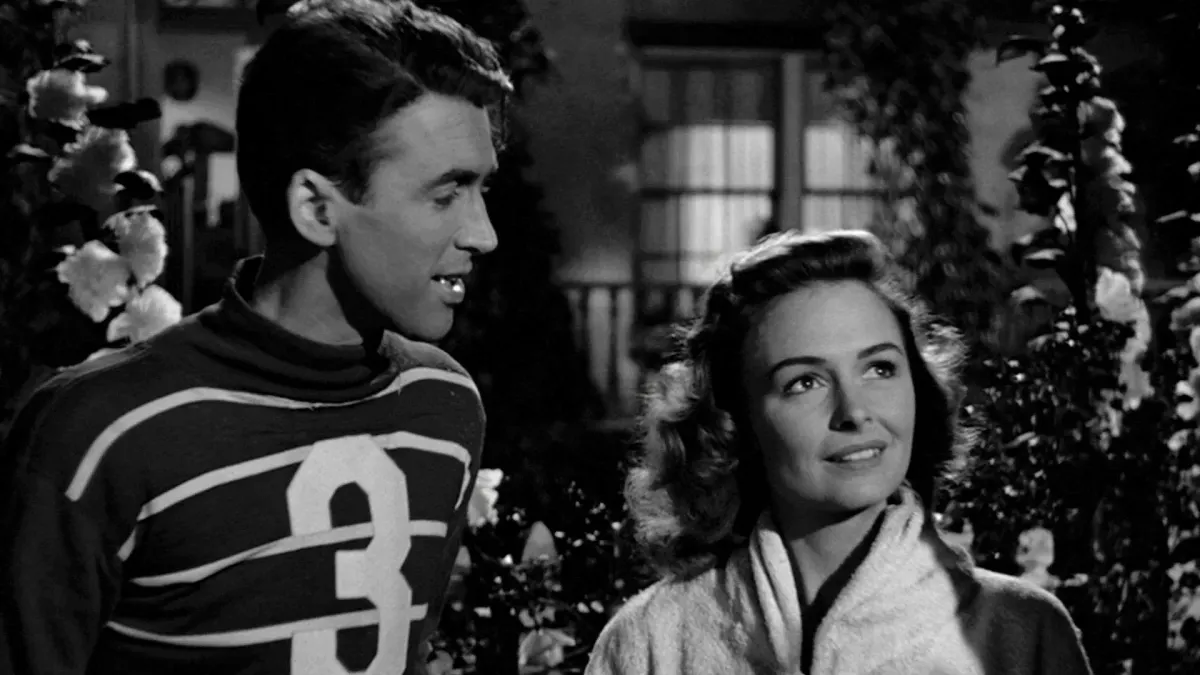
It's It's a Wonderful Month here at Episodes, where we will celebrate Frank Capra's It's a Wonderful Life — and Every Time a Bell Rings, the book about the film that Emily cowrote with Lauren Theisen of Defector. The film turns 80 in December; the book is out on September 29, and you can preorder it below.
Today, Emily and Lauren gather for a quick crosstalk on everything they love about this movie and what they learned working on the book.
Emily: The obvious question a lot of people will have about Every Time a Bell Rings — available from booksellers everywhere on Tuesday, September 29! — is the question I had when our wonderful editor, John Glynn, first pitched me the idea of a book on It’s a Wonderful Life: Does the world need another book about It’s a Wonderful Life?
To be fair to my imagined interlocutor, it’s a valid question. Whether you want a making-of book; a cookbook from Zuzu Bailey herself; or a, uh, Christian devotional, the publishing industry has you covered. And those are just three titles I picked at semi-random. There are dozens more out there, for every extremely specific taste or need.
Lest it sound like I’m trying to talk people out of buying our book, what we quickly realized is that for as many books about It’s a Wonderful Life as there are, there’s no single book that looks at it as a borderline perfect film and a cultural object like few others to have come out of classic Hollywood. What other movies from the first half of the 20th century are still shown regularly on American television? It’s pretty much just this and The Wizard of Oz. The persistence of It’s a Wonderful Life, despite how dated its trappings should seem, must stem from something. And right away, we concluded that it’s probably due to how ably the film captures both how America imagines itself at its best and fears itself at its worst. Bedford Falls and Pottersville, after all, are the same place.
Thus, Every Time a Bell Rings isn’t quite a making-of book or a history of the film or anything so simple as that — though it contains elements of both. It is, instead, an attempt to look at the film via as many different lenses as we could think of, usually starting from one of the movie’s main characters. War hero Harry Bailey becomes a way to consider the movie’s relationship to the PTSD many survivors of World War II brought back with them to the US. Uncle Billy becomes a window through which to look at the fraying American social safety net. Bert the cop and Ernie the cab driver become, of course, a way to think about if there’s any room for queerness in the film’s universe. And lest that all sound too heady or reading against the film’s text, there are also chapters on Frank Capra’s storied career; Wonderful Life’s very odd copyright journey; and the “real” Bedford Falls, Seneca Falls, NY.
“Wait!” I hear you saying. “What about George and Mary?” Well, of course there are chapters on George and Mary! We’re not monsters. So, I thought it might be a good idea to flesh out just how we feel about these two crazy kids who live through most of the significant events of the first half of the 20th century.
I’ll start because my love of It’s a Wonderful Life has always been tied to a self-identification with George that is, frankly, a little strange. As you might expect, the characters in film I most “identify with” (a concept I always find a little odd) are almost always women, and they’re almost always women who are separated from their true selves in some fundamental, if metaphorical, way. Chihiro in Spirited Away, Dani in Midsommar, Laura Palmer in Twin Peaks — all are fighting through some severe dissociation. There’s a reason I glom onto Furiosa in Furiosa so much more than in Mad Max: Fury Road!
 Emily St. James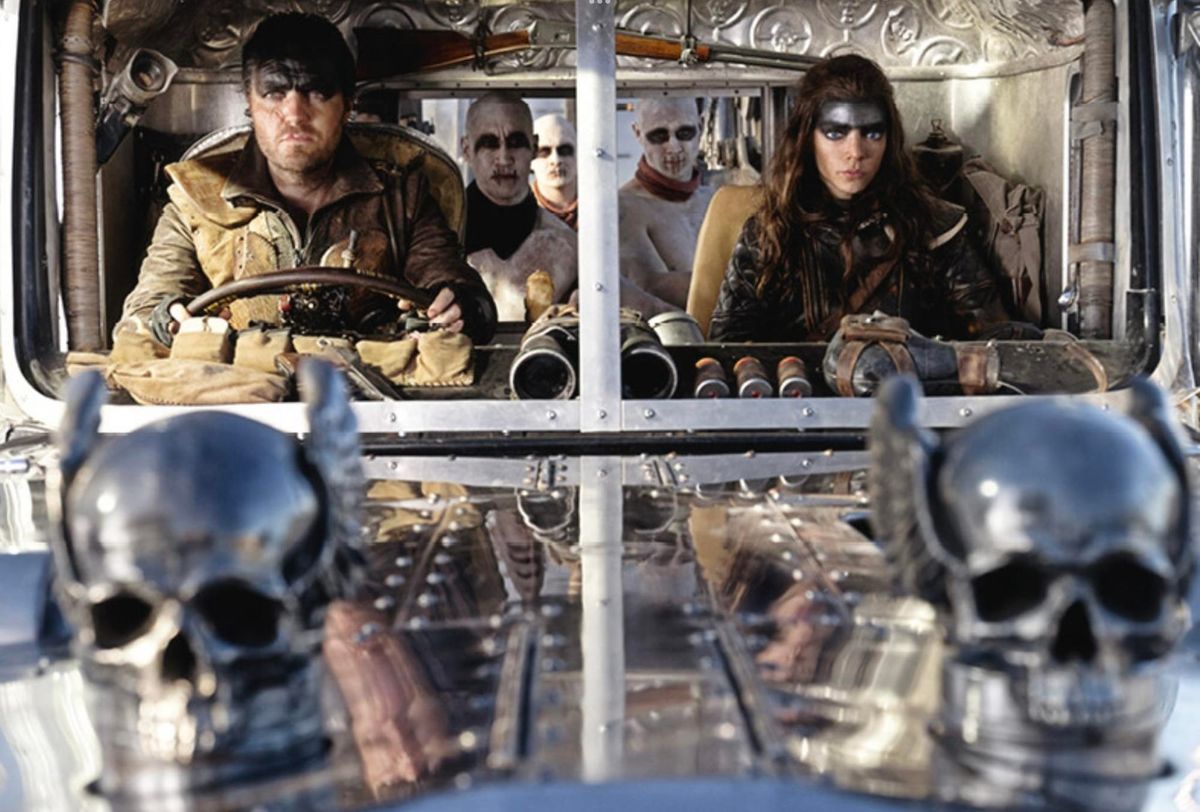
And then there’s George Bailey, known man and not even the kind of fictional man I can project a “well, he might be an egg!” narrative onto in the manner of, like, Craig in Being John Malkovich. He’s just the world’s best, most stand-up dude.
But there’s also something warped and frustrated inside of him, a piece of himself that will forever feel shitty about the fact that he “had” to save Bedford Falls instead of escaping to the big city and/or a tramp steamer somewhere in the southern Atlantic. What we love about George Bailey is that we see how his strong moral code prevents him from getting the life he wants, over and over again, something that finally comes to a head when he comes very close to suicide. How many of us know there’s something we could have if we were a tiny bit more unethical yet still have certain lines we will not cross? Plenty of people. And how much more potent has that idea become right now than even back in 1946? Much more.
What also makes George so easy to identify with for me is how readily he presents his own counter-factual. George literally gets to see a world where he doesn’t exist, but the tragedies that befall Bedford Falls in his absence could have just as easily happened if he had backed down from Potter at any point in time in the much less dramatic manners depicted several times in the film. I don’t want to say it’s anything like “What if I hadn’t transitioned?” or “What if I hadn’t moved to California?” or something, but it’s on the same wavelength. You don’t have to be like George Bailey at all to see something of yourself in him.
How about you, Lauren? What draws you to this film and its two main characters?
Become a paid subscriber: You'll get access to all the newsletters only paid subscribers receive, including the 26 Episodes feature and our book club; the Episodes Discord; and almost a decade of archives. Plus you'll get to comment and ask questions in the mailbag! Sign up for as little as $5/month below!
Lauren: Hi, Emily! Part of the reason it was such a cool idea to join you on this project was that I feel like, in a way, I’ve been preparing to write this book for decades. My parents first showed me It’s a Wonderful Life when I was a pretty young kid, and even though I didn’t fully grasp its near perfection at the time, the fact that it reappeared somewhere or another again and again at the same time every year meant that I was continually given the opportunity to deepen my appreciation.
I love that we structured the book the way we did, because this movie gains such a tremendous amount of life from its supporting and even background players, to the point where so many of their lines were constantly running through my head long before we pitched our outline. “This old thing? Why, I only wear it when I don't care how I look!” “Now, to get back to my story, see.” “It’s no skin off my nose, but one of these days, this bright young man’s gonna be asking George Bailey for a job.”
All of these smaller performances — and Capra’s willingness to spotlight them instead of cutting for efficiency — make Bedford Falls such an inviting place to return to December after December. It’s a treat to be able to write about all of them, but my essays in the book start with George and end with Mary for good reason. It’d be a stretch to say that I identify with George, exactly, but I have so much admiration for Jimmy Stewart’s work here — this ideal-to-me midpoint of masculine heroism that’s neither too aggressive nor too shy and innocent. He’s handsome and charming and trying his best, and to me, he serves as an avatar of a holiday season that, for all its excitement and festiveness, can also bring along some pretty intense anxiety about where our lives are at and whether or not our problems can be fixed. The very first thing we hear about George, alongside Clarence, are these two words, delivered with grave and efficient import: “He’s discouraged.” Who among us, right?
As I grew up, though, it was Mary Bailey and Donna Reed who occupied more and more of my headspace. Eventually, once you’ve seen It’s A Wonderful Life enough times, it sinks in just how heroic Mary is. Capra shoots her like a cavalry leader when she holds up the money to rescue George from the bank run, and then later, while her husband goes off to get drunk and crash his car into an old tree, it’s Mary who keeps him out of jail by rallying the town. (One of my favorite things about Uncle Billy, who helped cause this whole mess, is the way he shouts “Mary did it, George! Mary did it!” taking no credit whatsoever for himself.)
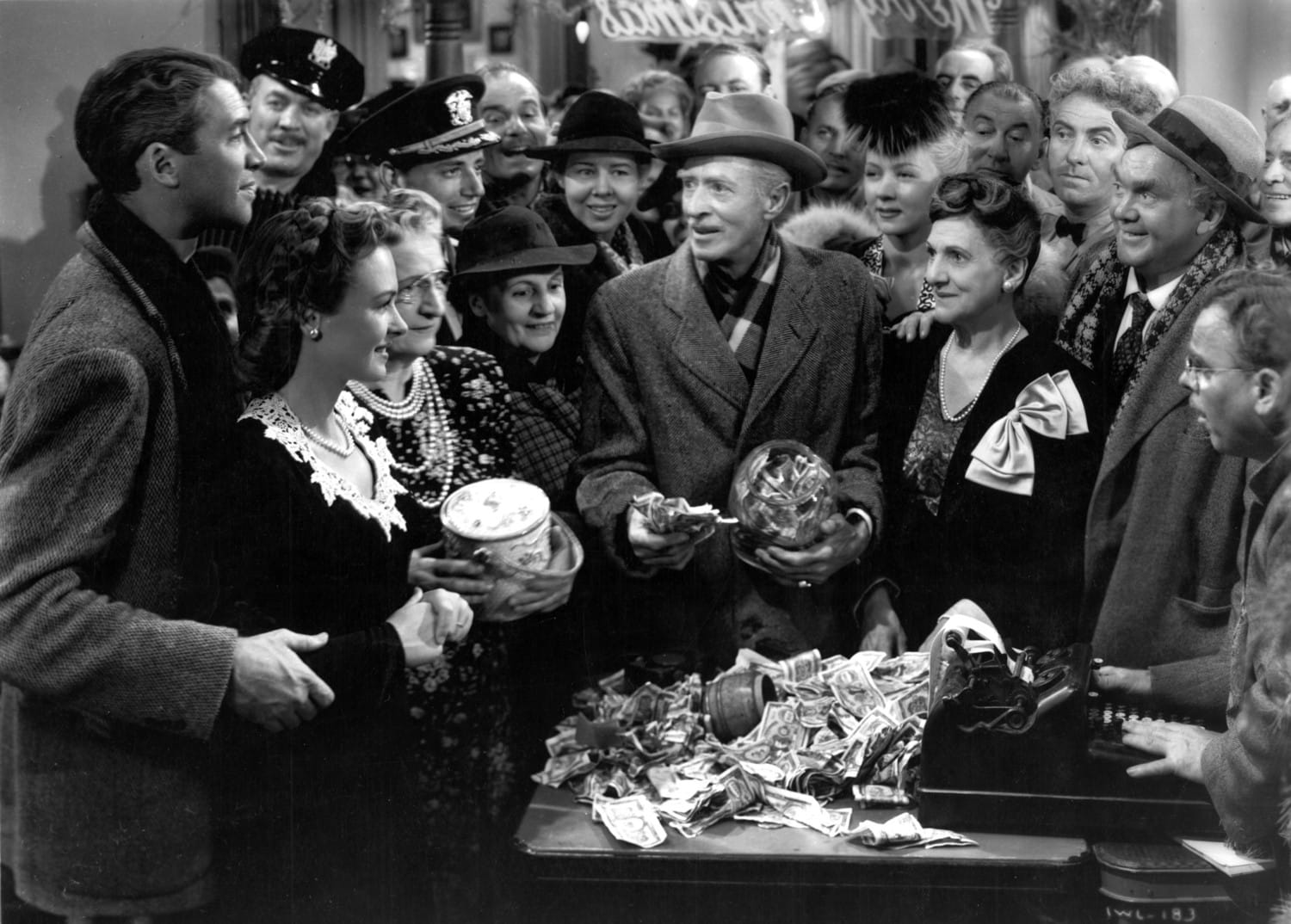
Donna Reed as Mary is so goddang perfect in this movie that it kind of scares me. She’s gorgeous, she takes care of her family, and the way she fits into her homemaker lifestyle foreshadows the part the actress would play a few years later in television’s The Donna Reed Show, which ran for eight seasons and also became a potent symbol of the cooking, caretaking housewife straitjacket that the women in The Feminine Mystique so desperately want to escape. In our book, my essay on Reed/Mary is the one where I get the most personal, writing about my still-fairly-new experience of being a trans woman dating a cis man in a relationship that’s opened this door to a whole new way of being perceived. With him, I feel unremarkable to others, protected at a time when I see new threats to trans women seemingly every single day.
So I watch Donna/Mary get everything she wants on screen, and I can’t help but see her as aspirational, talking myself into this idea that tradwife life would be bliss for me. It’s an escapist fantasy, balanced by the knowledge somewhere in my brain that I’m looking at a beautiful poison apple — that before my mother was even born, women who suffered from prejudice, abuse, depression, or a general lack of fulfillment in their lives disavowed the lie of this image.
Still, year after year, I poke at this question: How can I attain this life without being touched by its venom? Diving into the big pile of tradwife content that reiterates the Donna Reed allure, I can feel it corroding my soul with envy and materialism. But when I avoid getting distracted by Mary Bailey’s face and her clothes and the fact that she’s apparently never had a job, I do my best to admire the less-tangible things about her. She’s sharp, she’s driven, and she puts in the effort to be a good person. It’s a lesson that I’m not done learning.
So Emily, I’m curious how writing this book changed your perspective on the movie, and perhaps what’s still going to be bouncing around in your head during the screenings we’ve got planned in December.
 Emily St. James
Emily: I will be honest and say that, at some point, I had gone so far through the veil between reality and the movie’s world that I was pausing split-second shots to try to figure out where Bedford Falls is situated geographically based on road signs in the deep background that literally nobody would have been able to make out until very recently with the advent of high-definition displays. A single background shot of a road sign saying Albany is nearby might just be due to a props department that needed to get a road sign up to fill out the mise en scene; it could also be the secret that pulls this whole thing together. (It’s the former.)
For as long as I’ve made some portion of my living as a critic, I’ve believed in the power of the close read; at times, this book put that belief to the test. For instance, I have never thought all that much about George’s parents, who are important figures within the film but not necessarily its most memorable characters. Yet it’s clear from the scenes George shares with his dad and the scenes George then shares with his own kids that the changing role of fatherhood in 1940s America was at least somewhat on Capra and his crew’s minds. That led me on a deep dive into vintage parenting manuals, statistical surveys of the utter collapse in the number of parents who spank their children (a very recent phenomenon!), and Capra’s own complicated relationships with his parents and children. Like, did you know one of Capra’s children died, and after he took under a week to mourn, he got right back to working on You Can’t Take It with You, for which he would win his second Best Picture Oscar?
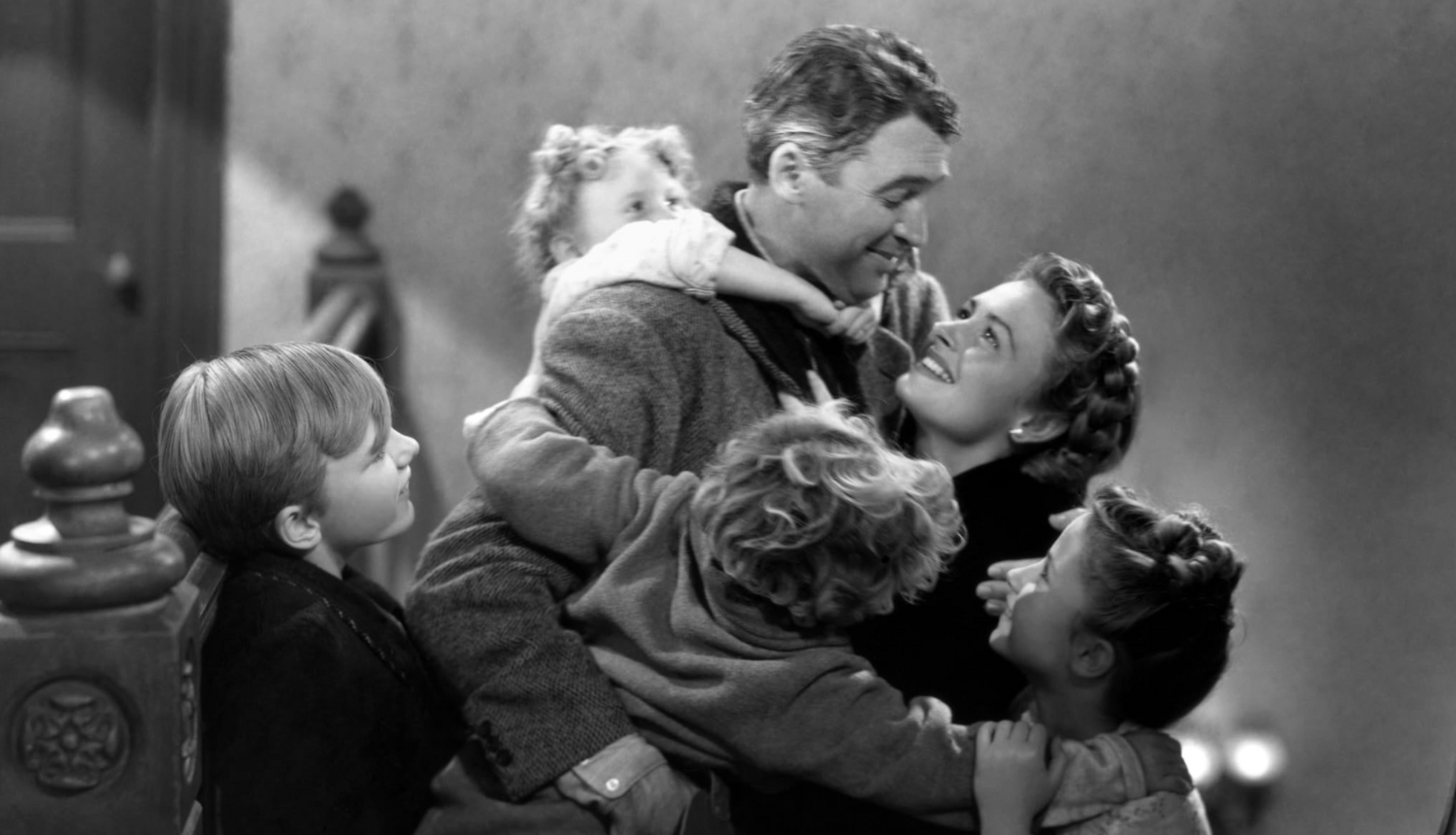
Finding that story deep within Capra’s life story validated a read I had on the scene where George yells at his kids, which is that the scene is presented as though George might really be just that bad of a dad. I don’t think we’re meant to conclude this, to be clear. But the film gives him plenty of rope with which to hang himself, and Stewart’s frantic, frazzled performance makes the moment all the harder to bear. Now, I’m known for writing about the ways in which familial abuse is depicted in pop culture, so I was slightly wary of my attempts to pull that theme into Wonderful Life. Yet after reading about Capra’s life story and seemingly abusive mother and especially after watching other contemporaneous depictions of fatherhood, like The Yearling, I did find myself more compelled by the idea that Wonderful Life lets us see a side of George that is not so noble after all.
What struck me most often when working on this project was how often Wonderful Life contains its own negations. Mr. Potter might seem like a presentation of unchecked capitalist avarice, but George Bailey is a banker too. Clarence says he’s a guardian angel, but he functions much more within the story like a Christmas ghost. Harry goes off to war, but the guy who seems to struggle with PTSD is George, who stays home. A Christmas setting is so intrinsic to the movie that its special effects team dreamed up a recipe for fake snow that we still use on film sets to this day (researching the chapter on that Oscar-winning special effects triumph was one of my favorite parts of working on the book) — and yet Christmas ultimately has very little to do with the plot at all. And so on.
Some of that sense of contradiction within the film, to be clear, is an offshoot of me having watched this movie so many times that I started to feel like its reality was almost a second world for me to disappear into. Yet so much more of it stems from how rich the movie’s text is. Much of that is due to Capra and his actors to be sure, but it’s also thanks to how many different people’s fingerprints are on this movie. Almost nothing of Dalton Trumbo’s early script for the film made it onto the screen, but you can feel his leftist politics subtly informing plenty of the film’s more political scenes. Similarly, Capra’s original draft of the screenplay involved long, technically complicated scenes set in Heaven that were never mounted, but plenty of the elements of those scenes snuck into all of the Clarence material. Even the casting itself ended up offering a metacommentary on the film’s power. Lionel Barrymore, who plays New Deal despiser Potter, was well-known within the industry for having opposed FDR’s 1944 reelection.
What I’m saying is that no matter your disposition toward considering this film — be it via an overtly political lens, a historical lens, a feminist lens, a formalist lens, etc. — there’s plenty of material to work with in It’s a Wonderful Life, and all of it is rich. It’s rare that I’ve seen anything this many times for a project I was working on without getting sick of it, but Wonderful Life (mostly) cleared that bar.
I’m still going to put it on ice for the entire year of 2027 because even I need a break.
Lauren, to wrap this all up, what were some interesting things you learned about the movie while working on this project? And what are the elements of it that mark it as irretrievably of its time, rather than timeless?
Lauren: My mind immediately goes to Annie, who was one of a great many maids played by the Black performer Lillian Randolph throughout her career. She gets some of the film’s best laugh lines, but there’s also that nauseating part where Harry chases her into the kitchen to slap her butt, as well as the movie’s overall disinterest in exploring who she might be without the apron. It’s a contrast with Wonderful Life’s other prominent non-WASP, Mr. Martini, who gets an expansive, normative family and an apparently successful small business that allows them to be upwardly mobile. For as much as Capra’s films try to capture the struggles of ordinary working Americans, those Americans are never Black.
The line a lot of people will probably think of, too, is George learning of Mary’s fate in the alternate universe that is Pottersville. A melodramatic Clarence informs him that his wife is “an old maid,” and he yelps, as if she’s trapped in a burning building, “She’s just about to close up the library!” The punchline, for modern audiences, is that Reed now looks like a hot soft-butch modern-day Brooklyn-chic version of her character, with glasses, a hat, and a blazer all meant to signify her fall from the domestic ideal.
My mom worked in a library, so the whole sequence always felt especially stupid to me. But I felt a little more sympathetic when I let the specifics fall away and just focused on the feeling. The panic in this scene doesn’t come from books being unfeminine so much as it does the nightmare that is looking into the eyes of someone you love — your soulmate, even — and going completely unrecognized. While writing the book, I thought a lot about Pottersville in the context of the incessant gambling-app ads that I see every time I watch sports on TV. They try so hard to convince you that losing money at what is inherently an individual endeavor will make you feel great, just like the neon signs promising excitement around every door. But what they actually do, if you’re unlucky enough to get sucked into the addictiveness of their designs, is sever you from any meaningful connection, then leave you burned out and broke like cynical, depressed, dead-eyed Pottersville Ernie.
When I think about what I learned, though, I’m especially grateful for my trip to Seneca Falls and the town’s It’s A Wonderful Life Museum, which I devoted a chapter to in the book. There’s a story about Seneca’s connection to this movie involving an alleged Capra visit and a barber named Tommy Bellissima that you can read about in there, but I also get especially preoccupied by a real person named Antonio Varacalli. There’s a bridge in Seneca that sure looks a lot like the bridge George jumps off of to save Clarence, and it contains a plaque (surrounded by bells) commemorating Varacalli’s sacrifice on April 12, 1917. “Antonio Veracalli gave his life to save another. He honored the community. The community honors him.” He was a young Italian immigrant who worked on the canal in Seneca Falls, and when a young woman named Ruth Dunham attempted suicide by jumping off the bridge, he rushed into the water to save her. Dunham survived; Varacalli didn’t.
In the original short story that Wonderful Life adapted, "The Stranger," the story's version of Clarence appears from out of nowhere next to George on the bridge and says (more or less), “I wouldn’t do that if I were you.” Did Capra learn about Varacalli and feel inspired to rewrite a pivotal scene? It’s impossible to say for sure, but that bridge made me feel something like a spiritual experience when I visited.
Even right now, I’m looking at the postcard of it that I got at the museum, which is on my bedroom wall, and I’m thinking of one of Clarence’s best lines: “Strange, isn't it? Each man's life touches so many other lives.” Even though I had this movie on continuously during the writing process, it genuinely does get me excited for a few more screenings around the holidays.
We’ll see about 2027.
Emily: Thank you for writing this book and also this crosstalk with me, Lauren. And remember: You can preorder Every Time a Bell Rings today. Preorders are vital to authors and help convince publishers to keep putting out books like ours. And it has foiled details and custom end papers! Doesn't that sound nice? Click the link below.
 Hanover Square Press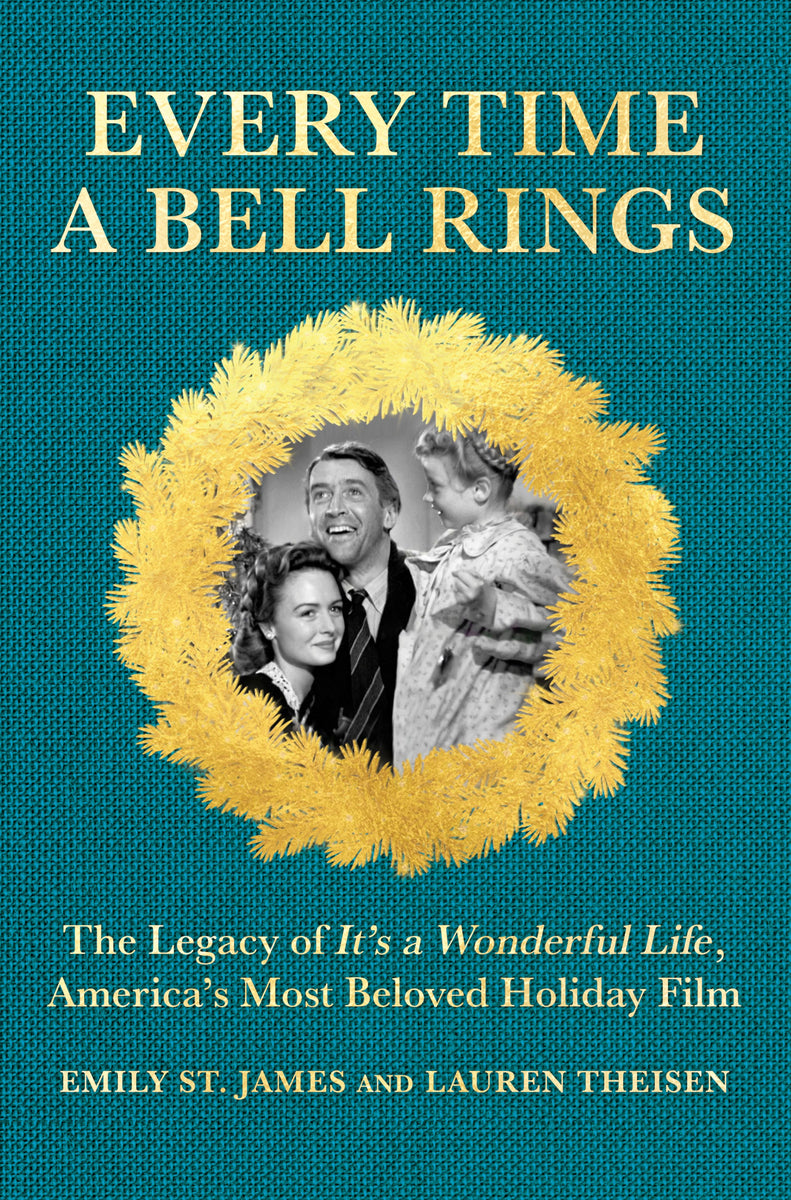
A Good Song
The free edition of Episodes is published every Monday and every other Wednesday. Premium subscribers get those newsletters, plus extra ones every Tuesday, Wednesday, and Friday. Our editor-in-chief is Emily St. James, and our managing editor is Lily Osler. If you have suggested topics, please reply to the email version of this newsletter or comment (if you are a paid subscriber).