People don't want YouTube movies. They want something new.
The considerable success of Backrooms and Obsession might lead Hollywood to learn all the wrong lessons. Again.

Paid subscribers: Don't forget to submit questions for Friday's mailbag edition!
 Emily St. James
Today, over my morning coffee, a great joy was bestowed upon me: the first trailer for Whalefall, the movie about a guy who gets eaten by a whale.
Based on the novel by recent Pulitzer winner Daniel Kraus, Whalefall has all the standard "protagonist in a horrifying tight spot deals with their past traumas" nonsense I've come to roll my eyes at, but — and I cannot stress this enough — it is about a guy who gets eaten by a whale. I've never seen that before! I didn't know I wanted to see that before! Now I do!
Whether Whalefall hits or not will be revealed when it comes out in October, but poke around on any social media site and you'll see reactions similar to mine, even from people who have no desire to see the movie. "A guy gets eaten by a whale" isn't a premise you've seen hammered into the ground by Hollywood in recent years, and that attitude — from both creative types and audience members — speaks to something that's been building through the industry in the past couple of years: New things are back, baby, and we can't get enough of 'em.
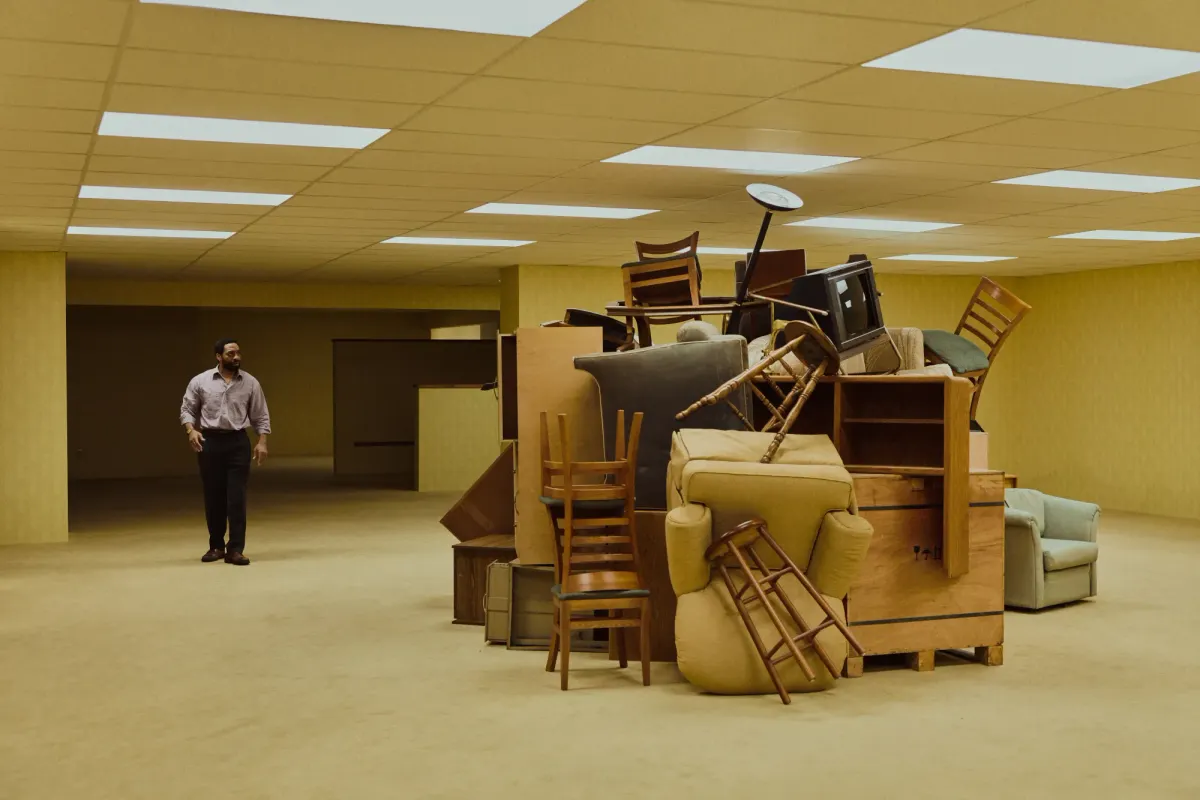
The most obvious recent example of this are the forever twinned successes of Curry Barker's "what if your girlfriend was a crazy psycho because you made her that way, you jerk" horror movie Obsession and Kane Parsons's "what if you found yourself in an infinite hotel basement" Backrooms. Both movies are made by very young directors — Barker, 26; Parsons, 20. Both are horror films that stretch small budgets in creative ways to prompt their biggest moments. And the success of both has been written about as though the directors have cracked the code as to "what Gen-Z wants," even as any movies as big as these two have clearly found audiences well outside of one demographic. Obsession, in particular, seems to have galvanized straight couples of all ages, who get to argue about who's the villain of the film in a manner that makes it something of a Gen Z Fatal Attraction. (Spoiler: The guy's clearly the villain, c'mon.)
What has most united the discourse around the two films, however, is the fact that Barker and Parsons got their starts on YouTube. I wrote about the YouTube horror boom last year, with Shelby Oaks's Chris Stuckmann and Talk to Her's Philippou brothers as other examples. Yet already in the first half of 2026, we've seen both Obsession and Backrooms blow up, while Markiplier's Iron Lung and the two-week theatrical release of the final episode of gooseworx's YouTube animated series The Amazing Digital Circus have seen more modest box office success (though both are successes).
 Emily St. James
Naturally, the conclusion much of the industry— and the entertainment press — has drawn is that YouTube is the next place to find successful filmmakers. I have no doubt that this will prove to be the case sometimes; there are a lot of talented directors making shorts on the platform, especially if you're interested in comedy or horror. Yet it's also hard to say that either Backrooms or especially Obsession are successes because of YouTube, as Ryan Broderick wrote about at some length a week ago. Iron Lung and Digital Circus? Sure. Those movies wouldn't have a marketing hook without the YouTube connection. But the others?
 Ryan Broderick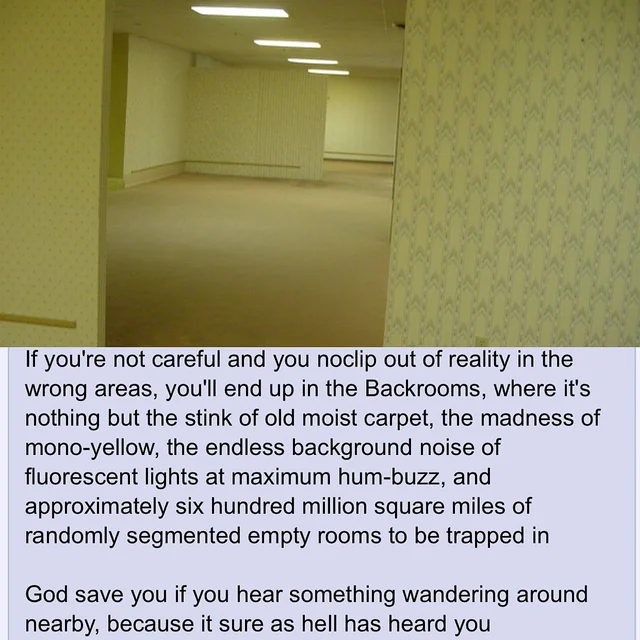
Hollywood, of course, often stampedes toward a conventional wisdom, dumps way too much money into that conventional wisdom, then eventually over-saturates the market. In 2029, we might well be groaning about all the horror movies directed by YouTubers. Hell, either Barker or Parsons might turn out to be the next flash-in-the-pan whose follow-up projects reveal an inability to move beyond one big hit. Like I love M. Night Shyamalan most of the time, but a better cautionary tale for "blows up big in one's 20s, then struggles to recapture the spark" has never existed. We've seen similar stampedes literally hundreds of times across the history of film and television.
But by chasing YouTube success stories — or even horror as a genre — Hollywood might miss the forest for the trees. What unites all of the above titles and several of the other year's biggest hits is that they feel new.
Become a paid subscriber: You'll get access to three weekly newsletters only paid subscribers receive, the Episodes Discord, and almost a decade of archives. Plus you'll get to comment and ask questions in the mailbag! Sign up for as little as $5/month below!
It has been almost impossible for box office reporters to write about Obsession and Backrooms without also mentioning the disappointing returns for movies like The Mandalorian and Grogu and Masters of the Universe. The undercurrent of this discussion is often that the youths are casting off the shackles of the tastemakers of earlier generations and carving their own path. To some extent, this might be true. He-Man, after all, is a property that primarily speaks to Gen X-ers and older Millennials, and, thus, not really something the Zoomers or the feral children of Gen Alpha have an affinity for.
But such a narrative ignores that some of the year's previous big hits are movies like Project Hail Mary and The Devil Wears Prada 2. Both of these films are based on the dreaded "IP," broadly speaking, and Devil falls under the umbrella of the legacyquel. Yet both have plenty that place them within the narrow Venn diagram intersection between "new" and "familiar." Hail Mary is based on a very popular book, and "guy stuck in space" is a frequently popular subgenre. But we're not drowning in examples of that subgenre. Similarly, while Devil could be seen as a soulless corporate brand extension, the audience it's targeting — women, especially mother and daughter pairings across generations — is woefully underserved by a box office that still prioritizes a rapidly graying male audience. And then there's Michael, quite likely to be one of the year's five biggest films domestically. It exists in a perennially popular subgenre — the musical biopic — and it's about one of the most popular musicians to ever have lived. But, again, it's hard to point to a lot of other movies like this of late.
Look beyond the biggest hits, and you'll find a fleet of more modest successes like The Sheep Detectives, Wuthering Heights, Hoppers, and Send Help, which really don't look like many other movies out there in recent years. That a movie where talking sheep solve a mystery is going to make just south of $150 million worldwide is really not something I would have predicted even a few months ago. Extend our lens to last year, and you start to pull in films like Sinners, Weapons, A Minecraft Movie, and The Housemaid. Again, you can find plenty of precedent for any of those movies' success, be it a well-known IP or the perpetual popularity of vampire movies, but to look at the overall trend is to see audiences finally willing to take a chance on new things.
The old ways obviously still work. The Super Mario Galaxy Movie is the biggest film of the year, and Toy Story 5 stands to make tremendous piles of money. And plenty of original films — even good ones — will continue to flounder at the box office, as they have throughout Hollywood history. Making a sequel to something people have heard of before that will draw in a large family audience remains a great way to find massive success. Even Mandalorian has done pretty well, especially relative to what is a modest budget for a Star Wars film. But if you want to talk about movies that people are clearly excited about, that they tell you you've just gotta see, it does feel like we've moved past the pure spectacle era of the 2010s and into something truly unusual and new.
And yet audiences have always craved the unusual and new. In many ways, the IP boom of the 2000s and 2010s was the natural endpoint of what we might call "Ain't It Cool News cinema." The industry could see the fervor for certain older properties online — especially those popular with men who were then in their 20s and 30s — and realized that fervor could be milked to some extent. But even looking back on that era, it's clear that the biggest success stories of the period — the Marvel Cinematic Universe and the early legacyquels — were doing things that movies hadn't done to that point, especially in taking serialized structures popularized by television and making them more movie-friendly. The geek cinema boom ran out of gas as surely as any of these trends do; it just took longer to move on to something new thanks to the twin production shutdowns tied to the pandemic lockdowns and the 2023 strikes.
I am under no illusions that Hollywood will look at the success of these movies and say anything like "Okay, let's keep greenlighting new and unusual things at modest budgets and seeing what happens." The continued struggle of comedy at the box office—– Scary Movie excepted — suggests an industry that still struggles to sell stuff outside of a diehard genre context. Curry Barker is already signed to make a Texas Chainsaw Massacre film, and I'm sure somebody somewhere is trying to wrangle the rights to Portal for Kane Parsons to adapt. Hollywood will make the same mistakes it always does.
But after years and years of all available incentive structures pointing toward continuing to wring blood from the same four or five IP stones, it's nice to see the industry remember that people want to see things that feel either different from things they've already seen before or just different enough. It's a lesson Hollywood often learns when it faces one existential crisis or another, and if that's what it takes for me to finally get to see a movie where a guy gets eaten by a whale, well, all the better.
A Good Song
(I had to do it.)
The free edition of Episodes, which (usually) covers classic TV and film, is published every other Wednesday. Premium subscribers get newsletters every Monday, Tuesday, Wednesday, and Friday. Our editor-in-chief is Emily St. James, and our managing editor is Lily Osler. If you have suggested topics, please reply to the email version of this newsletter or comment (if you are a paid subscriber).