The City Burners (preview)
A special look at this week's premium Friday newsletter!

Every week, Lily or Emily write and publish a Friday newsletter about what's happening right now in pop culture. It's only for paid subscribers! Here's an excerpt from this week's piece, in which Emily writes about The Odyssey and Christopher Nolan's filmography. If you want to read the rest, pick up a premium Episodes subscription using the button below!
"Some men just want to watch the world burn."
So says Alfred, Batman's butler, of The Joker in The Dark Knight, the 2008 superhero movie/homage to Michael Mann's Heat that took Christopher Nolan from "a promising young director" to one of the most important directors working. His ascent since then has largely been unquestioned, with the only real box office hiccup between that film and now — 2020's Tenet — still significantly outperforming what would have been expected for a movie released in the depths of a global pandemic. (It's easy to forget, but prior to Nolan's 2023 film Oppenheimer ruling both the box office and the Oscars, his most recent headlines had been about trying to browbeat Warner Bros. into giving Tenet a wide theatrical release amid lockdown.)
In no way has Nolan ever seemed like he's eager to separate himself from The Dark Knight, and it and its sequel, The Dark Knight Rises, remain Nolan's only two films to crack the $1 billion mark at the global box office (for now). Yet essentially every movie Nolan has made since his 2008 film has felt slightly troubled by how readily some segment of the populace really took to The Joker in his earlier film. Wanting to watch the world burn isn't supposed to be a good thing, and in The Dark Knight's third act, Batman's love of regimented order is vindicated over The Joker's sheer anarchy as humanity chooses empathy instead of destruction. Like, yes, the Caped Crusader takes a quick jaunt through a very George W. Bush-era depiction of the surveillance state on the way there, but then he tears that apparatus apart after using it the one time. The good guys are the ones who can look at unbridled, unchecked power and ultimately blink. The bad guys are the ones who pursue the heady rush of just doing whatever they want, without much thought for consequences.
But be honest: When you think of The Dark Knight, do you think of its themes? Or do you think about Heath Ledger's live wire performance as The Joker, the way not only the movie but the entire multiplex seems to bend toward him as he gleefully practices anarchic evil masquerading as a political philosophy? The answer is almost certainly the latter. And Ledger's Joker looms largest of any character in Nolan's filmography. It is not very hard to find people who watched The Dark Knight and thought the Joker was onto something. And Nolan seems to have some feelings about that.
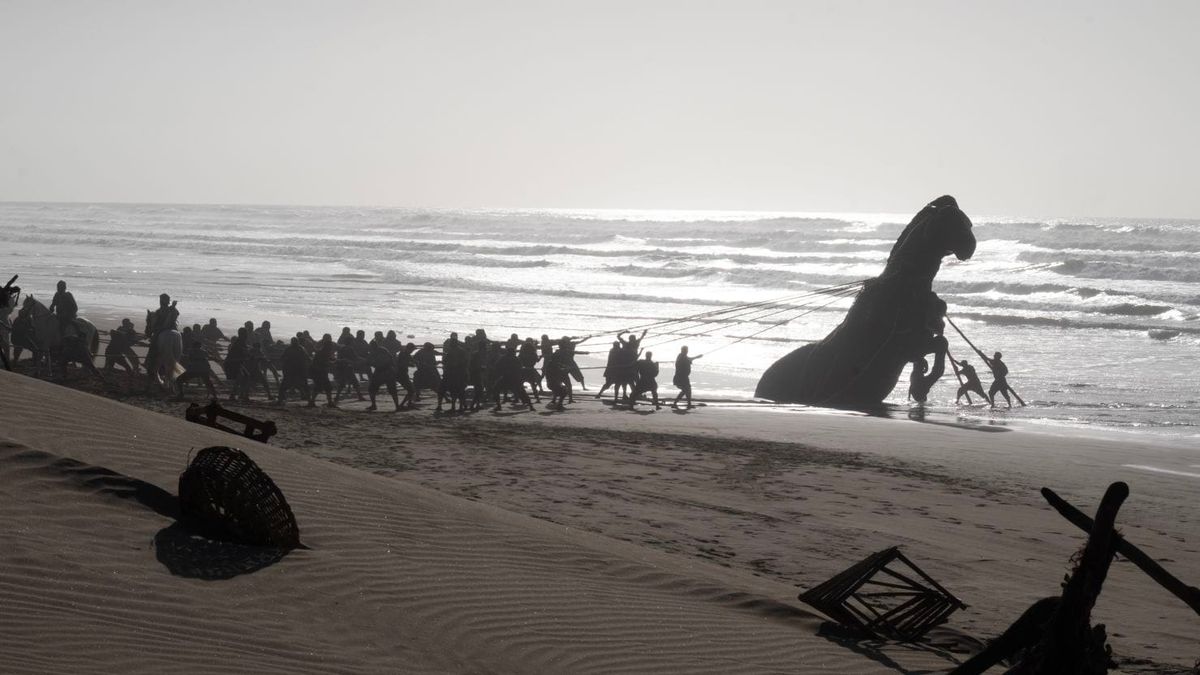
In the 2020s, Nolan has now released two straight movies that take as their premise the idea that the protagonist did at one point become The Joker. (I could stretch this metaphor to its breaking point to include Tenet, but let's not and say I did.) Intriguingly, these two movies are Oppenheimer, a biopic of a famous physicist whose work led to the invention of the atomic bomb, and Nolan's new film The Odyssey, an adaptation of the Homeric epic where Nolan all but explicitly argues that Odysseus's creation of the Trojan Horse was some real Joker shit. (And, yes, the Trojan Horse is not properly featured in the Iliad and is barely mentioned in the Odyssey but is prominently featured in Virgil's Aeneid, but it's the spirit of the thing. Away from me, pedants!)
If The Odyssey isn't Nolan's best film — and it might be — then it's damn close, an astonishing achievement for a man who finally won his elusive Best Picture and Director Oscars just a couple of years ago. The closest analogue I can think of in film history is David Lean making Bridge on the River Kwai, then turning right around and making Lawrence of Arabia, right down to the two men's very British obsessions with duty and honor and mild disinterest in the inner lives of women. (Lean just didn't have women in those movies at all; Nolan is lucky enough to work with Anne Hathaway and Samantha Morton, who both know how to find the heart in his occasionally flat parts for women.)
Nolan's Odyssey is recognizably an adaptation of Homer's epic, featuring all the stuff you half remember from having read the poem in high school, things like the Cyclops, the Sirens, and the witch Circe. But it's also unmistakably a Christopher Nolan film, and he has taken the material and warped it to his own ends, namely a single question: Once you've set the world on fire, can the inferno ever be put out?
Want to read the rest? Upgrade to premium today!