What does the Episodes staff know about Infinite Jest?
We're about to embark on a big summer reading adventure! Join us, won't you?


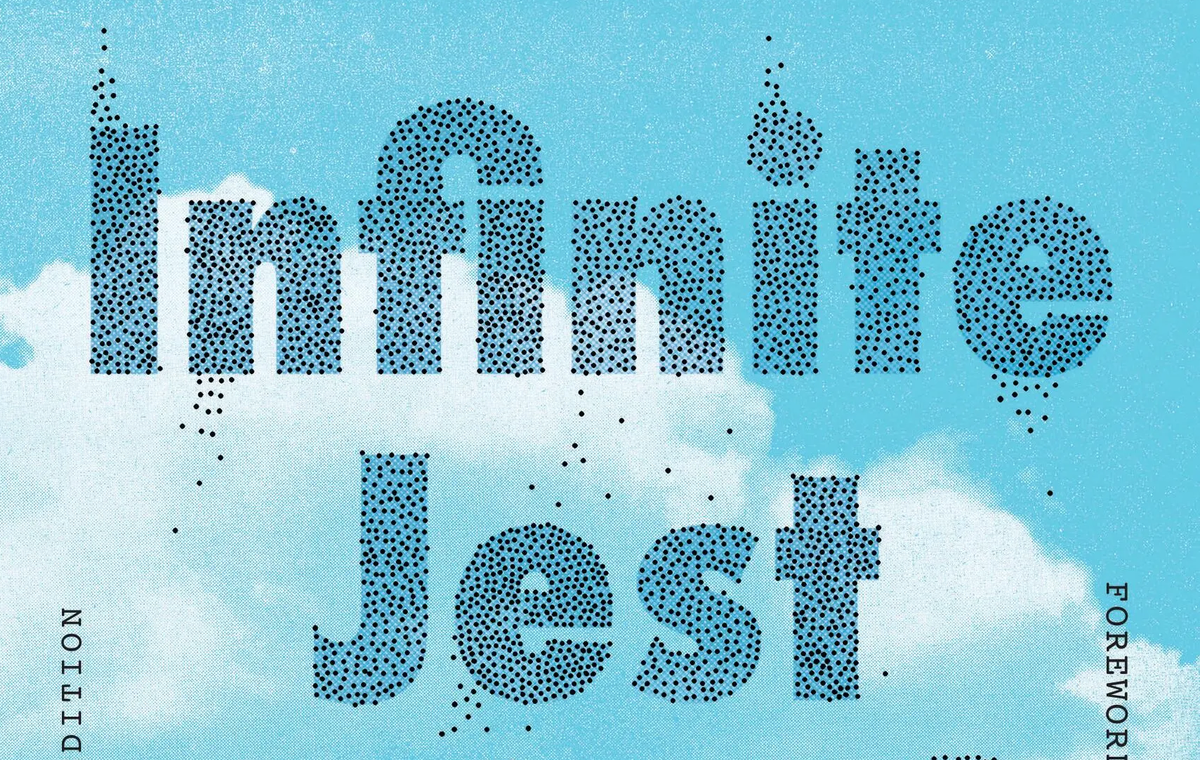
This is the preliminary installment of Emily St. James' and Lily Osler's summer book club series in which the two of them will read David Foster Wallace's maximalist 1996 novel Infinite Jest. Future crosstalks will only be available to paid subscribers, but this first installment is available to all. Become a premium subscriber using the button below:
Lily: I love Infinite Jest, but I absolutely didn't expect to when I first read it, more than a decade ago, on a dare.
It was 2013, during my junior year of high school. As you might imagine from, you know, my whole deal, I was an insufferable little dork, and I spent lunch most days at the school's writing center with other artsy geeks who would come out as some flavor of queer in undergrad. One day, a friend of mine and I got talking over lunch about pretentious novels that men like: What was up with those, we wondered? Mostly as a joke, we decided to find out. She would read Thomas Pynchon's Gravity's Rainbow, a famously difficult brick of a novel, and I would read the final boss of male-coded literary pretension*: Infinite Jest.
*I have noted this before and will note it again, but for the record: Every person I know who has finished Infinite Jest is a queer woman. I think the book's reputation could use a little updating, to be quite honest!
I'm not sure if my friend ever finished Gravity's Rainbow, but I found myself captivated by Infinite Jest. It took a while to get through its first 200 or so pages — the book's prose style, while incredible, is kind of tough to wrap your head around at first — but, once I got into the flow of things, I was obsessed. I was also a bit flabbergasted that a book this relentlessly hyped-up and endlessly mocked could actually be so substantive and hilarious and genuinely moving.
It's not a mystery to me why Infinite Jest has the reputation it does. For one thing, David Foster Wallace is, at this point, more famous for being an abusive monster toward women* than for the quality of his prose. For another: look at the weight of that thing! It's maybe not the absolute longest book you'll see in a suburban Barnes and Noble, but if you take a peek between its covers, you'll see long pages of single-paragraph text linked to endnotes in even smaller type with occasional walls of inscrutable mathematical symbols. Its title is a Shakespeare reference, and the whole book is a kind of postmodern Hamlet riff full of heavy-handed satire and point-by-point descriptions of tennis matches. No wonder it's (supposedly) a status symbol for asshole lit bros.
*I feel comfortable recommending Infinite Jest because I trust the readers of Episodes to understand the unfortunate capacity of horrible people to make beautiful things. It's also worth noting that Wallace has been dead nearly two decades now; the harm in publicly loving his work is far more diffuse and nebulous than it would be if he were still alive. All that said, Wallace's real-life misogyny certainly informed his work in some nasty ways, and I'll be discussing it from time to time in this series, so, if that's a sensitive area for you, use caution with these discussion posts.
And yet: Infinite Jest is, most of the time, a mightily fun read. Wallace's paragraphs may be long, but they're never long without reason, and they move far more quickly than you think. He's a master of rhythm in writing in every sense. He knows exactly when to release the tension of a long jargon-heavy turn of phrase with an incredibly stupid joke, and his prose sings when read aloud. The speculative fiction elements of the novel are surprisingly easy to track, often hilarious, and usually presented in ways that show that Wallace knows just how goofy his world is — the alternate American history of Infinite Jest's world, for instance, gets explained in a very on-the-nose puppet show around the book's midpoint. Wallace trusts his readers — see, for instance, the book's very frequent use of grab-a-dictionary words — but he's uninterested in boring us or, worse, treating us as his inferiors. As a result, Infinite Jest is far, far less pretentious than its critics (my teenage self included!) tend to assume. It's ambitious, and it doesn't want to talk down to you, but it is also, somehow, a very humble book.
It's also one of the most beautiful novels I've ever read. Wallace uses his gargantuan page count to stuff the book full of peripheral characters who appear for maybe forty pages tops but make a wildly outsized emotional impact. The most famous is Kate Gompert, a woman suffering from clinical depression whose experience of mental illness Wallace describes with uncommon precision, care, and tenderness. The book's Goodreads quotes page is littered with bits of the Gompert section, and for good reason. But Wallace uses the same thoughtful touch with so many other minor characters in the novel — here, for instance, is the brutally violent and yet unfathomably gorgeous single-sentence death scene of an insignificant mid-book character. This is a book full of so much more love than you might imagine.
I've also been obsessed with the book's themes for nearly half my life now. While Infinite Jest, per its title, is interested in entertainment and how it can cut us off from our deepest selves, the book cares just as much about why we might seek out forms of pleasure that dissociate us from our bodies, communities, and selves. The novel's protagonist, Hal Incandenza, spends so much of the book trying to find a way to feel something, anything, again, no matter what it will cost him. The book never comes to a clear answer, but in seeking one it reflects very keenly the struggle with dissociation that marked so much of my childhood and young adulthood. Infinite Jest can feel like a book about way too much, until, suddenly, it's a book about you.
I'll never pretend that Infinite Jest is a perfect novel. In his personal life, Wallace treated women like shit. In his professional life, he implemented racist policies in his creative writing classes. Those biases leak through into Infinite Jest, and the book can be, at times, a pretty tough read. (I'll specifically flag for Episodes' trans readership that Infinite Jest has quite a bit of transmisogyny in it, albeit in ways that I personally find kind of fascinating.) I can't judge anyone who dislikes Infinite Jest.
But it is, for better or worse, my favorite novel. It's certainly the book that's shaped my own life more than any other, from the way I see my dissociative tendencies to my habit of dropping a "kind of" in the middle of an overlong sentence to break it up. It's not a book that, like Emily sometimes says of John Crowley's Little, Big, feels as if it contains the entire world. Instead, it's something I find just as precious: a tsunami of individuality, a book that is completely and entirely itself. I can't wait to share it with all of you.
And, well, with one of you, specifically!! Emily, I've rambled for long enough about why I love Infinite Jest. What's your relationship with the book? What do you know about it? And what's exciting you, or making you anxious, about this read-along?
Emily: Here is what I know about Infinite Jest: Somehow, tennis is involved.
Despite being friends with you and a handful of other Infinite Jest fans, it has always been a book that slipped past my notice or desire to read it, not in the sense that I was actively avoiding it but in the sense that I never felt like I was particularly drawn to it. It was a title I'd heard without any significance to attach to it beyond that I seem to remember an annoying kid I knew in high school having read and loved it. (Not you; despite the fact that we are the exact same age, I didn't know you in high school.)
What's more, I have next to no relationship to David Foster Wallace. I know him by reputation as a writer of tremendous skill, and I have read one or two of his essays. I have always liked these but never loved them, but they also gave me the same sense of, "Oh, this is what everybody in my profession has been going on about" as I got when I finally read Gay Talese's "Frank Sinatra Has a Cold." Indeed, you telling me that he has problematic skeletons in his closet is the first time I've encountered this knowledge, so I am glad I know this now!
Even more, I have only ever really known Infinite Jest for being "very long." I have intuited from the broader conversation that it's a book for litbro types — despite every single person who's recommended it to me being queer, up to and including Michelle Zauner who wrote the foreword of my edition — but I don't entirely know what that means devoid of larger context. Is the book going to be full of satire that gets misread as endorsement like Fight Club? Is it going to make me want to fight a bear? I have no idea!
All of the above possibly sounds like a bit, but I assure you it is not. Despite being an avid reader of challenging fiction, I haven't ever really wanted to be seen as "a literary type" and have only recently, consciously, since I became a novelist been trying to consume classics that haven't previously captured my interest. It turns out most of them are classics for a reason, and that's part of why I'm excited to hop into Infinite Jest. (I also like tennis, so that's a plus.)
But I would be lying if I said I weren't also a little intimidated! Most of my favorite long novels have whole sections that are just, like, "Herman Melville tells you about whales" or "Leo Tolstoy has thoughts about Napoleon and how much he sucks," and these sections can be glorious... and often slow me down. What am I looking out for here? What are the parts that I should already be steeling myself for? I'm totally ready to find out what it's like to be a tennis ball! I just want to know it's coming!
Lily: This is actually a pretty interesting theoretical question: Does Infinite Jest have Whale Facts?
On one hand: No, it really doesn't. Because of the book's litbro-ish reputation, it's not often discussed as genre fiction, but that is what it is to its core. There are real-world scientific concepts in the book, but the vast majority of Wallace's infodumps are nothing at all like, say, Victor Hugo overexplaining Paris' sewer system in Les Misérables. Instead, he'll spend dozens of pages drawing you into the often kinda bonkers near-future he's created, which often goes down smoother than Whale Facts by dint of being, well, zany satire. Moreover, these sections are almost always also characterization goldmines — they are from someone's point of view, no matter how obtuse or arcane they are, and they tell you more about who that person is and why they matter to what the book is doing.
On the other hand: Come off it, obviously Infinite Jest has Whale Facts. Sure, it might not have long nonfiction digressions apropos of nothing, but it does sometimes get up its own ass about, like, a mathematical concept Wallace clearly thinks is cool. Brace yourself for lengthy disquisitions on calculus, topology, and independent film. And — this one goes out to all our readers! — do not feel obliged to read every word of the mid-novel section where the characters play Eschaton, a complex tennis-based wargame of Wallace's own invention. Instead, just watch the music video for The Decemberists' "Calamity Song," which is a straightforward adaptation of the Eschaton section directed by a mid-Parks and Rec Michael Schur!
And with that, it's time for us to get reading! This week, we'll be reading pages 1-105 of the print edition of Infinite Jest, up to the sentence that ends "...lost in the roar of a high-pressure toilet." You can buy the book on Bookshop.org or Barnes and Noble, or, if you're brave enough to navigate the endnotes on an e-reader, on Kindle, Kobo, or Apple Books. Alternately, many major library systems have copies of Infinite Jest they'd be happy to loan you! However you wind up getting the book, please join us in the Episodes Discord or the comments section to chat about the novel with us.
Happy reading, and we'll see you next week!
A Good Song
The free edition of Episodes, which (usually) covers classic TV and film, is published every other Wednesday. Premium subscribers get newsletters every Monday, Tuesday, Wednesday, and Friday. Our editor-in-chief is Emily St. James, and our managing editor is Lily Osler. If you have suggested topics, please reply to the email version of this newsletter or comment (if you are a paid subscriber).