You Can See Everything and the queasy duality of Elizabeth Holmes
Plus: Rachel Gillig's latest duology, Boorman and the Devil, and some great horror movies.


Happy Monday, Episodes pals! This week, we've got takes on You Can See Everything and Rachel Gillig's books, as well as our usual collection of other bibs and bobs. Remember: If you subscribe, you'll get this newsletter in your inbox every Monday!
And if you're a paid subscriber, don't forget to submit a question to our monthly mailbag! It's one of our best features every month.
Yeah, okay, You Can See Everything might be the movie of the year
A bad habit I have when I know I'm watching a movie with the goal of writing about it for this newsletter is that I'll often start writing a review of it in my head the instant the opening credits end.
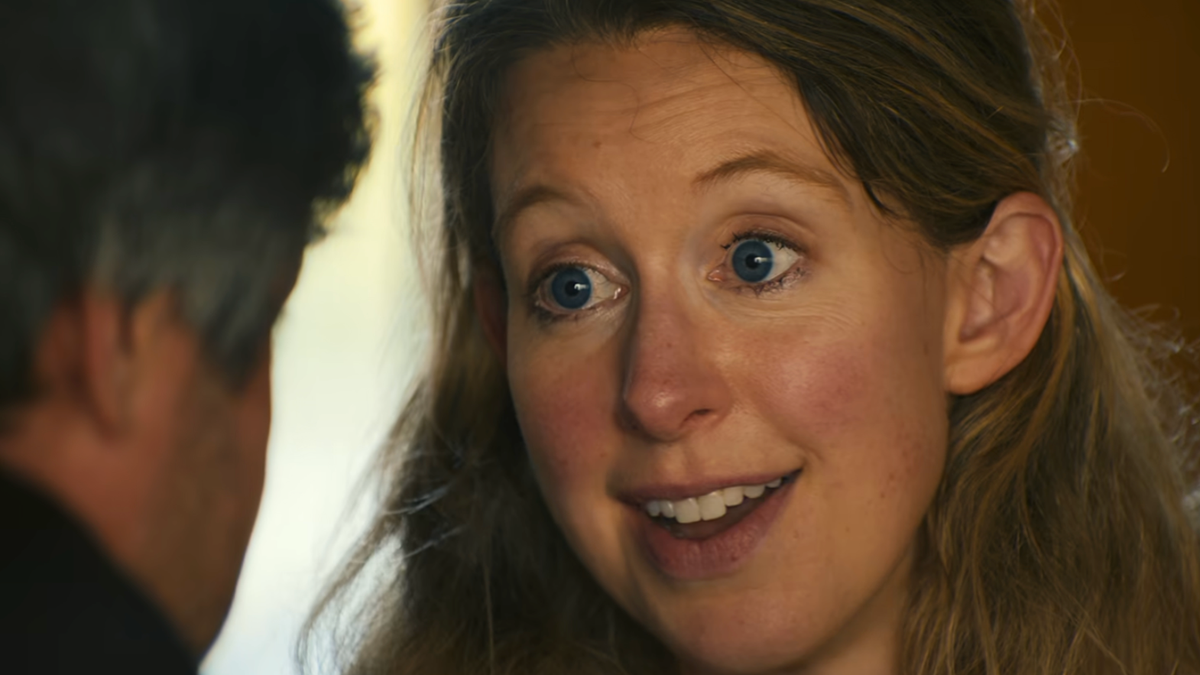
It was in this mindset that I watched the first 90 minutes of Lance Oppenheim and Nathan Fielder's absurdly buzzy new Elizabeth Holmes documentary You Can See Everything. The film's first few acts are skin-crawling in the exact way the viral teaser (embedded above) trailer promises: Elizabeth Holmes, 34 days out from the start of an 11-year prison sentence, flashes a creepy smile over and over as she blandly insists on her innocence to an uncomfortable Nathan Fielder. Was this, I thought, maybe a movie about the power of the reaction shot, the ability of a single facial expression to deflate a multi-billion-dollar fraud? Or was it maybe about the act of making comedy itself? After all, an absolutely crucial scene in the movie takes place while Holmes watches Abbott and Costello's famous "Who's on First?" routine.
And then Holmes goes to prison, the three-hour documentary hits its halfway point, and everything becomes clear.
This is not a movie about comedy or reactions or filmmaking or craft or anything formal or technical that Fielder or Oppenheim are doing. It is about abuse, power, and misogyny — and it's one of the most disturbing films I've ever seen on those subjects, up to and including the work of David Lynch. To explain why, I am going to need to spoil the whole movie. And yes, this is a documentary that can be spoiled. It deserves to be seen cold, so, if you haven't seen it yet, skip to Emily's very good romantasy item below!
...
Still with me? Then let's talk about Billy.
Billy Evans, Holmes' partner since 2017, gets, by my estimation, as much if not more screen time than Holmes herself. Bearing a superficial resemblance to Jake Gyllenhaal, Billy is an independently wealthy gym rat who claims, over and over, that he's devoted to Elizabeth, that he loves her and believes that she did nothing wrong. He is also, from jump, a controlling asshole. Right at the film's start, Holmes is whisking up a bowl of scrambled eggs when Evans rather coldly snatches it from her, explaining that she just doesn't know how to whisk them right. It's a small example of his control-freak tendencies, but a telling one: Throughout the film's first half, he's always hovering on the edge of the frame, ready to interrupt Elizabeth whenever she seems to be on the verge of speaking more openly to Fielder.
Most disturbingly, when Fielder finally gets a few minutes alone with Holmes' father Christian, who tells us that Holmes was sexually assaulted in college and then essentially groomed by Theranos COO Sunny Balwani, a visibly angry Billy bursts in to interrupt the conversation and take Holmes' dad away. It's a move that makes more sense once we realize that Christian does not like Billy one bit — the film strongly implies that he sees Billy as part of the same pattern in Elizabeth's life that started with Balwani.
We watch all these things through Oppenheim's camera, and then we watch them again from a very different perspective: After Holmes goes to prison, Fielder connects with Amanda Seyfried, who played Holmes in the 2022 miniseries The Dropout, and shows her his work-in-progress. She's instantly repulsed by Billy, and, while it's not exactly a surprising reaction, it is very cathartic after the pressure cooker of the film's first half to see a normal, thoughtful person see the same footage we've just seen and recognize those same dynamics in it.
Seyfried's fascinated by the footage, and she agrees to become Fielder's collaborator in the documentary: She will play Holmes in recreations of moments that happened before Holmes and Evans had signed image releases, and she will help Fielder figure out what Billy's actual deal is. Seyfried tells Fielder that she's good at getting people to reveal secrets simply by being in a room with them. And so the two of them meet Billy at his Austin home, where he proceeds to treat Seyfried with visceral, clearly sexist disgust. He sneers at her, insists that he's so much smarter than she is, goes on a disturbing rant about his tendency to exact revenge on his enemies, and grandstands about how disgusting it was that she had said the late Charlie Kirk was a hateful person. (Throughout the movie, he also keeps sniffling in the way people on cocaine often do. Not drawing any connections here, of course!)
And, true to her promise, Seyfried gets Billy to open up: He tells Fielder and Seyfried that he has Holmes' legal power of attorney and has used it to get access to her social media accounts, where he impersonates her in foul-mouthed posts that sound nothing like the person we've met. He seems to have no respect for Holmes' wishes or consent, giving his implicit blessing to a billboard campaign using a photo she despises so much it drives her to tears and building an AI model of her image that he plans to release despite Fielder's concerns that it will almost certainly enable nonconsensual deepfake pornography of Holmes.
Seyfried and Fielder are in agreement that Billy is a horrible, horrible person. And yet, as the film draws to its ending, only Seyfried seems capable of holding Billy's cruelty and Holmes' own complicity in her crimes in her mind at the same time. After Fielder secures a prison interview with Holmes and transcribes it to the best of his recollection, Seyfried is horrified by portions of the interview where Holmes repeats Billy's creepy statements of affection — that their love is a "monument" they are building together. Fielder, though, finds the moment moving. And he goes on to insist that there was no way Holmes — a convicted fraudster — was being manipulative in their interaction.
Seyfried reads him for filth: He has developed some sort of affection for his subject despite his best efforts, and it's clouding his judgment. Oppenheim's camera here executes a striking reversal: He frames Seyfried in the role Fielder once occupied, the keen interviewer trying to pin down the twitchy subject. At the end of the movie, she seems to be the only person who can see Holmes at all clearly. This is, of course, at least partially because she is the only major character in the film who has never met the evidently endearing Holmes face-to-face, who only knows her only through interviews, depositions, and her public image.
But it is hard to escape the conclusion that it's also because Seyfried is a woman. Unlike Fielder and Oppenheim, she is someone who has personally experienced misogyny and thus can very viscerally clock Billy's monstrously sexist behavior while still treating Holmes herself as a full person. A patriarchal society will always struggle to treat women as complex moral actors; by ending the way it does, You Can See Everything insists we see Elizabeth Holmes in all her queasy duality, as someone fully capable of both villainy and victimhood.
Anyway, You Can See Everything made me feel the way I did when I was hit by a car a few months ago. I cannot believe it exists, and I don't think I ever want to watch it again. It will probably wind up being my favorite movie of the year. —Lily Osler
Does romantasy have to be, like, good?
Despite being a huge fan of romance novels and an occasional fan of enormous fantasy novels, I must admit that I struggle a bit with romantasy as a concept. I've tried most of the big "franchises" in the space, as well as a few smaller titles, and I've never quite found anything that really grabbed me. Fourth Wing? More like four out of 10!!!! (I guess I love Holly Black's Folk of the Air series, but those are much, much, much more YA than anything else.)
The exception was Rachel Gillig's Shepherd King duology, which I wrote about last year. Gillig (who shares a literary agency with me) is a confident world builder, drawing from weird fairy tales and dark folklore to create communities defined by their near claustrophobic cloistering. Like the kingdom at the center of the Shepherd King books is seemingly a small town swathed in an eternal fog. It would otherwise be Twin Peaks, were it not for the tarot-influenced magic system. Gillig also clearly prioritizes the fantasy over the romance, which helps her keep her intricate plots moving. She crafts believable relationships, but I've never read one of her books just dying for the leads to kiss because they're always so busy, like, tearing down an ancient, oppressive magical order.
The Knight and the Moth, the first in her Stonewater Kingdom duology, was the book that broke Gillig through to the mainstream in a big way when it came out last year. Its sequel, The Knave and the Moon, hit the top spot on the New York Times bestseller chart, and both books have received glowing notices from the fans on Goodreads, for whatever that's worth. Knight follows a perpetually shrouded young woman who drank of a magic spring and now can occasionally see the future when she does a magic ritual. When her fellow seers, with whom she has spent almost a decade, begin disappearing, she joins up with a band of knights – including one really hot one – to go looking for her colleagues/functional sisters. I really liked Knight (I haven't read Knave) while feeling something very strange: Gillig might be too good of a writer?
Let me start with the part of that that's a compliment. On a sentence level, Gillig is probably better than anybody else working in the romantasy space, at least that I've seen. She writes beautiful descriptions of her unusual worlds, she's good at charting the emotions of her characters in the way the best romance novels do, and she occasionally peppers her books with genuine insight. Is she, like, Marlon James? God, no. But she's turning in prose that's far above and beyond what she strictly needs to come up with to make her books work, and if her dialogue makes all of the characters sound like they're starring in a CW show, well, let she among us who is without sin be the first to condemn.
Gillig is clearly driven by telling stories about young women escaping vaguely cult-y backgrounds that are coded in a hazy, semi-Catholic way, and it's that quality of her stories that surely draws me to them. She's very good at exploring the ways that unlearning everything you've been taught can be first terrifying and then liberating, and she's literally come up with a way to veil her protagonist, the better to hide her sight from the woes of the world. So, yes, the shroud falls away at some point, etc., etc., etc., vulnerability. It's all handled exquisitely!
And yet somewhere toward the end of Knight, I found myself wishing Gillig would just stop with the beautiful prose and get on with the fucking story already. Gillig is really, really, really good at plot, so shortly after I had that thought, she built her book to a cascading series of giant cliffhangers. So I was happy! And yet I was, like, "Why are we doing all this plumbing of psychology in a book with a talking gargoyle?"
I'm not saying I want romantasy to be purely slop, nor am I saying that genre stories shouldn't have thoughtfully deployed explorations of the characters' psychologies. But I did find myself thinking that when you want to have a thoughtfully built fictional world and an intricately detailed romance, you end up with a really limited "I am also an extremely literate person and crafter of beautiful prose" budget. Maybe Gillig just blew her whole budget at once, so I saw the seams. But I did think the book might have been better if it were slightly less good.
Then again, Gillig deliberately crafts her books as dyads, so maybe I will see the full picture once my hold on Knave lifts at the Los Angeles Public Library. I still believe in you, Rachel Gillig! Let's have coffee sometime! –ESJ
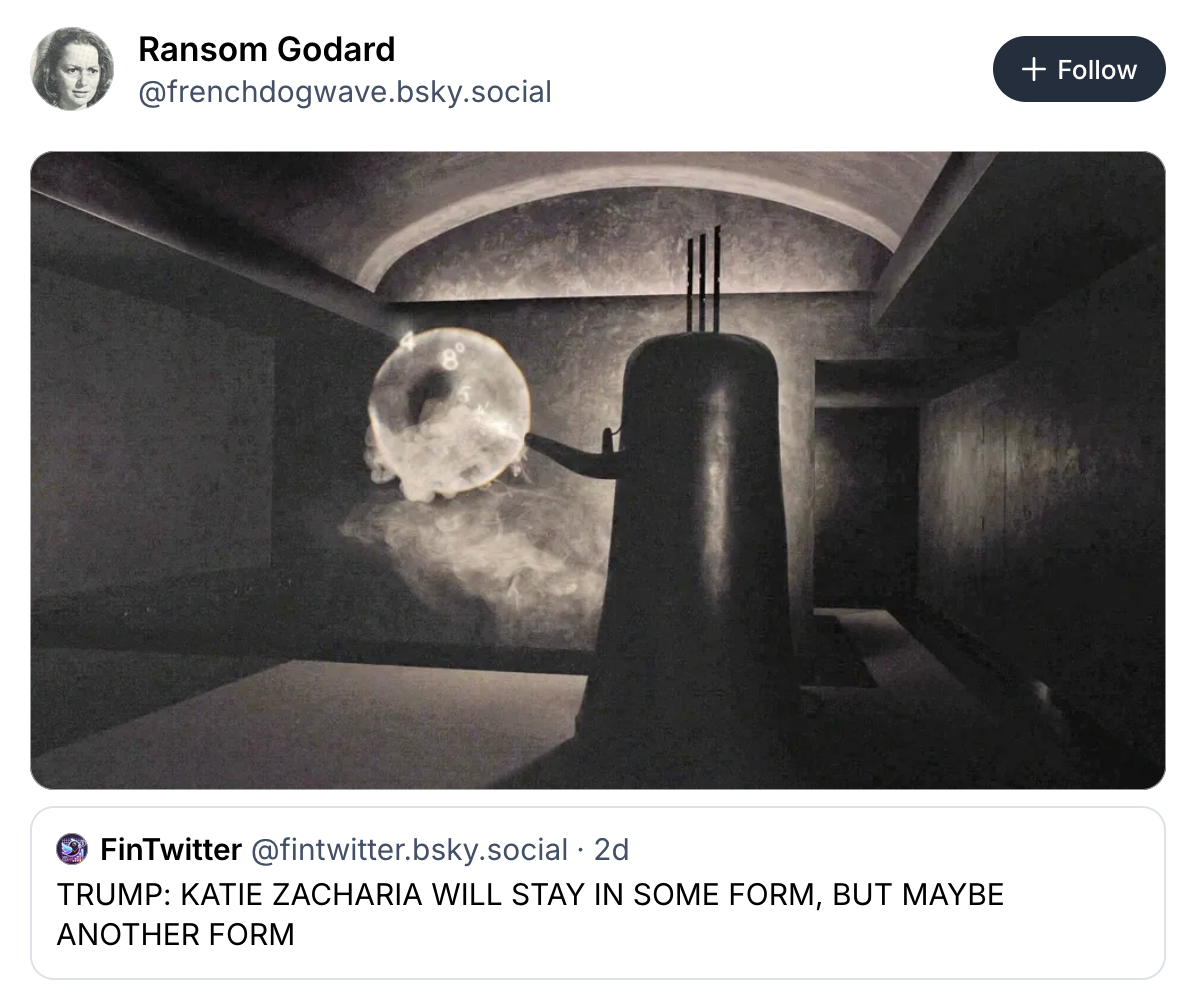
Who isn't staying in "some other form" these days??
Buy Emily's It's a Wonderful Life book!
Every Time a Bell Rings, the book about It's a Wonderful Life that I cowrote with Defector's Lauren Theisen, is out now! Less a making-of or a historical document, it's more an attempt to consider the film from a variety of angles, major character by major character. There are essays about World War II PTSD, whether Bedford Falls had any gays in it, and Donna Reed's impossible standard for womanhood. And it's an incredibly beautiful holiday gift, with a gold foil cover and festive seasonal endplates. Buy it today! —ESJ
Last week in Episodes...
- In our Monday Digest, Emily loved FX's Adults almost as much as Lily hated Amazon's The Love Hypothesis:
Like, yes, Adults depicts a version of twentysomething precariousness I'm glad I mostly escaped – except now I'm living through that very precariousness or something like it in my 40s. And I have a fucking kid. Because it only has eight-episode seasons, Adults is able to keep its characters from feeling too stable, which matches both their circumstances and what increasingly feel like my own. Will it be able to keep that going for five or six seasons, or will it eventually become like Friends and have everybody living in luxury by the end? I'm excited to find out.
- Our every-other-Wednesday free post took readers through the movies that actually, genuinely manage to scare the (generally pretty un-scareable) Episodes staff!
- Emily's recaps of A French Village began with a literal bang: the horrible moment when World War II suddenly and horribly comes to the titular village.
- And on Friday, Emily took on the question of the age: What even is the deal with Digger??
What feels different about Digger hive is how vociferous the movie's fans can be — and how many of them seem to be in the entertainment industry... What's more, a lot of the film's biggest supporters in the industry are, in essence, praising how much the movie hates them and the work they do, how it seems to suggest that literally all art backed by massive mega-corporations is tainted, empty, compromised.
Want to read all of that great stuff? The only people who have access to all of it are our paid subscribers! Why not upgrade your subscription today? If you do, you can take part in Friday's upcoming mailbag!
Some pop culture things we're into
- I finally filled one of the largest gaps in my horror-film knowledge and watched Neil Marshall's terrifying 2005 film The Descent. While I don't think I'm quite as hot on it as many of my fellow horror-heads are — the mid-'00s Everything Is Blue color grading and the mind-numbing number of cuts in the action scenes had a tendency to take me out of the moment — it has guaranteed that I will never so much as go near a cave for the rest of my life. (Also, did this movie prefigure the elevated horror monsters-as-trauma boom?? I think maybe it did!) —LO
- To the surprise of literally no one on the planet, Scream (the original 1996 one) is one of my favorite movies. To be sure, the only bad Scream movie is the seventh one, and Scream 2, 4, 5, and 6 are all very solid horror-comedies, but the original is something else entirely, replicating the cruelty of a teenage boy in its structure by joking until the sudden moment when it very much isn't. I try to see it every October, and this year I had the privilege of getting to see a free screening at the newly-reopened Dangerous Man Brewing in Northeast Minneapolis! The rest of their October movie lineup is top-notch, and the venue is extremely cozy; hit them up if you're in town! —LO
- The new documentary Boorman and the Devil is precisely my kind of behind the scenes tale, outlining as it does the chaotic, tortured production of Exorcist II: The Heretic, a legendary box office flop that also bombed with critics but has (of course) garnered something of a cult audience in the years since, thanks to director John Boorman's skill with operatically nightmarish imagery. I have tried to get on board the Heretic train, but its ending is simply too much of a mess for me to get all the way there. Still, Boorman and the Devil is quite good, and it made me realize what I really want is a series of documentaries about the productions of famous New Hollywood box office bombs from the summer of 1977 that got caught in the path of the Star Wars steamroller. Like, yes, we have standard making-of docs about Martin Scorsese's New York, New York and William Friedkin's Sorcerer, but I want somebody to really go all out, really pull out all the stops. Let's see what else Star Wars destroyed! –ESJ
- Adults watch continues with Season 2, which is somehow even funnier than Season 1. Yet if anything, the show's pathological fear of teenagers and young twentysomethings has grown deeper. Unfortunately, I have rarely been as "omg, it's me!" about a character as I am about Billie, an uptight blonde woman who got a fake ID at 16 so she could join a Wework. –ESJ
- In other reading news and other New Hollywood news and other Star Wars news, I started Paul Fischer's The Last Kings of Hollywood, a history of New Hollywood told largely through the perspectives of Francis Ford Coppola, Steven Spielberg, and George Lucas. I'm still pretty early in the book, but it's always wild to remember just how acclaimed Lucas was as an experimental filmmaker before he because, you know, George Lucas. –ESJ
Let's watch Amanda Seyfried answer some questions about Elizabeth Holmes, shall we?
(If you, like many, are unable to see You Can See Everything, you should really watch The Dropout! It's wonderful! Amanda Seyfried gives one of the best TV performances of the decade in it!)
Discuss
Who should Nathan Fielder and Lance Oppenheim profile next? Who shall wither under their unyielding gaze?? Talk about it in comments or the Discord!
Some good links
- Trace Elements and The Mulai [Ancillary Review of Books]
- The right is pushing its anti-trans fury on the WNBA. Players and fans are loudly pushing back [The Guardian]
- How Rod Serling (mostly) survived World War II [What's Alan Watching]
- Yellowjackets Season 4 trailer [Showtime] [WHAT? I GET TO DO THIS.]
- PS: Eat dumplings with chopsticks and gabagool with a fork [Bluesky]
A Good Song
The free edition of Episodes is published every Monday and every other Wednesday. Premium subscribers get those newsletters, plus extra ones every Tuesday, Wednesday, and Friday. Our editor-in-chief is Emily St. James, and our managing editor is Lily Osler. If you have suggested topics, please reply to the email version of this newsletter or comment (if you are a paid subscriber).