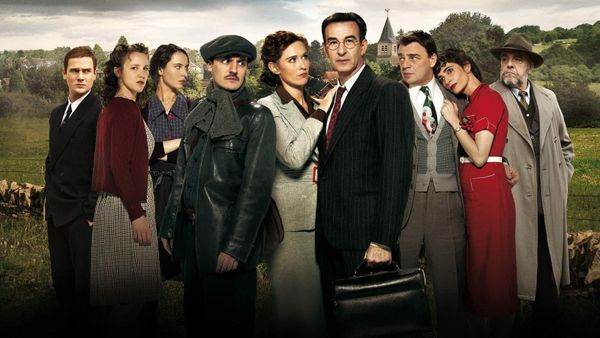
A French Village, Season 1, Episodes 1 and 2: "The Landing" and "Chaos"
The acclaimed World War II drama begins by introducing us to a town about to be irrevocably changed.

This is the first installment of our weekly recaps of A French Village, the World War II drama that aired between 2009 and 2017 in France and is available in the US on MHz Choice and other platforms. Future recaps will only be available to paid subscribers, but this premiere edition is available to all. Sign up by clicking the button below.
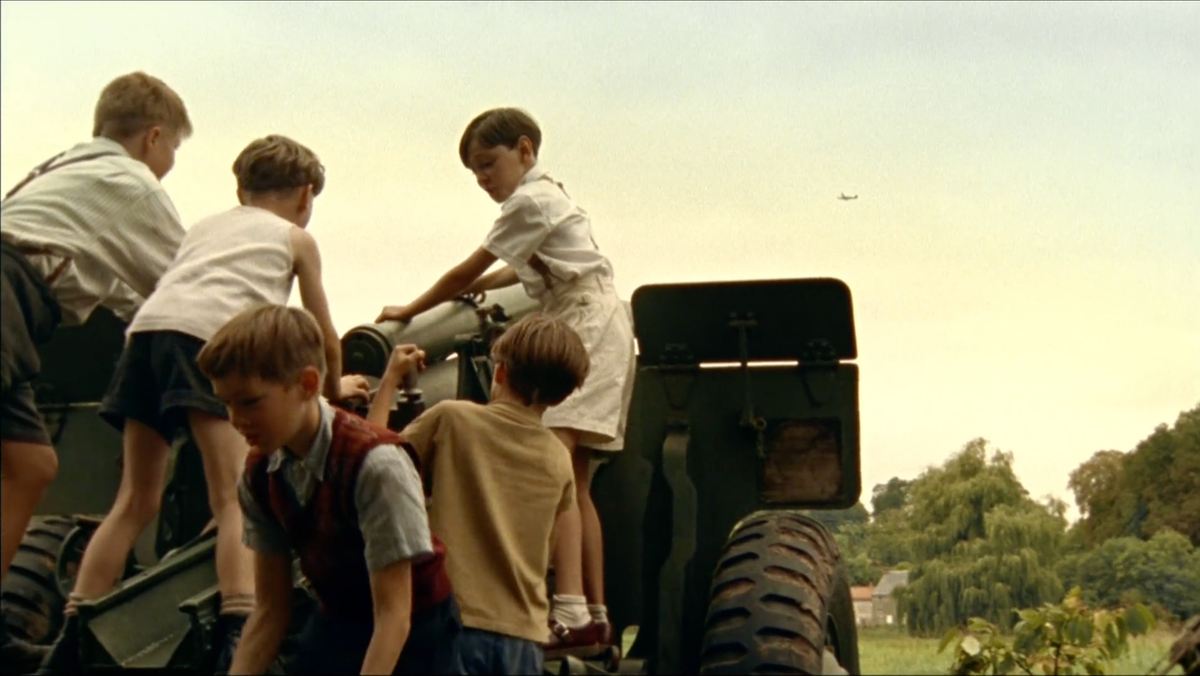
We get maybe 15 minutes with the people of Villeneuve — the French village of A French Village — before the Nazis invade, which is not a lot of time to establish a status quo to disrupt. Smartly, the series* sticks to the most basic elements of the characters' lives. The doctor has to deliver a baby. A man seeks a little time alone with the woman he hopes will become his mistress. The students at the local school go on a field trip. The war looms — the German army has been reported 100 kilometers away, and the children find a French cannon hidden away in the trees near their field trip site — but offscreen somewhere. Nobody expects it to arrive in Villeneuve today. Nobody expects it to arrive in Villeneuve at all, even if it's 100 kilometers away. Even when you always expect the worst, it's another thing for it to actually happen.
*-Normally, I would butt in here with the writers of the episode in question, but it's murderously difficult to figure out who wrote which episodes of this show, at least via means I typically use. So let's note that the show is created by Frédéric Krivine, Philippe Triboit, and Emmanuel Daucé, with Triboit directing both episodes discussed today, and leave it at that.
To a degree, A French Village doesn't have to establish a status quo that gets disrupted because history has done the work for it. Even I, someone who hasn't done a ton of reading about World War II, know that France fell far more quickly than expected to the Nazi blitzkrieg and that its citizenry soon found itself trapped between the twin poles of collaboration with the occupiers and resistance to them. Every face introduced in those first 15 minutes leaves you wondering how, exactly, they'll fare in the long, dark years ahead. The status quo disrupted is the status quo always disrupted by war: the quiet rhythms of an everyday life.
A good series premiere — and I think we can count both of these episodes, so closely tied together they are — will use its initial scenario to establish the core characters in a situation that shows them when they are most themselves, which will allow us to measure them against that baseline going forward. I could make a few quibbles with "The Landing" and "Chaos," particularly the latter, but for the most part, these are two remarkably confident, thrilling episodes of television that more than clear the bar of showing us the characters in a tense, involving situation that reveals their truest selves. Again, the series can draft off of history somewhat. It's hard to imagine a more tense situation than the invasion of your hometown. But even then, A French Village has so many characters to establish, thanks to a truly sprawling ensemble.
Which brings me to a simple fact: I'm still not sure what a lot of these people's names are. To be sure, the show has positioned a couple of characters as protagonists — we'll see if this bears out — and consequently, I (mostly) know their names. But there's an entire subplot with local communists that my brain helpfully filed under "the communists." This is not a flaw in the show's design, as no ensemble drama premiere can ever hope to successfully establish every character completely, nor should it. It is merely to apologize for occasional lack of specificity in this article. I will get up to speed quickly, I'm sure.
Now: Let's break down the various corners of the show's world, one by one, then look at how the show positions the characters as either collaborators or resistance fighters.
Dr. Larcher: I guess this guy is the closest thing we have to a traditional protagonist. The actor who plays him — Robin Rinucci — is listed first in the credits, and he's also been in things I've heard of, which suggests a level of fame that has slightly transcended his native country. He's also the character whose pre-Nazi storyline has the closest thing to life-and-death dramatic stakes: He has to deliver a baby. Yes, that's a routine procedure for even a small-town doctor like Larcher, but "routine" goes out the window pretty quickly when the stability of everyday life is disrupted, as we know it's about to be.
"Let's make the protagonist a doctor" is one of those ensemble drama shortcuts to creating a central character whose storylines will allow a series to do episodic storytelling within a serialized framework. Lost, for instance, could tell stories about Jack that were about the mysteries of the Island or about him trying to save lives without access to modern medicine. And both "The Landing" and "Chaos" give Larcher stories along these lines. In the first, the delivery quickly goes from bad to worse, and the Nazi invasion doesn't stop Larcher from trying to save the mother from hemorrhaging out, even going so far as to find what remains of the French army to beg them to take the woman to a nearby hospital. (They say they will — if the hospital still exists.) Larcher takes the baby home to his wife, Hortense, and she seems pretty into the idea of taking care of the child, a thing that will surely turn into a long-term story across the life of the show.
In the second episode, Larcher finds himself the only doctor for a church full of refugees dealing with injuries and dysentery, something that threatens to become an outright plague within the enclosed space. His story here is another one common to medical dramas — triage after a mass-casualty event — but woven throughout it is a growing sense that Larcher's desire to do no harm makes him both a natural leader to his fellow townspeople and exactly the sort of guy who might make enough compromises with the Nazis that he ends up de facto working for them. The episode gives us hints in both directions, showing him rounding up weapons at the Germans' behest but also showing him refusing to turn over a local communist when the Germans demand it. We know he has some lines he won't cross. The question, now, is how firmly those lines will hold.
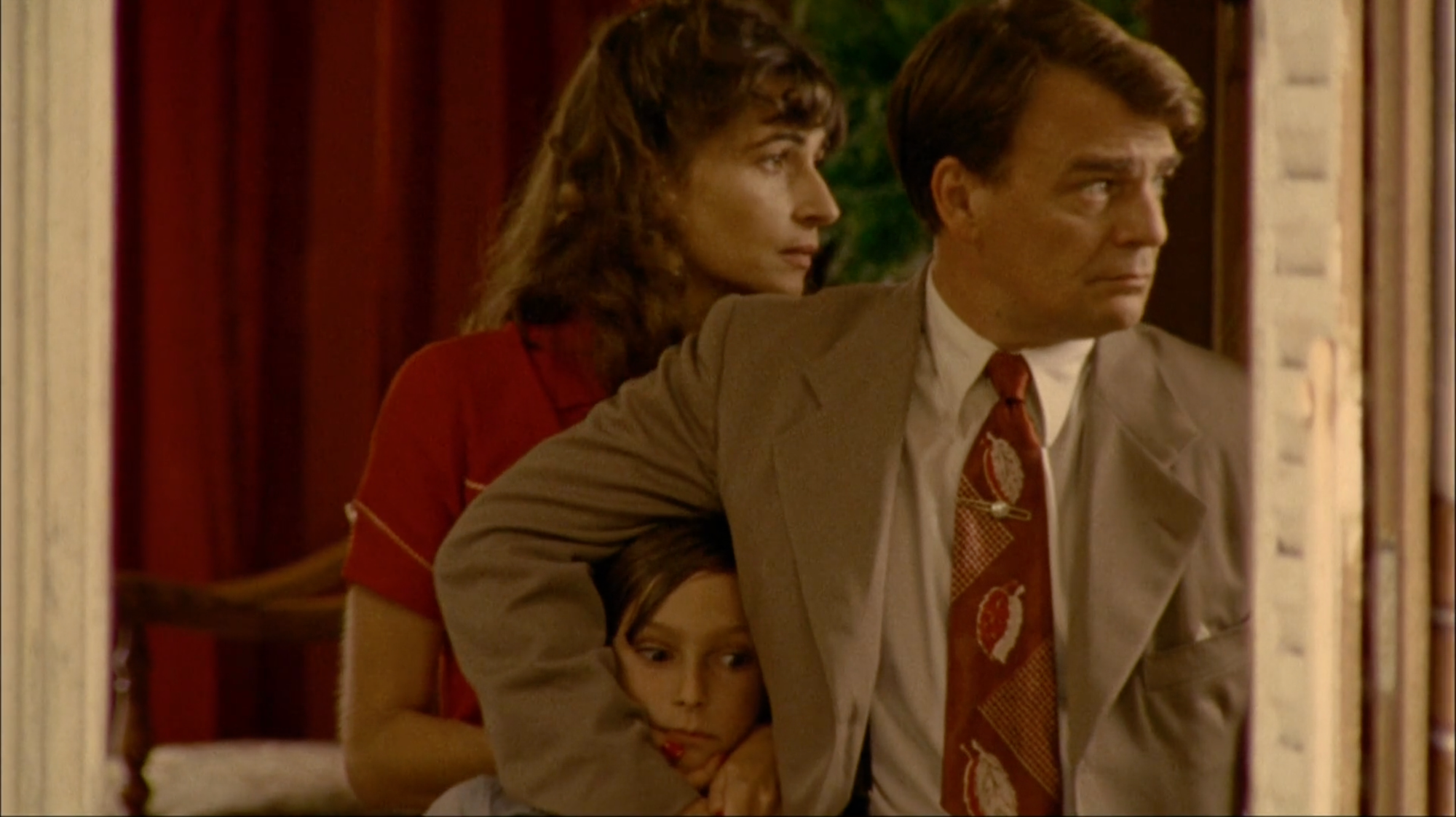
The Schwartzes: If we've got another character who seems like he might be the protagonist, it's Raymond Schwartz, a local sawmill magnate who lives in a large house with his "beloved" wife Jeannine and children, who include both a son who goes on the field trip mentioned above and possibly a teenage daughter. (A girl popped up in some of the late scenes, and I don't think she was a servant.) When we meet Raymond, he mostly wants to get out of his house so he can go flirt with Marie, a woman he briefly connected with at a party prior to the events of the series. He manages the feat, which leads to some fun sexytimes — and then the Nazis invade. (Who hasn't had this happen?)
The episode then pivots to the Schwartzes trying to reunite, even though the son was on the ill-fated field trip (more on this in a second). When Raymond returns to his home to find it in disrepair after the initial Nazi strike, Jeannine nowhere to be found, he clutches her with deep relief when she finally arrives. At last, he's realized he's got a hot wife! you might think, but he's right back to trying to make time with Marie in the next episode, so far as going into the church full of refugees to see if he can pull her away from her duties as an impromptu nurse.
The Germans take over the Schwartz home to be Nazi HQ, but Raymond and company mostly seem to steer clear of more direct German involvement. Yet my suspicion is that the series is nodding toward where this storyline might go via the characters' last name. Schwartz is a common German surname, but its historical roots, though tangled, typically point to some degree of Ashkenazi Jewish heritage. Which seems like it might not turn out well for the Schwartzes.
The field trip: By far the most harrowing scene in the first episode is the kids out on an idyllic school field trip slowly realizing their day has gotten much worse when a German plane spots them before opening fire. Two kids and the teacher's boyfriend die in the gunfire, and a couple other boys, including Young Schwartz, are injured (not gravely, thank goodness). One boy — Gustave — runs into the woods and eventually encounters a dazed French soldier named Jacques, who seems like he's got some rapid-onset PTSD. (I hope he pops up again. His dark view of the world is a nice contrast to the residents of Villeneuve.)
Beyond that one scene, there's not much to this beyond establishing the children of the community as characters we will follow, at least implicitly. Knowing what I do about how thoroughly the Nazis tried to indoctrinate kids through the school system, I assume that's where this storyline is going, but by episode two, the teacher and her boss are mostly worried about lawsuits stemming from the fact that the school went forward with a field trip when there were Nazi planes flying around. Listen! I'd take that case!
The communists: I'm not sure what to make of this just yet, except to note that the town has a small but loud number of communists who are occasionally a thorn in people's side and who provoke the ire of some local leaders but don't seem to do much more than annoy everybody else. Even Schwartz — our most prominent representative of capital — doesn't seem like he's all that bothered by their presence. You know who is bothered, though? The Nazis, who gun one of them down in a church. The presence of the communists in these episodes mostly seems like a piece placed on the board to be paid off later, since we know communists were among the millions killed in the Holocaust — and also often some of the most prominent resistance cells in the fight against the Germans in occupied Europe.
Jacques: So far as I can tell, he just wandered off in the opposite direction of Villeneuve, but I know a character who's teased in early episodes, then returns in later ones, when I see one! I might be wrong here given the nature of the show's setting, but I hope I'm not.
That's a pretty rich group of characters to follow in the seasons ahead, and even if I assume some of them are not long for this world, I'm invested in all of them to at least some extent. Plus, there are plenty of other characters who don't yet seem central but are given enough prominence to suggest that they will become so — like the guy with the great beard. I desperately want to see more, which means the first two episodes of A French Village easily clear the most important hurdle any new TV show must hop over.
Other thoughts I thought:
- In case it's not clear, I really loved these two episodes, especially "The Landing." It's always nice to see a TV show that knows exactly what it is from the earliest moments, and A French Village knows exactly what it is.
- The credits drop into the second episode so randomly that I assume the first two episodes — which both debuted on June 4, 2009 — aired as a two-hour block on that night, with the credits being added to Episode 2 for later broadcast, particularly in other countries.
- When Larcher drops into English as an attempt to communicate with the woman in labor, who is Spanish, I was briefly thrown, but I guess the prominence of Great Britain would have made English the lingua franca even back then. Maybe?
- It's a good bit that the mother says, "Te quiero" (I love you) to her newborn baby, then Larcher and everybody just assume that's the name she's given the boy, so they start calling him Tequiero. I hope they give him a new name!
- A character who just has to get laid, even when the world is falling apart, is always funny to me, so Raymond's constant seeking out of time to get alone with Marie played as more amusing than romantic to me, but I suspect that was the intent.
- Seemingly every Nazi speaks French, but I love how the subtitles drop out whenever they speak German to each other. It perhaps stretches credulity a bit that nobody in this town would speak German, but I suppose we're so firmly in Larcher's point-of-view in those scenes that we only need to establish that he doesn't speak German, which I buy.
- I mentioned some quibbles with "Chaos," and they both stem from Tequiero. First, Hortense's baby fever basically makes sense as a trauma response to an uncertain situation — after all, someone will need to care for the child — but still feels a little too much like the writers decided, "And then this lady will want a baby!" and stopped at that. Second, the accidental death of the one nun who might have taken Tequiero from the Larchers to reunite him with his biological family was one of those tragic story turns that also played as a little too convenient. It was the one time I felt a storytelling shortcut at play.
Next week: We jump forward in time several months for "Crossing the Line" and "On Heaven, As It Is on Earth." Remember: If you want to read those recaps, you'll need to sign up for a paid subscription!
A Good Song
(We're going to run out of songs we know that are in French very quickly here.)
The free edition of Episodes is published every Monday and every other Wednesday. Premium subscribers get those newsletters, plus extra ones every Wednesday, Thursday, and Friday. Our editor-in-chief is Emily St. James, and our managing editor is Lily Osler. If you have suggested topics, please reply to the email version of this newsletter or comment (if you are a paid subscriber).