There is no magic button to press
So we're gonna have to do this ourselves


Hey, paid subscribers: Don't forget to submit your May mailbag questions before Wednesday!
 Emily St. James
One of my favorite games ever created is Adam Cadre's Photopia, an interactive fiction (née text adventure) piece from 1998 that hit me very hard when I first played it in the early 2000s, to the degree that I haven't brought myself to play it since. By many accounts, the game is showing its years a bit – particularly in its portrayal of a teenage girl who's less person than saint – and many of its innovations have been so thoroughly swallowed up by the IF community that if you are at all active, you will find nothing in Photopia particularly new. Still, it's worth playing, which you can do by clicking on the link above. You should especially play it if you don't want me to spoil you on the game's most famous puzzle. It will take you around an hour, probably less if you're familiar with the conventions of IF.
Don't worry. We'll wait. And if you do play the game, you can skip the next paragraph.
Photopia is told along two tracks that run in (mostly) linear parallel. One track, making up the bulk of the story, follows a babysitter telling her charge Wendy a bedtime story to try to get her to fall asleep. The babysitter takes the form of the text descriptions the computer feeds you, while you play the role of Wendy, helping to "make up" the story. On the other track, a variety of people's lives intersect with that of a teenage girl named Alley. You quickly figure out that Alley is the babysitter from the bedtime story. You also quickly start to suspect that something very bad is going to happen to her.
When it was released, Photopia caused some degree of controversy within the IF community for its level of interactivity. (Also of note: Cadre, who was well-known in the community prior to Photopia, initially published it under the name Opal O'Donnell, to allow it to exist in something like anonymity for a time.) The game initially seems like a standard IF piece, with a large, sci-fi inspired world to explore, but the more you poke around on it, the more you realize that the number of things you can actually do is sharply curtailed. Since you are "being told a story," you are on a railroaded path determined by Alley, the storyteller.
Similarly, in the vignettes where other characters interact with Alley, you only think you have agency. In one scene where a character has to perform CPR on a child Alley who has been pulled from the pool, near-death, you have to type in the instructions relayed to you by a 911 operator on the phone. If you don't do this, an NPC will push you out of the way and revive Alley himself. (For much more on Photopia's innovations in design, read this article.)
All of this is designed to get you to a point near the game's conclusion where you realize that a) the car you are driving with Alley as a passenger is going to get into a crash with the drunk drivers you played at the very start of the game and b) Alley is going to die in that crash. And, what's more, there's nothing — absolutely nothing — you can do about it. Someone is telling you a story, and you are trapped inside of it. The revelation is shattering the first time you play through the game, and Photopia's embrace of a tragic ending that cannot be averted, IF conventions be damned, was hugely influential on the IF space and eventually all of gaming. It is Cadre revealing that the freedom of choice games purport to allow you is a lie. You are always trapped in someone else's story, with an ultimately finite number of ways to affect the story.
Yet astute players surely would have grasped this long before Alley's death, thanks to the game's most famous — and arguably only — puzzle. The space explorer at the center of Alley's bedtime story has found themselves in a maze, a staple of IF. At first, you begin diligently mapping the maze, sure there's a way out. Then, the cooling fan on your spacesuit fails, prompting you to remove it. Shortly thereafter, the game tells you, "The cool breeze ruffles the feathers of your wings." You might understand what to do just then, or it might take you another agonizing while to realize the maze is unsolvable by design. The solution is to type "fly." You might be trapped in a story, in a maze, but there's a way to rise above it all the same, and you have possessed that power all along.
When I was agonizing over whether I was trans or not, I frequently came across a famous thought experiment that still carries some currency with tortured eggs, even as it has been largely pushed aside in favor of other thought experiments: the magic button. The idea is that you are confronted with a button that, if pressed, will immediately change you into your commensurate self in whatever gender you long to be. Everyone in your life will know you as that person and be okay with you. Do you press the button?
You can surely see the flaws in this thought experiment already, which mostly stem from a simple fact: No such button exists. Even if you know with all your heart that you would push the button, the act of transition, whatever form it takes, will never magically turn you into some other self, nor will it ensure that everyone in your life is okay with you transitioning. For me and many others, the magic button was a trap because it posed a hypothetical scenario that was just different enough from reality to feel unobtainable. Would I push a magic button if it "made me a woman" and everybody still liked me? Sure! If it also made me look like Margot Robbie! (Actually, I would still like access to this button if it exists. I can be reached in the comments.)
Now, those who have their eggs cracked by the magic button thought experiment often cite the idea appended to some versions of the idea: The act of pushing the button — even in a hypothetical — indicates that you are already the gender you long to be. If you want to be a woman, you can just be a woman. For me, this never quite clicked because it took an externality — that damn button — and attempted to place it inside of myself when I knew it didn't work that way. To self-accept as trans is an intensely internal process, and the magic button situates that process outside of the self. So much pre-self-acceptance trans thought ends up trapped in the loop of "Well, if someone else did it for me, I wouldn't say no," because it strips away agency, trapping you in a maze of thought and keeping the wings you've always had pinned down. To come out is one of the greatest acts of agency you can undertake, and exercising that level of autonomy is scary, especially when you're a would-be trans person who can't see a way out of the maze. Better to imagine that there is a button somebody might press somewhere that will solve all of your problems.
So, all of that said, let's talk about American politics, shall we?
Become a paid subscriber: You'll get access to three weekly newsletters only paid subscribers receive, the Episodes Discord, and almost a decade of archives. Plus you'll get to comment and ask questions in the mailbag! Sign up for as little as $5/month below!
Being alive and politically conscious for the first two years of Trump's second term has been like a constant display of Murc's law, which is "the widespread assumption that only Democrats have any agency or causal influence over American politics." Put another way, if Republicans do something, they only did it because the Democrats made them or failed to stop them, regardless of whether the Democrats have any structural power or not. This cartoon, in other words.
To be sure, the last two years have featured a constant stream of Democratic fecklessness, particularly when it comes to rhetoric. Too often, a Democratic politician will post something, like, "When will Donald Trump address how expensive it is to be alive right now?" on the same day that Trump invades another country or sends forces into the streets of an American city. Most members of the Democratic base, across the entire spectrum of the American left, want a fight, and most Democratic politicians have proved terrible at signaling that they welcome such a fight. If nothing else, this is bad politics, a failure to understand the best way to keep your voters happy and, thus, ensure you keep your job.
Yet there's also a sense from too many people I follow that everything is the Democrats' fault, that they should have done something to, say, get rid of ICE or stop Trump from bombing Iran, takes that largely ignore which party currently controls all branches of government. There will always be ample room to criticize both the Democratic Party as an institution — I just did it above! — and individual Democratic politicians for bad votes on various bills. But too much criticism seems like it emanates from the idea that there's a magic button somewhere that could make all of this stop, and the Democrats simply refuse to push it while the Republicans keep pushing the "make things worse!!!" button. It's a kind of learned helplessness. The world is only going to get worse, and nobody will ever try to help us, so why even hope for better things? Or, rather, why embrace the grueling work of making change when nothing will ever match up to the better world in our hearts? Reality is a mess, after all!
I can already hear 10 billion basic objections to this thesis — at least some of which I share — but even those objections often carry within them some remnant of the magic button idea. If a revolution breaks out, for instance, it is not going to be a thing that happens quickly and is over all at once, with the world changed into a paradise afterward. It will be long and bloody and terrible, and a lot of people will die or be grievously hurt. Those are the table stakes, as it were. There is no simple outside force that will get us out of this mess, and waiting for one to happen without any input or sacrifice on one's own part — no matter how small — will only make the moment when you realize that no outside force is coming to save you all the worse.
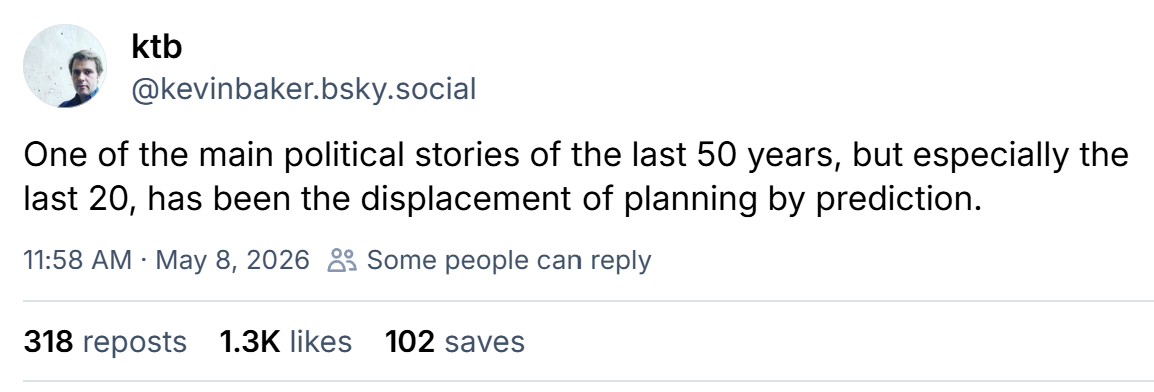
I started thinking about all of this thanks to this post, which speaks to at least some of where this magic button idea stems from. Across my lifetime — and especially since the Obama agenda was stymied by Republicans in Congress — too many people across the entire spectrum of the American left have been trapped by a sort of self-defeating knowledge. If we try to do something, Republicans will get in the way, and if they do, Democrats will cave, so why try to begin with. Versions of this idea, adjusted for one's politics, can be found in discussions among leftists, among technocrats, among centrists, and the end result is always that the fact of knowing how this will probably end means that the act of trying is pointless.
And, yes, I, too, can point to dozens of times when the above pattern played out, but I'm not sure that means the act of trying was pointless. Much of this is informed for me by the fact that I grew up in evangelical Christianity at a time when it seemed to my various compatriots like the United States was slipping further into hedonism. Yet that experience was rarely greeted by "Oh, well, we should probably just keep to ourselves!" Instead, an entire political project was launched that took decades to reach fruition but has more or less succeeded. So what would that look like for the left? What would it look like to have plans and keep pushing forward with them, regardless of failure, rather than assuming failure's inevitability?
Well, it might look like realizing that there's no magic button, but you have had the capacity to escape the maze all along, to gain a better vantage point on the trap that binds you. Will that solve every problem? No. But it might let you better see the places where you can actually start to make a difference. And the more people who do that, the more the world will start to change, little by little, a gradual transition that might feel like it takes too long, until you wake up one morning and find that you live somewhere else, somewhere better.
A Good Song
The free edition of Episodes, which (usually) covers classic TV and film, is published every other Wednesday. Premium subscribers get newsletters every Monday, Tuesday, Wednesday, and Friday. Our editor-in-chief is Emily St. James, and our managing editor is Lily Osler. If you have suggested topics, please reply to the email version of this newsletter or comment (if you are a paid subscriber).