How to make a movie with John Wilson
Carolyn Wang — making their Episodes debut! — on what makes John Wilson's films humane in an age of artificiality.

In case you haven't heard, Episodes is publishing freelance pitches again! Today's is by cultural critic Carolyn Wang. If you're interested in writing for Episodes, here's a pitch guide — we'd love to hear from you.
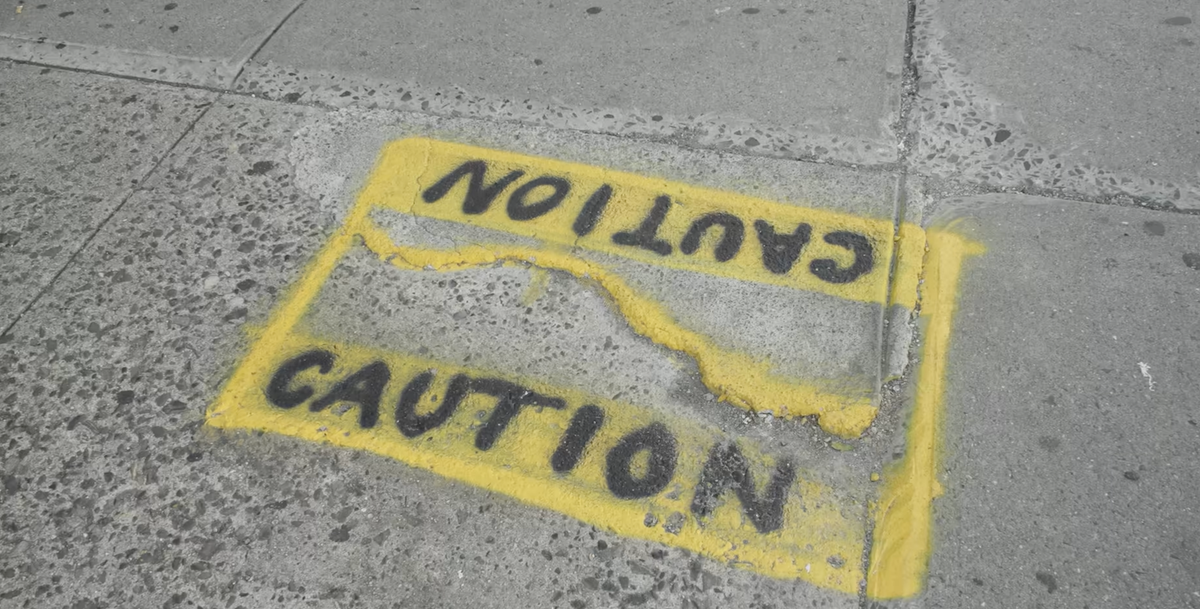
Concrete may seem like an unusual subject for a feature film, but to comedian-documentarian John Wilson, there’s nothing more fascinating than the pedestrian.
In his HBO show How To with John Wilson, Wilson described how to perform mundane tasks: how to make small talk, how to appreciate wine, how to throw out old batteries. In his new film, The History of Concrete, he takes on the challenge of documenting the most boring subject he can think of. Concrete, he observes, is everywhere: sidewalks, skate parks, highways, housing developments, fast food restaurants, public pools, and even (prospectively) on the moon. But the more we see it, the less we think about it, even as it comprises so much of our public infrastructure and our global carbon emissions.
In order to help us understand what concrete is and what it’s used for, Wilson pieces together a dizzying collage of narrative plotlines, all unified by their relationship to concrete: the crumbling infrastructure of the Brooklyn–Queens Expressway, a bricklaying competition at a concrete convention in Texas, transcendentalist ultramarathoners running a 3,100 mile race around a high school in Queens. In its ubiquity, concrete proves to be a remarkably organic and elastic metaphor. It comes to encapsulate a wide range of themes, including artistic creation, political stability, environmental degradation, and the impermanence of human existence.
Looming over The History of Concrete, however, is the threat of a world that no longer needs Wilson’s films. In a metatextual turn, Wilson spends much of the film’s runtime trying to finance the very film you're watching. While he is routinely approached with offers to direct commercials, his attempt to make an original film is met by investors with indifference and bemusement. In The History of Concrete, the only thing more ubiquitous than concrete is the profit motive. In Wilson’s failure to secure financing, the film underscores the existential dread of making art in an industry actively invested in rendering human labor obsolete.
Indeed, Wilson’s ideas may seem odd to investors, but The History of Concrete suggests that those investors' own logic is no less bizarre. From an inexplicable offer to finance the film only if it features a prominent musical act to the non-disparagement clause he signs at a concrete convention to “not portray concrete in a negative light,” Wilson exposes the absurdity inherent in making art in a capitalist world that seeks to reduce everything to its profitability. The film indicts a system where art is made in service of capital, artists are subjugated to arbitrary market forces, and the media industry treats its viewers first and foremost as consumers.
In an ironic attempt to make his project more appealing, Wilson attends a workshop hosted by the Writers Guild during the 2023 strike, where he learns how to write a Hallmark movie. He then decides to apply these techniques to his own film. Of course, Wilson’s takes on these formulas turn out unmistakably him: His version of the “ambitious, big-city girl” character is an aspiring rock star who works at a liquor store. But the film points out that these rules govern so much of the content that people consume. The workshop encourages writers not to mention money or financial difficulties in their Hallmark movies, and Wilson criticizes a representative example for smoothing over the political friction of the affordable housing debate and neutering the film’s social commentary.
In its comprehensive overview of late-stage capitalism, The History of Concrete is a reminder that the commodification of storytelling long precedes the advent of generative AI. But generative AI accelerates that process, automating the production of cultural content that serves a commercial and political agenda. By extending the artifice of a Hollywood production to a digital unreality, AI image generators covertly advertise political ideologies by “capturing” objects, people, and places that do not exist. Likewise, in automating the seemingly mechanical tasks of information retrieval and synthesis, AI chatbots and other LLM interfaces rely on probabilistic models that create the illusion of inherent semantic meaning while reproducing the political rhetoric of the institutions that created them.
The History of Concrete can't escape AI's encroachment. At one point, Wilson discovers an Instagram ad that uses an AI-generated imitation of his voice to sell gutters. The ad plays like a parody of Wilson’s artistic approach: the idiosyncratic creator finds himself pushing an unbelievably mundane product. This uncanny moment of technological capture reappropriates Wilson’s voice, literally and figuratively.
Texts without authors, images without subjects, and symbols without referents: Generative AI realizes a capitalist vision where artists are no longer necessary for the production of cultural work. Such technology clearly puts independent creators like Wilson at risk. These days, if you wanted to learn about the history of concrete, you wouldn’t have to watch a 101-minute documentary; you could ask ChatGPT, Gemini, or any large language model.
But would ChatGPT’s history of concrete retain Wilson’s acute critique of late-stage capitalism? And would its narrative be so wondrous and strange?
In The History of Concrete, Wilson draws on the visual style of How To with John Wilson, and part of what makes Wilson’s filmmaking in any medium so entertaining is his treasure trove of unusual footage. Throughout the episodes of How To, he intersperses his primary narrative with visually arresting montages of B-roll footage captured in New York: a woman grabbing a pigeon and stuffing it in a bag, a man wearing a dog as a hat, Kyle Maclachlan trying and failing to swipe his Metrocard.
His emphasis on visual storytelling serves as a refreshing departure from the second-screen storytelling that dominates streaming service content, where showrunners assume (often correctly) that most viewers are not paying attention to their shows. In typical streaming fare, the goal is to remind the viewer what’s happening on their secondary screen (the television) with expository dialogue without distracting them from their primary screen (their cell phone or computer). Such content trains the viewer not to engage with the work (let alone its political implications) and exacerbates the decreased attention spans, lowered literacy rates, and decline of critical thinking associated with a post-AI, postliterate present.
Casually watching Wilson’s show, though, is like listening to a Buster Keaton gag. During his montages, Wilson delivers a running stream of commentary over strange images as he reflects on how they connect to his central subject. But his voiceover rarely describes what the viewer is literally seeing. If you look away from the screen, you won’t even realize that you’re missing the joke.
Consider this sequence from Season 1, where Wilson tries to use the memory palace technique to remember his shopping list. In this scene, Wilson documents his commute to work while panning to objects that remind him of his groceries. Now, if the viewer “watches” the show without looking, all they hear is Wilson reciting a list of unremarkable items: “When I get on the subway, I’m reminded of the fresh baguette that I want — and the dandruff shampoo that I also need.” However, if they watch the footage, they are confronted with the comedic delight of Wilson’s unusual representations: broccoli in the form of a fallen tree, chicken breasts as a female mannequin, acne cream as a car rolling over a jelly doughnut. Likewise, watched on mute, the sequence becomes a nonsensical stream of unrelated images.
Wilson’s syncopated, nasally narration infuses the footage with subjective meaning, transforming simple montages of raw footage into visual puns, sight gags, and unexpected metaphors for the human experience. Because the video and the audio are connected via Wilson’s associational logic, the cinematic text of the B-roll montage only makes sense when he explains what he’s thinking.

As Wilson defamiliarizes everyday objects, ideas, and behaviors, he disrupts the conventional chains of meaning that people use to automatically make sense of the world and encourages the viewer to think critically about what they perceive. Doing this interpretive work yields the show’s comedic rewards, and it reminds the viewer of the pleasure of exercising their critical judgment — a pleasure that's otherwise lost to automation.
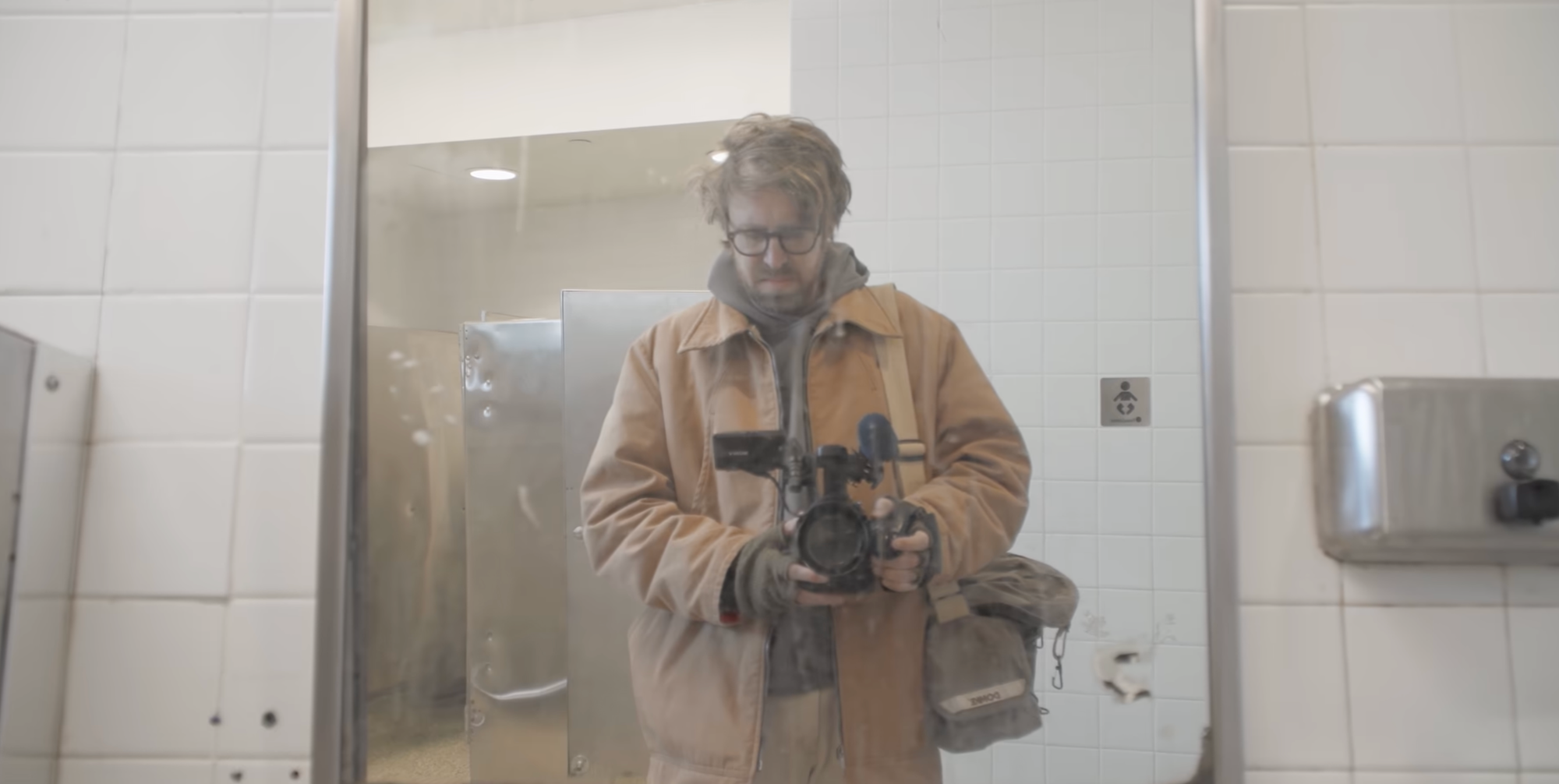
Moreover, Wilson employs a conspicuously tactile approach to documentary filmmaking. His handheld camera (clearly visible in reflective surfaces) always reminds you of his embodied presence. In his footage, he occupies the same physical space as his subjects, and that proximity leaves open the possibility of reciprocal exchange. Wilson is drawn to oddballs and eccentrics (and former New York City Mayor Eric Adams). Much of his work is motivated by his spontaneous encounters in the city: a vacuum cleaner enthusiast, an avid fan of James Camerson’s Avatar franchise, a reverse-circumcision activist.
In these encounters, How To reveals that ordinary people are more complicated — and more interesting — than they might initially seem. As Wilson follows these strangers into their subcultures and listens to them volunteer deeply intimate information about their lives, the dreaded awkwardness of these encounters becomes a feature — or, at least, a very funny bug. By documenting the world without assuming what it already looks like, he takes the vast, abstract possibilities of how humans might behave and makes them specific and concrete.
Wilson’s humanistic portraits help restore the meaning of social connection in a modern city characterized by loneliness and indifference. His documentation of everyday life pushes back against the anomie and alienation of social media algorithms and the hallucinatory precepts of generative AI technology. While large language models ape the explanatory function of documentary films, they remain a spectral technology, more capable of summarizing existing scholarship than inferring new conclusions from the world. Unlike Wilson, they are unable to encounter people’s strangeness on such an interpersonal level, and they cannot change and be changed in return.
In one revealing scene in The History of Concrete, Wilson interviews the man who owns GumBusters, a company that removes gum from concrete sidewalks. When I watched the film, as the owner pointed at black splotches in the sidewalk, I suddenly realized that I'd never considered what those commonplace marks really were: wads of chewing gum embedded in the concrete, degraded into tar-like substances. (Honestly, before this scene, I had hardly noticed them at all.)
By studying these marks in a typical drive-thru, Wilson deduces from the frequency of the spots that drivers tend to spit out their gum immediately before ordering, whereas passengers wait until they’ve picked up their orders to spit out their own. This reconstruction of human psychology startled me: What seemed like a part of the natural landscape actually reflected broader patterns of human behavior. When I exited the theater, I found myself reflexively scanning the pavement, newly cognizant of the marks people leave behind.
Like Wilson’s other work, The History of Concrete presents itself self-consciously as niche and anti-commercial, but the positive response the film has received speaks to a genuine appetite for thoughtful and idiosyncratic work. But of course, Wilson’s filmography doesn’t exist outside of the system it criticizes. In the end, its survival (and the production of similar films) depends on its continued ability to reach a moviegoing audience.
When I first pitched the film to my friends, they were less than enthused: As one of them explained, with confusion (and a little offense), “Who wants to watch a movie about concrete?” But they loved it — even a man who had once disclosed (without a trace of embarrassment) that he preferred watching AI-generated movie summaries to the movies themselves told me that The History of Concrete was his favorite movie of the year, by far.
His enthusiasm speaks to Wilson’s revelatory approach to storytelling. By focusing on the ordinary and the commonplace, Wilson works within a shared language. In a postliterate world, he proves that art doesn’t have to sacrifice cinematic pleasure for intellectual depth or vice versa. While Wilson’s unique style has amassed him a small but passionate fanbase, his work clearly has the potential for broader appeal. His formal innovations open up new possibilities for storytelling in a modern context, where films can entertain viewers without collapsing entirely into apolitical spectacle.
The challenge, then, is to get people in the room in the first place. Ultimately, the risk of generative AI is not just the immediate downsides of consuming AI slop, but also that it gradually undermines the general appetite for original and formally challenging work. Still, as Wilson’s documentaries observe, people are strange and unpredictable creatures. Despite the well-trodden insights of market research and the valiant efforts of targeted ad campaigns, they consistently behave against expectation and explanation. They dress their children like poultry; they write songs against circumcision; they run 3,100-mile races in the rain. They reveal deeply personal information to a complete stranger; they make art instead of making money. They even watch movies about concrete.
A Good Song
The free edition of Episodes is published every Monday and every other Wednesday. Premium subscribers get those newsletters, plus extra ones every Wednesday, Thursday, and Friday. Our editor-in-chief is Emily St. James, and our managing editor is Lily Osler. If you have suggested topics, please reply to the email version of this newsletter or comment (if you are a paid subscriber).