Is Coyote vs. ACME the perfect movie for the moment?
Also: Paranormal Activity on stage, the Furious finale, and a good comic about a cat.


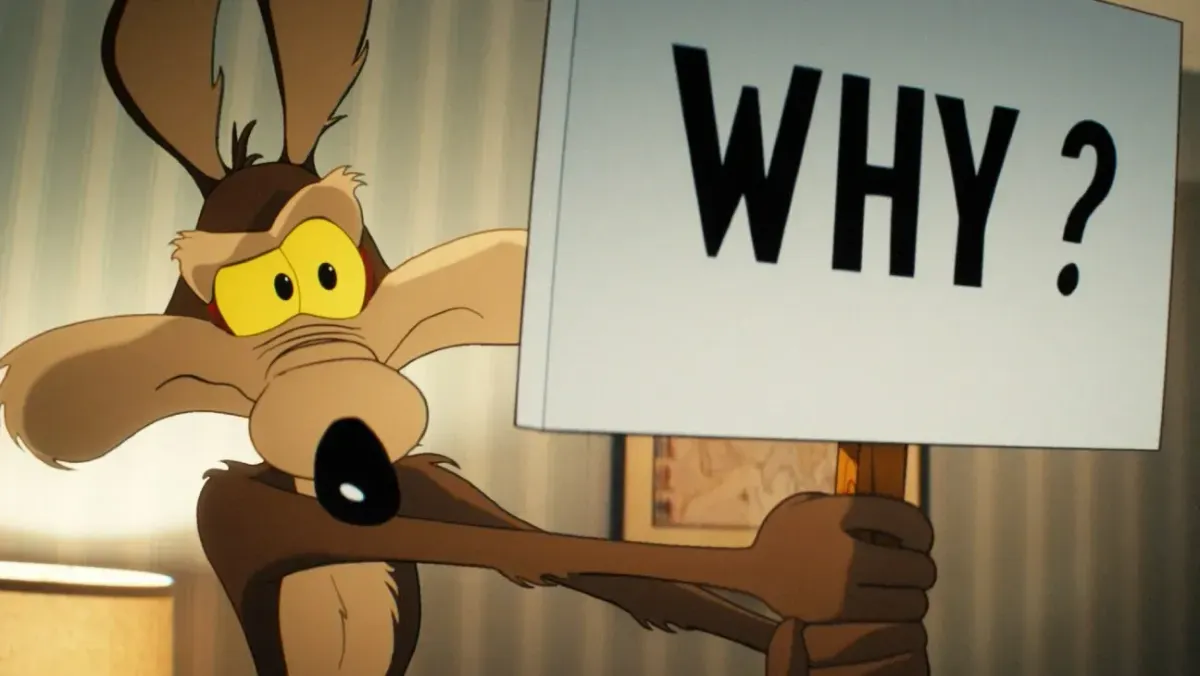
Happy Monday, Episodes pals! This week, we've got takes on Coyote vs. ACME and the Paranormal Activity stage show, as well as our usual collection of other bibs and bobs. Remember: If you subscribe, you'll get this newsletter in your inbox every Monday!
Coyote vs. ACME and the Sisyphean struggle of being alive right now
The other day, I realized I'm not doing so hot, mental-health-wise. My brain being what it is, I typically discover that it's in crisis only after the crisis has nearly passed, when some part of me is, like, it's weird you've stopped leaving the house, right? And sure enough, the moment of realization was enough to get me back on some sort of path toward equilibrium. But some combination of the uncertainty of life right now, raising a child in a world she doesn't realize is deeply fucked, and the usual everyday chaos has made me a little more on a knife's edge than I typically like to be.
Which is to say that I found the ending of Dave Green's Coyote vs. ACME deeply moving and perhaps even profound, but I think I was in exactly the right headspace to find it so. And yet lots of other people I've talked to or checked out the reviews of have said roughly the same. Isn't it neat that there's a movie that speaks to the ongoing dystopian corporate hell we find ourselves trapped in? And that it's about the Looney Tunes so it's got a lot of great slapstick?
I don't know if Coyote vs. ACME would have hit nearly as hard if it hadn't had to navigate its own corporate hell to make it to theaters. Famously, Warner Bros. tried to take the completed film and abandon it in favor of a tax write-off, before industry and (eventually) public outcry led the studio to look around for a distributor who would take the movie off their hands. It found one in Ketchup Entertainment, a company now mostly known for releasing Looney Tunes movies Warner Bros. abandoned. (It's done so twice!) The long, strange journey of the film to theaters ends up making its corporate satire feel more savage than it is because it's easy to read "gosh, David Zaslav must have incredibly thin skin!" backward from the movie's fairly anodyne "big companies often screw over the little guy" themes.
And yet big companies do often screw over the little guy! In a world where this movie came out during the Biden era, it probably would have been warmly received — it's quite funny, and the legal thriller plot is more involving than it needs to be for the movie to work. But so much of its seeming heft stems from how the characters' fight in court against ACME, the enormous corporation that seems to exclusively manufacture products that blow up in cartoons' faces, parallels our own quixotic attempts to tilt at the windmills of wealth consolidation and unchecked corporate greed. Like, ACME doesn't map cleanly onto Amazon or Apple or SpaceX or Meta, but that allows it to map onto all of them simultaneously.
The movie's "this is surprisingly touching" bona fides have been largely attributed to a late-in-film sequence where Wile E. Coyote and the Road Runner realize they are part of an inseparable dyad and, indeed, need each other. But I found even more moving the story's conclusion, wherein Wile E. races after the scrawny desert bird he inexplicably thirsts for, despite knowing, on some level, that he will never catch his prey. The point is not the result; the point is the chase. One must imagine Wile E. Coyote happy!
Anyway, lest I make this sound too heady, it's still a very silly movie full of slapstick gags and lots of great Looney Tunes easter eggs. Like when I put together just why there was a Carrot Festival in Albuquerque, I was over the moon, and I loved Will Forte — as the lazy lawyer who ends up representing Wile E. in court — saying, "Who is this?" suspiciously to a caller who says, "Ehhhh, what's up, Doc?" in an immediately recognizable voice.
As someone who bought Lana Condor stock after To All the Boys I've Loved Before, I wish her character had any point at all, but that's my main complaint. See it! Stick it to the man! Consumption is the true protest! —Emily St. James
Paranormal Activity brings the joys of found footage to the stage
My wife and I just got back from our annual-ish trip to New York — this time occasioned by two (2) different weddings in the city! — and, as usual, we wanted to take in a show or two while we were there. In honor of Tim Curry, of course, we saw the Rocky Horror Show revival that's currently at Studio 54; as we expected, it was phenomenal. Just as good, but less expectedly so: the new Paranormal Activity play at the August Wilson Theatre.
I wouldn't categorize myself as a Paranormal Activity (the franchise) hater, per se — I always have a pretty good time with the first movie in the series — but I don't see too much artistic value in it. Worse, I don't feel like the movies ever quite deliver on the promise of their premise. A found-footage movie set entirely in a house just like your own, one where every bump in the night is one you'll be thinking about as you lie awake in your own bedroom? Sounds terrifying! And yet Paranormal Activity (the film) is often boring, with thinly-drawn characters and scares that wear out their welcome quickly. There's only so much tension the premise can sustain.
Paranormal Activity (the play) fixes that by entirely ditching the trappings of the movie — the minimal dialogue, the untrained actors, all the things meant to make it feel realist — and allowing it to be very, very stagey. The whole thing, instead, is a melodramatic Gothic haunted-house yarn in the style of The Changeling or Burnt Offerings. Lou and James, newlyweds recently arrived in London, are hoping that the strange events that made their life in Chicago so unpleasant won't have followed them across the Atlantic. They have, of course, and in even greater magnitude. A company of lurking shadows hides out in their house's nursery, ready to possess any unfortunate soul who crosses their threshold. All the tensions in Lou and James' marriage — the question of whether to have kids, their trust in one another, all that good stuff — get worked out in increasingly fervent tones as the haunting escalates around them. It's classic stuff, it's executed well enough that it never feels old hat, and it bears truly no resemblance whatsoever to its source text.
The way Paranormal Activity, the play, earns its franchise stripes is in its staging. The play takes place entirely in a very elaborate set: a dollhouse-style cross-section of James and Lou's surprisingly spacious townhouse. The only door closed to us is, of course, the nursery at the top of the stairs. The lighting is entirely diegetic; a space is lit only if a character hits the switch and stays lit until they turn it off, creating a deeper sense of immersion and, crucially, giving audience members a naturalistic guide for where they should be hunting for things that look not quite right.
What makes a great found-footage movie work is that it puts the burden of looking for the uncanny on its audience. The in-universe filmmakers, at least for a while, aren't aware they're in a scary movie; you are forced into a position of frightening empathy with them as you review the footage alongside them, looking for things that are out of place. Paranormal Activity on Broadway has a few very stagey jump-scares, but most of its horror comes from that same well: watching and waiting. This time, though, the audience is more than just the onlooker watching over the character's shoulder. We are the camera itself. It's a staging choice that makes a concept as hokey and played-out as found footage feel profoundly new. Go see it if you're in town!! —Lily Osler
Buy Emily's It's a Wonderful Life book!
Believe it or not, we're less than a month away from the publication of Every Time a Bell Rings, the book about It's a Wonderful Life that I cowrote with Defector's Lauren Theisen! It is — I say with some pride — a very strange book that is less a making-of or a historical document and more an attempt to consider the film from a variety of angles, major character by major character. There are essays about World War II PTSD, whether Bedford Falls had any gays in it, and Donna Reed's impossible standard for womanhood. Buy it today, and if you're in Los Angeles, come to our launch event at Village Well in Culver City! —ESJ
A good comic about a cat
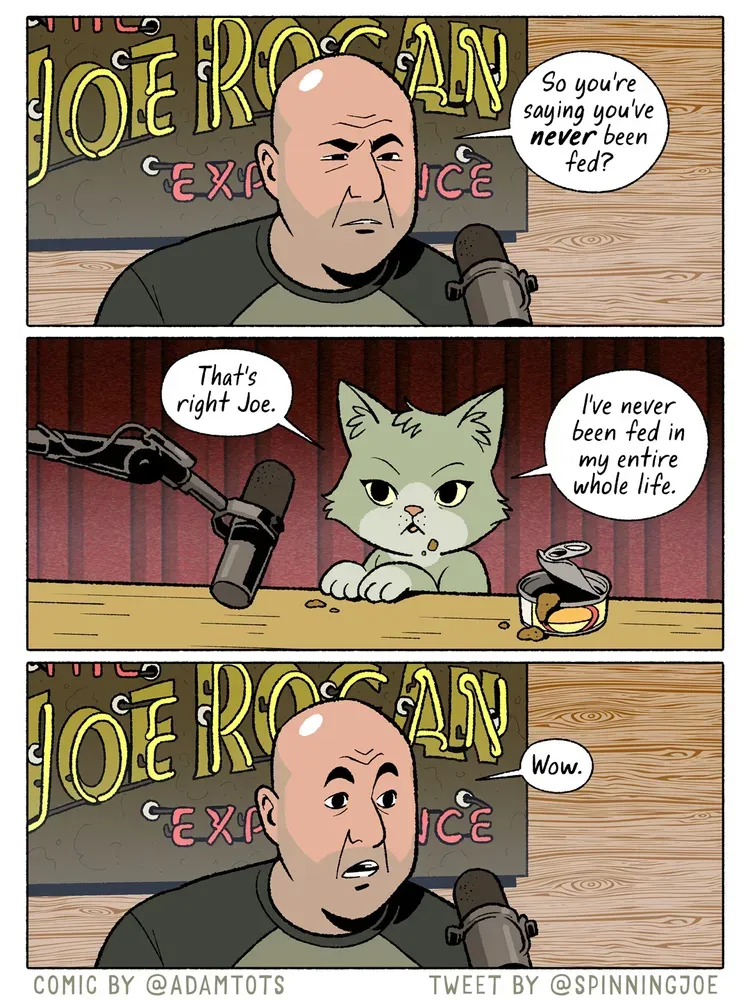
(From here.)
Some pop culture things we're into
- Furious has one of those finales that will inevitably play differently in retrospect. It seemingly sets up a new status quo that will separate it from all of the other "case a season" shows, and that new status quo is one that sets up a particularly treacherous high-wire path for the show to follow in future seasons. And yet after New Girl, The Dropout, and Dying for Sex, I've realized I implicitly trust Liz Meriweather to figure it out. She might be my favorite showrunner currently working (non-Emily's bosses division). The Furious finale perhaps ended up being a little more "and that's how that resolves" than the rest of the show, which was frequently baroque and strange, but that's the job of a mystery finale often. And it was worth it all for the scene where Catherine finally confronts her core trauma. —ESJ
- It's time for another "Did you know Emily has a child?" blurb because we're continuing to delve into the world of age-appropriate chapter books, and I cannot get enough of Annie Barrows and Sophia Blackall's Stella and Marigold series, about a pair of rambunctious, imaginative sisters living in the Philadelphia area. Are they reskins of Beezus and Ramona Quimby? Somewhat. But their relationship is less contentious, and Barrows has really thought through how versions of Beezus and Ramona who were alive right now might behave differently from Beverly Cleary's originals. The books also make my kid laugh, which, as she is my kid, is a tall order. —ESJ
- We're about to launch a look at all of Guillermo Del Toro's 2000s films on Podcast Like It's..., and revisiting his 2001 movie The Devil's Backbone was a great reminder of why it's always been my favorite of his. Del Toro has long understood that ghost stories need to have one or two good scares, sure, but they gain so much more of their power from an overwhelming sense of melancholy, an understanding he puts to great use in this film. Plus, it has one of the all-time great ghost designs. If you haven't seen it, it's a great one to check out this spooky season. —ESJ
- I am not a hard rock girlie, but a friend turned me on to Die Spitz, and I have to admit they're extremely my shit. If you like girls yelling, can I recommend them? —ESJ
- I mentioned it above, but the Rocky Horror Show currently on Broadway really is phenomenal, and tickets up in the nosebleeds are much more affordable than you might expect given how recently Tim Curry passed away. The way the production team has dressed up Studio 54 for the play is worth the price of admission on its own. —LO
- One fun thing about being in New York is all the bookstores. Another is all the time you spend on the subway getting to those bookstores — time, as it turns out, you can spend reading those books! Sara and I hit up The Twisted Spine, a new (and very Instargrammable) horror-specific bookstore in Williamsburg, and they had plenty of selections for people who aren't horror-lit superfans like myself: I wound up picking up Ursula K. Le Guin's The Word for World Is Forest and Daniel Kraus' Whalefall. Brief thoughts on those two below!
- The Word for World Is Forest has always been described to me as Le Guin at her most prescriptive, least subtle, bluntest, etc. And all of that is true! But, also, this is a gut-wrenching book about slavery, rape, and the depredations of colonialism written in the midst of the Vietnam War; I think a blunt style might just be what's needed here. Great, very upsetting book.
- Whalefall was a novel I didn't think would be quite so (implicitly) about gender dysphoria?? But that definitely made its coming-of-age narrative far fresher! I do not think I would like to be swallowed by a whale. —LO
Let's watch Bluey discover she lacks free will, shall we?
Last week in Episodes...
- We commemorated the life of Dolly Parton with a whole host of her greatest covers.
- Emily took us back into It's a Wonderful Life to explore the way that it confronts a deadly pandemic that has (mostly) been left out of the arts and culture that have endured from the first half of the 20th century.
For as many times as I've seen this movie, I had never quite clocked that George's encounter with Mr. Gower as a young man almost certainly nods to the Spanish flu. Some of that is because George is still a child and, thus, less tapped into world events than he will be as an adult. But even more of it is the fact that as time has worn on, the Spanish flu has receded in the collective memory until it has become almost buried underneath the weight of World War I depictions.
- Our Infinite Jest book club got to a part with a guy who murders a lot of pets – but it was some of the best stuff in the book so far!
- And Emily tackled the different ways that two of the summer's biggest indie movie hits – The Invite and Obsession – invite the heterosexuals in our midst to consider questions of just who's at fault in relationships going stale or even toxic.
A couple of weeks into Obsession's historic box-office run, one where it made more money in its second weekend than its first, then more in its third weekend than its second, box office analysts noted that the film had crossed over with audiences who don't normally see studio pictures, especially older ones. Why had this happened? Well, the movie gave straight couples something to argue about: Who is the true villain of Obsession?
In the week to come, Emily will look at Atlanta for her 26 Episodes series! If you want to check out all of this content, plus so much more, please become a paid subscriber by clicking the button below!
Discuss
Who's your favorite Looney Tune, and why is it Marc Antony, the big bulldog who adopts the little kitten in "Feed the Kitty"? Tell us in comments or the Discord!
Some good links
- The Game That RUINED a Genre (but not really) [OneShortEye]
- Welcome to the Indie Game Talk Club [Indie Game Reading Club]
- Trans athletes never took over women's sports. So why is the WNBA in an uproar? [San Francisco Chronicle]
- How the adult swim pirate ship set sail [Inverse]
- An Interview With A Biographer Of Renée Richards, An Actual Trans Athlete [Defector]
A Good Song
The free edition of Episodes is published every Monday and every other Wednesday. Premium subscribers get those newsletters, plus extra ones every Tuesday, Wednesday, and Friday. Our editor-in-chief is Emily St. James, and our managing editor is Lily Osler. If you have suggested topics, please reply to the email version of this newsletter or comment (if you are a paid subscriber).