The new Great American Novels: 9 books from the Trump era that earn the title
Some great reads that will help you understand America at 250.



As a concept, the so-called Great American Novel speaks to a great many things: our nation's desire for a specific cultural identity, our generalized anxieties around not having as significant or storied a past as many other countries, our desire to shout, "USA! USA! USA!" at various opportunities, etc. Yet it's also served as a useful organizing principle for American literature, and many, many, many great American novelists have tried their hand at writing just such a thing.
Generally, the "Great American Novel" is considered to be a book by an American writer that speaks to a certain quality of Americanness, usually by exploring the good, bad, and (especially) complicated of living in a country that has such a messy, checkered past. It also often takes a long time for a book to cement itself as just such a classic: Moby-Dick was published in the 1850s but didn't cement itself as a classic until the 20th century, for instance.
Well, what if it didn't take a long time? What if the staff of Episodes were the people to determine just such a thing? Here are nine titles from the Donald Trump era (roughly 2015 to present) that we think might someday qualify as Great American Novels. For the most part, they're already hugely acclaimed; there won't be many big surprises on our list. But they're all worth reading and grappling with in this, our 250th summer as a country.
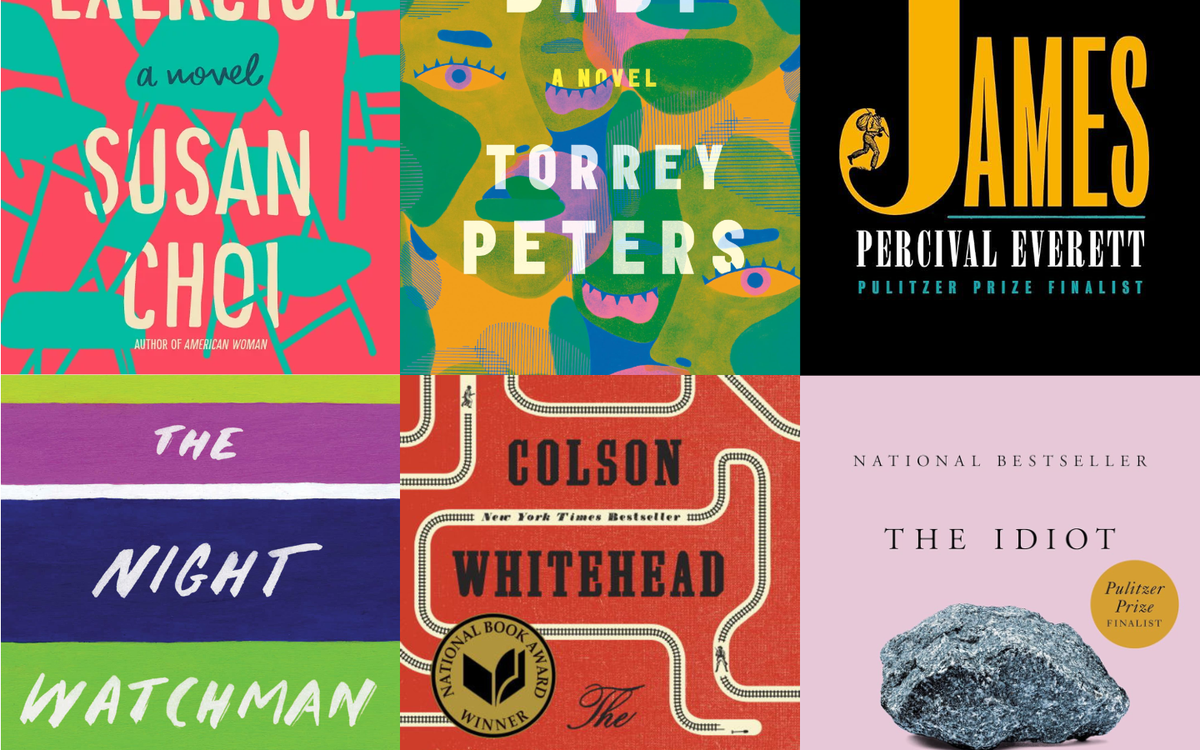
The Underground Railroad (Colson Whitehead, 2016)
An almost instant classic that won the Pulitzer for fiction, Whitehead's keen blending of historical fact, historical fiction, and the slightest touch of speculative fiction resulted in one of the most acclaimed novels of the century to date.
Following Cora, an escaped slave in pre-Civil War America, the novel begins with a brutal depiction of slavery's evils before sending Cora onto the famed Underground Railroad between the southern slave states and the northern free states (and, eventually, Canada). Whitehead's big conceit is the idea that the Underground Railroad wasn't just a series of waystations and hiding places on the route north but, rather, an actual, literal railroad running beneath the surface of the Earth. As the book continues, Cora's progress northward also carries her metaphorically forward in time, to examine the United States' continued exploitation of Black Americans. And all the while, a slave catcher is after her.
Whitehead has often blended literary fiction and genre fiction in unexpected ways, most notably his 2011 novel Zone One, which is a gorgeously written zombie novel. The danger of blending such modes is always the fantastical stepping on life's mundane horrors, but Underground Railroad only grows more pointed the more unusual it becomes. Whitehead's core notion uncovers how little the United States has truly reckoned with the legacy of slavery and institutional racism, a theme that's only grown more prescient with every passing year. –Emily St. James
Problems (Jade Sharma, 2016)
There were two big emotions I felt after reading this book: 1) a deep sadness that this is the only book by Jade Sharma, who died in 2019, that will ever exist; and 2) an equally deep gratitude that this book does exist, and that we get to read it. Problems follows Maya, a young woman in New York City scraping by on a troubled relationship, a boring bookstore job, and a just-barely-controlled heroin habit. While the book is fairly plotless, Maya’s voice is impossible to ignore – she is at once wise and petty, sarcastic and tender, and above all, rattlingly clear-eyed about her own self-destruction.
I see the influence of this voice, this particular narrative stance, in so many literary moments of the past decade, from the autofiction boom to the NYC alt-lit scene to the “unhinged women” BookTok trend. But what sets Sharma apart from all her many imitators is the complete commitment with which she wrote this book, her defiant mark on twenty-first century literature. I only wish she were still here to see how far and wide her singular voice has carried. —Olivia Wood
The Idiot (Elif Batuman, 2017)
I’ve reread The Idiot, Elif Batuman’s erudite and hilarious campus novel following a Harvard freshman named Selin in the 1990s, more than perhaps any other novel, and I always laugh out loud when I get to the final line: “I hadn’t learned anything at all.” To me, this is the book’s rueful thesis statement, a summary of all Selin’s tragicomic attempts to connect with her fellow students while stumbling her way towards some kind of epiphany. For all the knowledge that Selin gains and discards over the course of her first year in college, all the social interactions she muddles through and picks apart later, she ultimately comes away with nothing but a hard-won awareness of how ridiculous it is to pursue the life of the mind.
The Idiot itself, however, remains a joyously rich source of wisdom, an examination of the folly of youth that is playful instead of punishing, and a reminder that the passage of time alone is enough to make our prior selves the kinds of people who can only be greeted with laughter. —OW
Trust Exercise (Susan Choi, 2019)
The complicated legacy of the #MeToo movement in the arts has been a number of bad actors driven out of show business (most only temporarily), a handful of industry initiatives that mostly turned out to be hot air, and a lot of overdetermined art, dead set on making An Important Point. Trust Exercise, Choi's slippery National Book Award winner, now seems like the definitive #MeToo novel, largely because Choi wrote it not in response to that movement but, rather, in response to the rise of Donald Trump in general. It's a book about the power imbalances between men and women, the ways in which fiction blunts reality, and the risk of ever trying to remember the past accurately.
Trust Exercise is also the kind of book that gains a lot of its power from being read knowing as little about it as possible. Suffice to say, it's about Susan and David, two students at a performing arts high school in an unspecified US city that is not a cultural capital. A complicated relationship develops between the two, and then...
Trust Exercise swerves and twists in the manner of a great literary thriller, and yet not much happens in it. The swerving and twisting is largely metatextual, as the reader wonders if Choi can land any of the planes she's set off on their flight. Then, she sets another plane aloft. And a zeppelin. It's a bravura piece of writing that will leave you desperately wanting to chat about it with someone, anyone. –ESJ
The Topeka School (Ben Lerner, 2019)
The jump in quality between Ben Lerner’s first two novels, Leaving the Atocha Station and 10:04, and his third, The Topeka School, is so staggering that it actually made me angry when I read all three back to back. And this is saying something, because those first two books are really good!
But where Atocha Station and 10:04 are pretty standard, if excellent, autofiction — light on plot, heavy on introspection, overtly conscious of their narrator’s neuroses on the page — The Topeka School kicks up into a higher gear. It is a big, rich, satisfying novel, replete with the sorts of classic moves that tend to mark American literary ambition: polyvocality, non-chronological storytelling, complicated local and familial histories, side plots that spin out into their own pocket dramas. It takes the rigorous practice of self-examination at the heart of good autofiction and applies it to America as a whole, which sounds like an exercise in pretension but is instead shocking, beautiful, and profound. I don’t know how Lerner pulled it off, but I’m glad that he did. —OW
The Night Watchman (Louise Erdrich, 2020)
I read The Night Watchman for a class on novel structures in the first year of my MFA in which virtually every novel had some kind of organizing gambit: a braided narrative, a linked collection of stories, that sort of thing. What struck me about The Night Watchman in that class, and what has stayed with me as its most interesting idea, is how thoroughly it resists any kind of structure.
The book moves (mostly) linearly through time, but, otherwise, it uses its pair of main narratives — titular night watchman Thomas' efforts to stop the federal government from dissolving his tribe and reservation and his niece Patrice's hunt for a missing family member in Minneapolis — as a jumping-off point for a sprawling narrative about the Turtle Mountain Band of Chippewa writ large. You'll get a chapter about the smell of printer fluid, then a passage about two horses having sex, then a gorgeously written omniscient-voice section structured as a prayer for the coming year. Its plots don't follow the structure you'd come to assume, either: Patrice's journey, which seemed like the book's central conflict, is in fact over by the novel's midpoint.
That sprawl and sense of roaming is far from a problem, though. Rather, it's the point of the novel, which is largely about the ways Native identity, and Turtle Mountain Ojibwe identity specifically, resists the atomizing forces of American colonialism. The Turtle Mountain Band are a community; their stories belong together. In breaking apart the expected structure of a novel, Erdrich creates something warm, enveloping, and entirely unique. —LO
Detransition, Baby (Torrey Peters, 2021)
Now that the waves of discourse that followed Detransition, Baby's release have finally begun to quiet a bit, can we talk about what a precisely and intricately crafted novel this is? I can take or leave the parts of it that read like Peters putting her own pet theories for Why Queer Communities Are Like This into her characters' mouths (see: the baby elephants analogy that was subject of so much of said discourse), but the actual book beneath those theories is one of the more exquisitely put-together pieces of contemporary literary fiction I've read.
As a writer, I'm especially in awe of the skill with which Peters uses an organizing metaphor. Reese's fixation on the Wim Hof method as a proxy for her desire to dissociate is both wrenching and subtle, never feeling too on-the-nose while simultaneously recontextualizing the way that I see dissociation in my everyday life. The same is true of how Peters treats Ames's titular detransition: It's specific and personal even as it's also a potent metaphor for the ways queer progress and self-acceptance, especially in contemporary America, can be far less linear than we'd hope. And I kind of have to mention the scene at crossdressing emporium Glamour Boutique, which is the obvious centerpiece of the book, a metonym for many of its ideas about trans acceptance in America, and a quiet, painful moment rooted entirely in Ames's conflicted emotions about their own gender and sexuality.
Torrey Peters can use her books to make discourse-y arguments all she likes; the fact remains that she's a rare talent whose first novel will shape American queer literature for decades to come. —Lily Osler
James (Percival Everett, 2024)
Mark Twain's The Adventures of Huckleberry Finn pops up on lists of Great American Novels more often than not, so it only makes sense that this hugely acclaimed companion piece – the rare winner of both the National Book Award and the Pulitzer – would too. The always adventurous Everett, who has always flitted among genres and pulled apart the underpinnings of the novel across his incredibly prolific career, reimagines Twain's book from the perspective of Jim/James, the runaway slave that Huck sails down the Mississippi alongside.
Everett does more than "just" retell Huckleberry Finn from a different perspective, using his version of the story to complicate and recontextualize various moments and characters from the earlier book, including coming up with new turns in the plot wholesale. And every time Huck and Jim are separated in the original book, Everett comes up with new adventures for James that are Twain-esque while always exploring some new, inhumane aspect of the period.
The strongest thing about Twain's book is how its child's perspective allows for a knowing irony to creep in, so an adult reader comes to understand just how much Huck isn't seeing. Everett doesn't entirely lose that sense of irony – there are things someone with a modern perspective will know about the history James will live through that he necessarily cannot – but he underscores the original book's tragic core by giving full voice to James's rich interiority, never pretending to elevate Twain but, rather, to intertwine with his voice, to suggest how thoroughly bound up in each other these two Americas truly are. –ESJ
The Buffalo Hunter Hunter (Stephen Graham Jones, 2025)
One of the biggest literary stories of the last 10 years has been the ascendancy of literary horror, and at the forefront of that ascendancy has been Stephen Graham Jones, whose 2020 novel The Only Good Indians was a major force behind the genre's rise. I've liked everything Jones has written since that breakout hit, but The Buffalo Hunter Hunter is both the scariest and the most astute about America writ large.
What I find most interesting about The Buffalo Hunter Hunter is the way its nested stories escape their bounds and bleed in the future. Pastor Beaucarne, the 19th century Lutheran minister whose writings make up the bulk of the novel, assumes at first that the vampire narrative he's hearing from Good Stab, his Blackfeet interlocutor, is fictional; even when he comes to believe Good Stab, though, he's in denial about his own monstrous role in Good Stab's story. But the sins of the past always break through the skin of the present. Just as Good Stab has to live forever with the consequences of Beaucarne's actions, so too do Beaucarne and his present-day descendant Etsy have to endure Good Stab's vengeance.
The great sin of America, Buffalo Hunter Hunter argues, is willful forgetting, the capacity to act like everything is okay even in the wake of murder and genocide. It's a theme that seems unnervingly apt these days, and Jones delivers it with uncommon style. —LO
A Good Song
The free edition of Episodes, which (usually) covers classic TV and film, is published every other Wednesday. Premium subscribers get newsletters every Monday, Tuesday, Wednesday, and Friday. Our editor-in-chief is Emily St. James, and our managing editor is Lily Osler. If you have suggested topics, please reply to the email version of this newsletter or comment (if you are a paid subscriber).