Want a romcom that goes to some very real, complicated places? Try Girl Next Door.
Rachel Meredith, author of Emily's favorite romance novel of 2025, discusses wedding ridiculous premises to real psychological heft.

Anyone who's read this newsletter for any length of time knows I'm fascinated by romance fiction. Yet for as much as I love romance novels and romcoms, I always find myself bumping up against the ways that the very normal, realistic darkness of real life has to be kept at a remove or so over-indulged in that the book tilts over into a subgenre like "dark romance." In our world, people fall in love in less-than-ideal circumstances all the time, they forgive each other for great sins, and they manage to figure things out. Thus, whenever I find a romance that deals with these harder topics in a manner befitting how they might play out in reality, I tend to fall in love with it deeply.
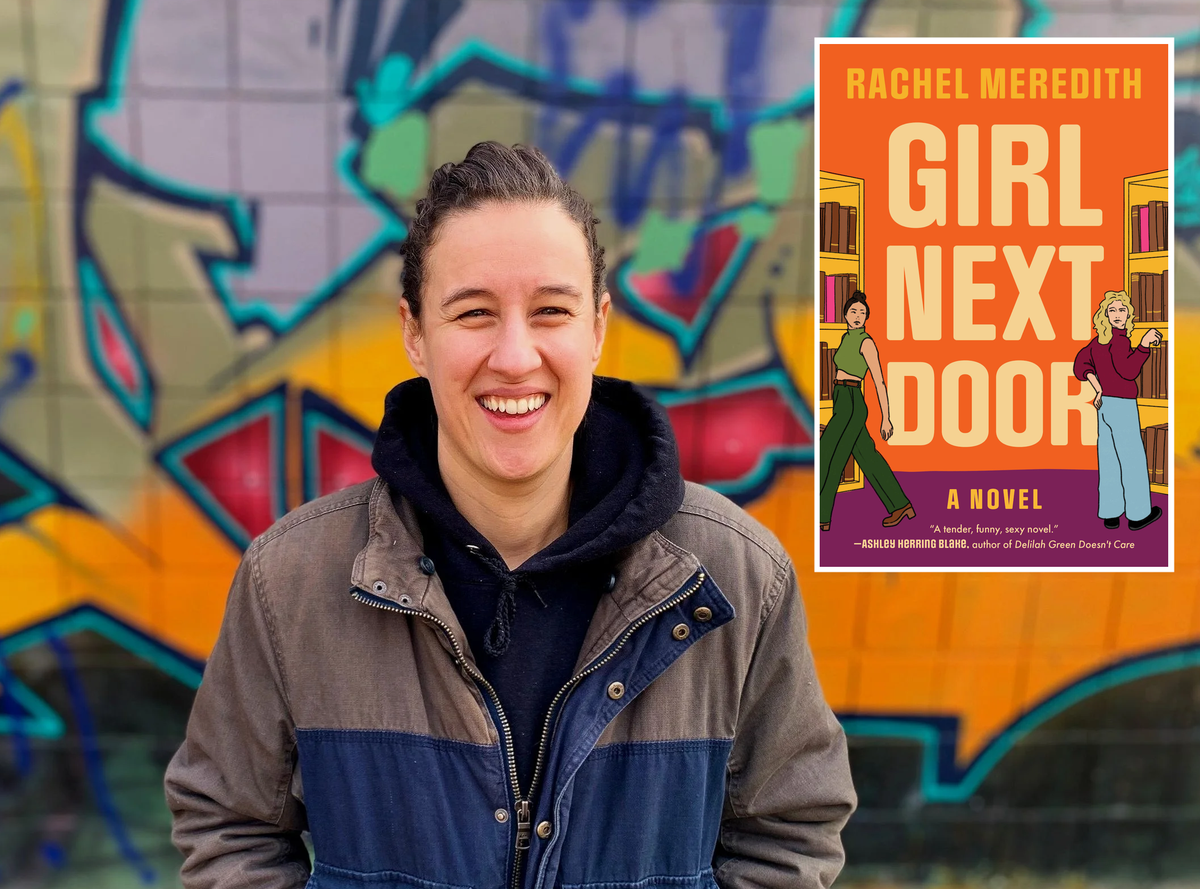
So it was with Rachel Meredith's 2025 novel Girl Next Door, which weds an absolutely absurd "could only happen in a movie" premise to a serious consideration of the ways in which our teenage selves might be let down by the adults we become, the raw pain of infidelity, and the destructive secrets that can end relationships before they begin.
In it, MC (Mischa Celeste, but also main character, haha) works as a struggling writer in New York, just barely keeping her head above water until the assignment of a lifetime falls into her lap. The country's best-selling book is a thinly disguised roman à clef about MC's tumultuous will-they/won't-they with Nora, the titular girl next door from MC's teenage years who wrote said best-selling novel under a pseudonym. The only problem is that MC had absolutely no idea Nora was into her. MC heads back to her hometown under false pretenses to get to the bottom of Nora's story — and eventually publish the first ever magazine profile of this deeply secretive best-selling author.
That sounds absolutely unhinged, right? It is absolutely unhinged. But Meredith thinks through all of the ways real people might react to this "only in a movie" scenario, imbuing both MC and Nora with a perspective on this situation and making sure that the secrets they're keeping from each other have a real gravity to them. What's more, in the book's second half, Meredith completely blows up her own premise far earlier than expected to figure out if two people who built something atop the lies they told each other can still function as a couple once those lies are out in the open. Also, there's a pretty major subplot about a character cheating on his wife that pops up all the time in the novel's Goodreads reviews as a reason not to read the book that I, nonetheless, loved for how grounding it was for the novel's other flights of fancy.
Naturally, I wanted to talk to Meredith about her book, about treating ridiculous premises with psychological realism, and about the humor inherent in sex scenes. Our conversation has been edited for length and clarity.
The premise of your book is pretty wild, and it's the sort of thing that probably wouldn't happen. But you treat everything with real emotional seriousness and stakes. How did you approach that idea of treating something that would only happen in a movie with psychological realness?
The main plot started out as a side plot in another book that I was trying to write that was more outlandish. I thought it would be a funny side story that this character's neighbor has written a book in which she's actually one of the main characters, and it's kind of an unflattering portrayal. Then when I ended up doing this as a romcom, as something I would consider genre fiction, I decided to lean into it. I was thinking about what a romcom really is in its spirit, and contrast is a big part of it for me. So I wanted to contrast this very absurd premise with an incredibly ground-level view of some twentysomethings living in New York City or the suburbs and trying to figure out what their lives are. I really like bringing the high and the low together. I find something funny in that.
What was the original version of this book like before you spun it off into this version?
I had this idea that it was going to be about a father-daughter relationship, about a girl whose dad was an eccentric and an asshole when she was a teenager. Then he gets hit by lightning, and his whole personality changes and he becomes an incredibly nice person. It was a comedy about how she's so mad at him now that he's super, super nice. Then he becomes a cult leader and starts telling people to go get hit by lightning to solve all their problems.
I got about halfway through it, and I couldn't get the tone to stick. But I kept being drawn to the B-plot with the next-door neighbor who's a big curmudgeon who discovers the father after he's hit by lightning and brings him to the hospital. The more I wrote the romance between the main character and her, all I wanted to do was bring the two of them together, and I became less interested in the father-daughter relationship. I'm still interested in it, but maybe I'll just go back to it at a later point in my life.
The book hits all the plot points of a romance, but it's structured a bit oddly – like the third-act breakup happens at the end of act two. It's disjointed in a way I really appreciate. When you started to delve into these characters' psychology more, did that drive you to shift around some of those romcom beats more too?
The structure of the book went through a lot of revisions, but the idea of the reveal moment that blows up the premise of the book happening earlier than you're expecting was a decision I made very early on. I set up an intense concept where either the main character makes a choice that has horrible repercussions or she doesn't. If she didn't make that choice, it would be boring, but because she made the choice, I needed to give her and everyone else a lot of time to recover from it. So I actually think of the book as having a five-act structure. I'm no expert on acts and structures, but in my understanding, I wanted to work with something that had a longer stretch in terms of high points and low points. In terms of the length of a novel, having more of an up-and-down story along the way created a certain momentum and suspense that I like to see in books, especially books I'd read by other authors around big moral questions.
The psychology I was really interested in was feeling aimless, feeling like a loser, and the ways in which romance rescues you from that and thrills you. It's this accessible experience of becoming a star to somebody, but there are also pitfalls that come with that. I wouldn't call the book a satire by any means, but I do think there's cheekiness about what it means to desire somebody or want them to love you. There's a lot of complexity inherently built into that!
People sometimes say, "Romcom is meant to be light." I did still want the book to be light, funny, fun, romantic. But I liked also being able to bring a little bit more shading to how I was portraying the people I was talking about.
Romcom is a huge part of the publishing business right now, but in all its forms, the genre struggles to contain something like a character cheating on another character and then that getting resolved as it sometimes does in real life with one character forgiving another. But that's a plot element for a supporting character in your book. How did you work that weightier stuff into a romcom without cheating either side of the equation?
When I was starting to write it, I had the benefit of being naive. I had spent close to 10 years trying to be a writer of incredibly dark, serious second world fantasy with a little sci-fi mixed in. I had written several books that didn't quite get published, and I was, like, Maybe I'm just done writing. I was doing heavy stuff that took years of world building to create, and I wasn't achieving my objective. I wasn't even upset at the world for not getting me; I was upset at myself for not connecting with readers.
So I stopped writing for three or four months, but I really missed it. I didn't want to go back to writing sci-fi or fantasy, so I decided to tell a story about someone going back to their hometown and the sorts of zany situations I got into growing up on Long Island, just to see where it went. As I worked on it, the romance subplot really spoke to me, and my wife said, "You should just do the whole thing as a romance." I didn't think I could do a romance! Not in a sneering way! I have a lot of respect for romance, but I'm the least romantic person in the world.
But I did think romcom could be more my speed, since I could write something funny. So I read Emily Henry's Book Lovers very, very closely. I was reading a lot of sapphic romcoms too, Ashley Herring Blake, Meryl Wilsner, Laura Piper Lee. I was trying to do my research, but I was still pretty new to it. I knew about tropes and about things that people are very affected by in a negative way but not enough to really think about it. In a way, that was good. I told the story I wanted to tell.
I don't spend a lot of time looking at myself on the internet, but I have my wife look over stuff to give me a sense of what's going on. So I'm aware that this book is not for everybody. I'm glad that the people it's for are super enthusiastic and feel like there's not a lot of stuff walking the line between what you would expect from this type of packaging and the type of story you end up getting.
Every single member of the ensemble cast in this book does something morally reprehensible at some point in the story, and while the book does believe in love and romance, it also doesn't back away from how hard those awful things can be to forgive. I think I responded so much to your book because I'm often craving that in romance fiction, a sense that there are serious offenses we can do to each other that are, nevertheless, forgivable, but also that that forgiveness doesn't come easily.
I have made mistakes in my relationships and coping with those mistakes and trying to improve from them — I have my entire life because of that. So that feels like a natural thing to linger on and include within romance. And it's important to the comedy too! While it's important that those mistakes feel dramatic and reprehensible, people's poor choices can be hilarious, and it can be easier to read about them than live through them. We don't always tell the truth to the people we love, and we tell ourselves it's because we're protecting them, but we're mostly protecting ourselves. To me, that's the core stuff of fiction.
The biggest fantasy of the book, honestly, is that everybody does come to a place of forgiveness. It just doesn't happen like that in life, or at least not with the unity and orchestration you expect in a romcom. That's part of the pleasure and the coziness of the story, that all of these characters can help each other realize something about themselves that makes them more real, open, better people.
When you were working on this, was there ever a version where you were tempted to include Nora's perspective in addition to MC's? So much of the story is about how Nora remembers the past in an utterly different way, but we only get to see that via her fiction, not her own memories.
I tried to write her perspective. I tried to do it as an alternating POV, less because I wanted to get her take on it so much as I knew it would create even more suspense, and suspense is often what gets me excited to spend tons of time alone working on early drafts of something.
I wrote some Nora chapters where she's talking with her editor on the phone and she's under pressure to write another novel. I actually started another book within the book where because MC was back, Nora tried to write a sequel about the real MC. It was so convoluted, and the second I got it on the page, I realized it wasn't going to work. There was just something about the third-person close on MC that felt natural to me. Nora was so clear to me in dialogue alone, and her whole vibe didn't change much in editing. She felt very distinct to me as a character. But when I tried to get into her head, it fell apart a little bit. I was reading Book Lovers at the time, and that's a single-perspective romance where the love interest still feels like a full and fascinating person, and he gets to be a little mysterious, and that's kind of the draw. So I dropped Nora's perspective.
I did spend quite a lot of time thinking about the book from her perspective. I outlined an entire version just from her point of view, learning more about the librarians [she works with] and her parents. It didn't make it into the book, but it felt worth it to go down that road. I just had to trust my instincts to say we were going to get just one character, and that was what I was going to do.
The fictional small town in this book is well-realized in its strengths and faults. How did your fantasy and sci-fi background help you with the more mundane world building of Girl Next Door?
Doing a lot of sci-fi and fantasy and putting a ton of effort into not just world building but also understanding why that world building is important to the story and characters was very, very helpful. I spent a lot of time thinking through what the places in this town the reader might like to visit or see MC and Nora hang out in, which led me to settle on some very specific places — the movie theater, the pizza parlor, etc. They just felt more vivid in my mind.
I didn't go back to my hometown, which I have a complicated relationship with. But I went back in my mind. My next-door neighbor growing up is my best friend, so she and I did a lot of discussing too of the past, since neither of us live there anymore. It was interesting to do all that remembering and then create on top of it. I loved writing the sections of the book where I could sit and really think about what the light looks like in the pizza place on Valentine's Day, these specific and brief details that give you a sense of what that place really feels like. That, too, is part of the pleasure of a romcom — not just that they're going to go on a cute date but that they're going to revisit places that have an effect on what they're discussing and struggling with, even if it's not hitting them consciously at the time.
What do you think is the funniest thing about falling in love?
People who know me sometimes joke about me being MC and my wife being Nora, but we're really not like that in real life. Like I said: I'm pretty bad at romance. So my marriage wasn't the inspiration. But there was something when I met my wife about the way she flirted that made me wonder if she hated me! But it had such an interesting energy, and our back-and-forth felt very funny to me at the time, like how somebody could be romantically interested but also mysterious and veiled.
And the physical stuff is very funny, which sounds crazy, because when you're falling in love, it's so intoxicating and overwhelming. And when I read all those romances and romcoms, I would get to the intimate scenes, and they would be the glossiest possible version of sex. But those moments are also awkward! And I wanted to see some of that physical comedy, in the midst of all the wanting and yearning because I just didn't see that as much, and I think it's so often funny in real life.
How did you approach writing sex scenes? They stress me out. In Woodworking, I just cut away every time somebody has sex.
In my original draft, there was a lot of cutting away. My publisher suggested we make it steamier, and I was hovering over my computer, trying to let go of myself to be able to do it.
How did I approach it? I just did my best. I tried not to be self-conscious. I got to a place where I realized a sex scene is all about vulnerability and living that vulnerability out. And in editing, it was really helpful to have other people read those scenes because they could say a beat wasn't working or that something was funny but it wasn't hot.
I got to a place where I was trying to make sure the intimate scenes, like everything else in the book, had a story purpose, not just whether MC and Nora would get together but what this version of their characters getting together had to say about the progression of where they were at in their relationship. There's a hookup that happens in the middle of the book before their secrets have come out, and it's a very different encounter than one they have much deeper into the book when they've actually reckoned with each other and dealt with all the bad stuff that goes down.
What are you working on next?
I'm deep in another romcom, maybe my last romcom. If Girl Next Door is a back-to-school second chance romance, this one is the summer vacation version. It's another story where the characters knew each other back then and they re-encounter each other. I don't want to say too much before I even sell it, but it's about a wedding planner who is falling in love with a bride. So, there's a lot of drama and moral issues. I'm trying to keep it funny and plotty and age up the characters a little. If Girl Next Door was very mid-20s, this is characters on the verge of 30, so they're a bit more emotionally mature. Shenanigans still happen, but they have a different weight to them.
Girl Next Door is available everywhere books are sold, and I think you should read it!
A Good Song
The free edition of Episodes, which (usually) covers classic TV and film, is published every other Wednesday. Premium subscribers get newsletters every Monday, Tuesday, Wednesday, and Friday. Our editor-in-chief is Emily St. James, and our managing editor is Lily Osler. If you have suggested topics, please reply to the email version of this newsletter or comment (if you are a paid subscriber).