Pluribus: Episode 1, "We Is Us"
Our new recap series begins with a book tour, a tragic night out, and some very nice pod people who just wanna help.

This is the first installment of Lily Osler's weekly recaps of the first season of Pluribus, the Apple TV series that marked X-Files writer and Breaking Bad creator Vince Gilligan's return to sci-fi. Future recaps will only be available to paid subscribers, but this premiere edition is available to all. Become a paid subscriber by clicking the button below:
The first human we see on Pluribus stands alone beneath a gigantic desert sky. If you've heard anything about the series, you'll be unsurprised to know that this guy is, as befits the show's sci-fi premise, the first person to discover irrefutable proof of extraterrestrial intelligence. He might be the most important person in the history of the world, the sort of guy who'd have bronze statues in courtyards across the world if Pluribus' future were one where artists still made statues of people.
And yet what hits you when you finally see his face in his colleague's headlights is just how sweaty this guy is. His hair is slicked over. He's twitching a little under his thick dorky sweater. He looks like a weird kid who just found a dead snake in a ditch. He invites his colleague into the drop-ceilinged little hut where the radio observatory's equipment is stored to look at the signal. Soon, the hut fills with more people, more bodies squished in between the dingy upholstered walls. A scientist tries to set her laptop down on a table and knocks someone's drink to the ground. The laboratory where more scientists eventually synthesize the alien virus that kickstarts Pluribus' plot is not particularly slick; it looks like a relatively fancy high school's science lab. When that virus finally jumps from lab rat to human, it happens in the basement of a very '70s brick building whose low-ceilinged corridors press against the top of your head as you suddenly hear someone's oddly precise footsteps approaching behind you.
It's refreshing to watch a science-fiction show that feels so grounded in the unglamorous lives that actual scientists live. Just as wonderful, though, is the focus Pluribus puts on embodiment. No one, at least for now, is an ethereal figure, an agent of pure plot detached from physical reality. People in the first thirty minutes of Pluribus sweat and bleed and awkwardly jostle each other's bodies as they try to squeeze together to see what the first alien signal to Earth might say. Your body is tied to your mind. Your nerves and excitement show on your face and in the twitch of your finger as you direct your friend to your office to look at what you've found. There is nothing more human — nothing more individual — than to be a weak, flimsy body in space.
Pluribus is a show about bodies, but it's not a show about the first man to discover alien life. It's a show about Carol Sturka, a person who mostly uses her body to lie to others.
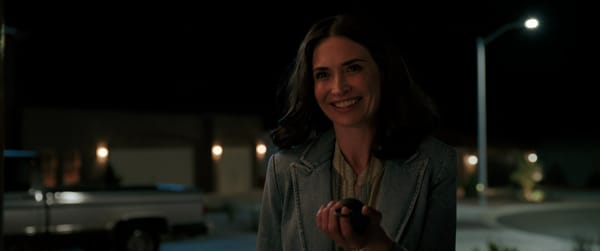
At least, that's the Carol we see in her first scene on the show. She's at a Barnes and Noble somewhere in the vague America exurbs, doing a reading from the latest book in her romantasy series. We see her audience (mostly women, mostly in late middle age) smiling at Carol, a sea of affirmation and unconditional love, before we see Carol herself. She only matches their smiles every once in a while, but she does match them in little grins peeking out from behind her book. She is playing the role of an author too modest to admit she likes her own work as much as her audience, and she plays it well. At the signing, she leans in to fans' ears to whisper little secrets to them, promises that their favorite characters aren't actually dead. In the group photo outside the store, her teeth shine so, so white.
And the instant she gets into her Uber with the woman we'll soon realize is Helen, her partner, she slouches. The smile evaporates from her face. When the Uber driver asks if he should know her, Carol smirks a bit. "Depends. You a big fan of mindless crap?" She grabs Helen's hand, grips it like she's holding on during a bout of turbulence.
Helen is a very special person for Carol because Helen alone, it seems, knows how to match Carol's cynicism and by mirroring it show how hollow it really is. In an hour, Carol will be, for all intents and purposes, the last person alive in her country. But for now, she drinks a martini she probably shouldn't have, at least based on her car's ignition interlock, to try and forget the memory of who she had to be on book tour. She goads Helen to join her in a drink, and Helen goads back, insisting that if Carol hates her career this much she should try publishing something she actually cares about.
Later, bumming a cigarette off Helen in the parking lot, Carol thinks about how to answer some questions from fans. She paces the edge of the lot, walking a line on the edge of the patio like she's trying to pass a field sobriety test, as she thinks. You can tell from her body language that this is a pattern, that she's done this a million time before with Helen. There is nothing awkward in the long pauses in their conversations; this is part of their intimacy. There is no Pluribus without patience because Pluribus is also a show about how time passes in a person's mind. The waiting is the whole thing.
Helen asks Carol another question from the fans: Was there a real man Carol used as a basis for Raban, her series' romantic hero? They spar about it for a moment as Carol, very obviously not someone who's into men, insists Helen put down George Clooney. Helen's a bit begrudging. Carol writes straight romance for straight women in a universe where romance fiction has seemingly not undergone the sea changes of the past decade; her job is a closet, and Helen is obviously trying to nudge her out of it. It's not working, not yet. But you get the sense that time is on Helen's side.
Until it isn't. A truck screams into the parking lot, smashing into the side of a parked car, and when Carol comes back from trying to help the driver, she sees Helen twitching back and forth on her feet for a moment before she falls flat to the pavement. Science fiction has collided with Carol's life. She's panicked. She runs into the bar to try and get help, only to find that everyone in there, save one unlucky soul bleeding out in the kitchen, is spasming too. Vince Gilligan, the creator of Pluribus and the writer/director of its first few episodes, refuses to let you avert your gaze from the violently shaking bodies in the bar. No matter where Carol goes, there's always another person sputtering on a hard surface in the frame right in front of her.
Carol leaves the bar and, with great, halting effort, drags a sign over to Helen to use as a makeshift stretcher. Her own car's got the interlock and she's been drinking, so she, panting and wheezing, shoves the truck's driver to the passenger seat and uses that to bring Helen to the hospital. Everything is so difficult for Carol, but wouldn't it be difficult for you, too, if you were her? There is no one to help her bring her dying partner to a medical facility, no pairs of hands beneath white scrubs to help her wheel a gurney onto a waiting ambulance. Our bodies are meant to work together for things like this, and Carol is, suddenly, all alone.
Well, not alone, precisely. Most of the people who'd been twitching in the bar — the ones who didn't die in the process of joining their minds to one another — are, it turns out, still very much alive. But the question of who is in their bodies is a tricky one. They are themselves, they later tell Carol. But they are also everyone else. They move as a fluid mass, like a flock of birds migrating in the fall. Gilligan's camera shoots them overhead as they inoculate petri dishes with their saliva, their arms moving in synchronized figures. It's frightening and whimsical at the same time; when Gilligan captures the Joined (as they call themselves) in a wide Steadicam shot, I still sometimes expect them to break out in song. No VFX work is needed to convey that they are a single creature. They simply don't move like independent organisms.
And just like Carol — Carol who immediately rushed to the pickup truck to make sure no one was hurt, Carol who saved a baby at the hospital in the middle of the twitching plague — they want to help. They tell her this, in chorus, every time she interacts with them. They offer her food, medicine, anything else she wants. Carol gets furious at these offers. When she's trying to transport Helen — Helen's body by the episode's end; she was one of the many people who didn't survive the virus — through the crowds of Joined, every offer of help turns her feral. She looks like she wants to rip their throats out.
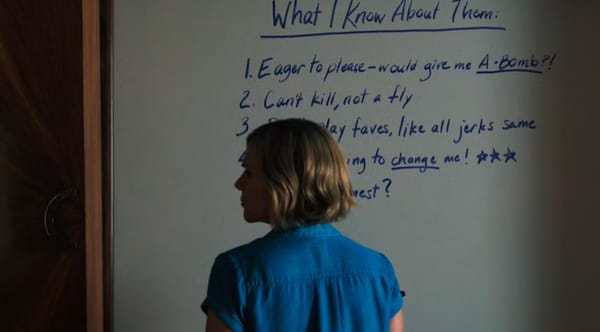
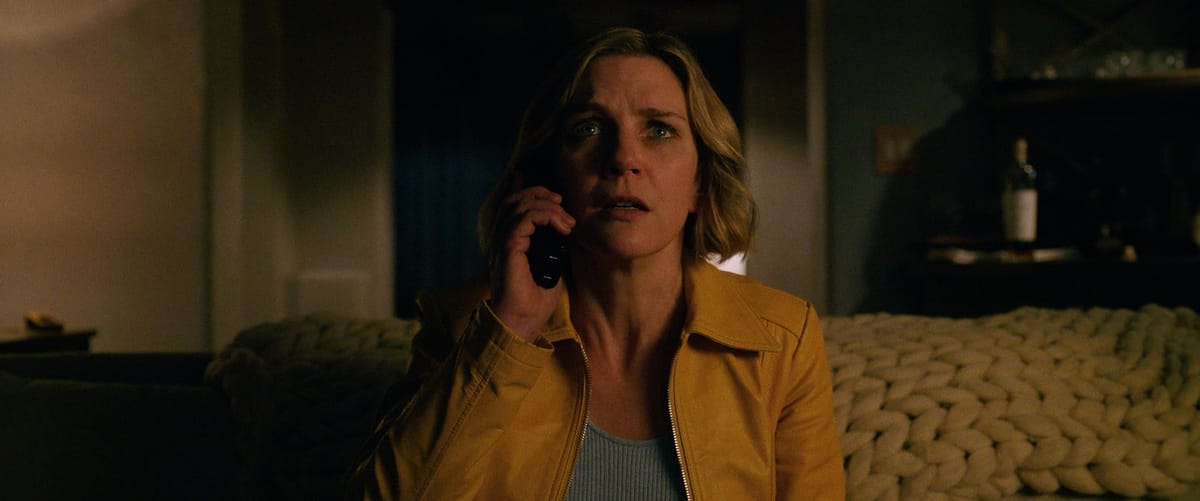
And then she is home, flipping through channels on her TV until she finds one where a man with well-coiffed hair stands behind an official-looking United States lectern and urges her — yes, her, Carol Sturka in Albuquerque — to call him on her landline phone. She holds the phone close to her face, glass of wine in the other hand, elbows tucked to her sides, a body collapsing into itself, as she begs for an explanation for what has happened to everyone she's ever loved. When the speaker on TV tells her that they — the plural they, the Joined — want to figure out how to join her to the rest of humanity, she asks, dread in her voice, "So, what happens when I say no?" The man on the other end of the line reassures her that she'll soon come to understand how wonderful it is to be joined. She hangs up the phone and screams.
The last we see of her in this episode, she's curled into the fetal position, a pose of comfort every human instinctually knows how to assume. It's how your body pretends it isn't alone.
Other thoughts I thought:
- One thing I didn't mention above is that Pluribus is way funnier than it has any right to be. For instance: "Undersecretary Davis Taffler" is maybe the best fake government official name I've ever heard.
- Speaking of the government, I guess Donald Trump is diegetically dead in this universe.
- While I think Pluribus's portrayal of romance fandom (and especially romantasy fandom!) is pretty outdated, it does seem accurate to me that the only man who's brought a book to be signed has also brought a real sword.
- I love what Pluribus turns into, but rewatching this episode made me a little sad that this is its only real dalliance with full-on horror. Gilligan is absurdly good at framing a background scare. [His X-Files episodes were terrific at this, and he should do more of it. –ed.]
- The chyrons on CSPAN are amazing. My favorite is "WE'RE ONE," but it's one of many!
- Finally, I do think I have to ask a hard question I've seen no one else ask about Pluribus: When babies get joined, are they able to talk, and if so, how creepy is it?
A Good Song
The free edition of Episodes, which (usually) covers classic TV and film, is published every other Wednesday. Premium subscribers get newsletters every Monday, Tuesday, Wednesday, and Friday. Our editor-in-chief is Emily St. James, and our managing editor is Lily Osler. If you have suggested topics, please reply to the email version of this newsletter or comment (if you are a paid subscriber).