Olivia Rodrigo, theater kid
Or: Why Olivia Rodrigo was voted most likely pop star to write a musical in her 40s.

Our weekly Friday newsletters, which deal with the latest in pop culture, are available only to paid subscribers, but this one is open to all, as the very end of our free preview week. If you like what you've seen this week, our Pride sale runs through the end of June. Take 20 percent off the normal cost of an annual subscription by clicking the button below!
If you've spent any time at all consuming Olivia Rodrigo content on YouTube — couldn't be me — then the algorithm has eventually served you this video of an 8-year-old Rodrigo singing "Don't Rain on My Parade" at a Temecula, California, talent show. The video displays that tiny Rodrigo had a wonderful singing voice and surprisingly adroit breath control for a child. It also shows off her full ham. She's doing a Barbra Streisand impression, right down to a slightly overstated Noo Yawk accent. It's adorable in the way precociously talented children are.
For those who paid a lot of attention to Disney+ programming in the late 2010s — or were TV critics made to watch all of it to issue reviews — Rodrigo then popped onto the radar as one of the stars of High School Musical the Musical the Series, the Glee-ish series about a high school putting on the titular musical adaptation of the TV movie. (It makes sense in-universe, I swear.) As you would expect from that premise, much of the music Rodrigo performed within the series was heavily influenced by Broadway.
Rodrigo, of course, has since become a major pop star, and her third and most recent album, you seem pretty sad for a girl so in love, has garnered the best reviews of her very young career, the kind of reviews that suggest she will be with us for decades to come. For the most part, those reviews focus on her alt-rock influences, especially The Cure, a band she has frequently cited as one of her all-time favorites and whose frontman Robert Smith duets with her on a track. That Smith has so obviously given Rodrigo his stamp of alt-rock approval has given her a deep amount of cool girl cred. It's easy to see why Smith is so into her work. She's already a smart and thoughtful songwriter, and she has mastered the form of the punchy pop-rock song. More, she pulls in new influences with every album, making clear that she's the kind of musical polyglot who has a deep knowledge of pop music past and present, as evidenced by how absolutely she crushes this episode of BBC's Speed Test.
Rodrigo has also drawn frequent comparisons to Taylor Swift, largely for a number of overly obvious reasons: Rodrigo was a teenage Swiftie, and both artists write highly confessional songs about their love lives. A less obvious comparison point between the two, however, is their love for writing story songs, which is to say songs that have something of a three-act structure and follow a narrator through a situation that resolves over the course of the song. One could even argue that you seem pretty sad goes beyond the mere concept album to become something of an album-length story song.
In Swift's case, the love of story songs makes sense. Even her poppiest songs are often built atop the architecture of country music, a tradition where story songs reign supreme. But while the alt-rock, bubblegum pop, and punk music that most influence Rodrigo certainly have their fair share of story songs, far more common are songs that attempt to capture a specific mood or vibe or brief character sketches. Something like The Cure's own "Friday I'm in Love" is a good example. It's not really telling a story so much as it's capturing an endless, earnest yearning. That attempt to nail down a feeling also goes for Nirvana or Smashing Pumpkins or the many '80s New Wave artists Rodrigo nods to on her new album.
So why do Rodrigo's story songs feel so unique within her assorted milieus? Because she's still a theater kid at heart, and she's writing show tunes.
Let's imagine a Broadway musical
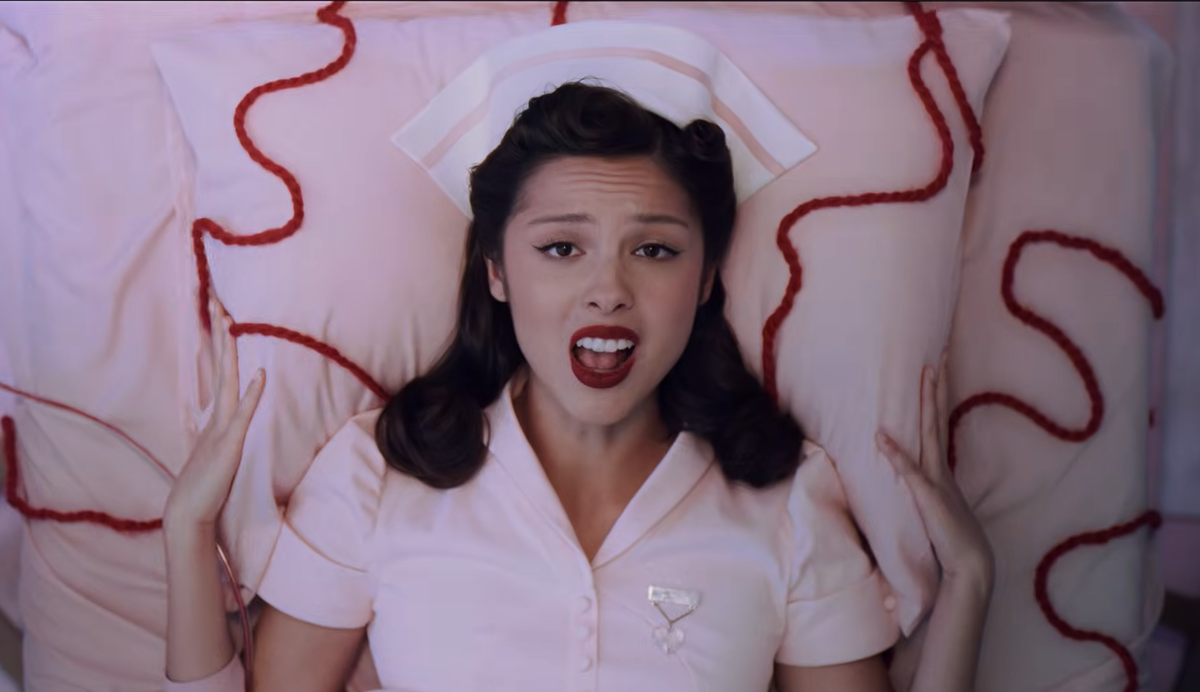
Let's try a thing. Listen to Rodrigo's "the cure," the second single from you seem pretty sad, and try to listen past the art rock influences in the instrumentation and just pay attention to how the song is put together. It's less of a story song than, say, "drop dead" (the leadoff single), but in its progression from "girl hopes boy will save her" to "girl is annoyed boy won't save her" to "girl realizes she can only save herself," it does have a story structure. It is easy to imagine her singing it directly to said boy, as the world around her slowly opens up and becomes slightly more of a surreal representation of her emotional state. Indeed, that's basically what happens in the music video.
Now take all of that and transplant it to a Broadway stage where "the cure" serves as the end of Act One in a future musical adaptation of you seem pretty sad that Rodrigo shepherds in a couple of decades when she's older and more tired. Indeed, if you listen to "the cure" on the album — where it lands as the eighth track of 13 — it more or less falls where the end of Act One would in a stage show. The song even builds musically in a similar fashion to a show tune, introducing a couple of musical ideas that recur and intertwine and undo themselves, with the overall sound growing until it reaches a serious crescendo in the final chorus before tapering off. That song structure is not unique to musicals — far from it, since I just also described, like, "Hey Jude" — but it stands in marked contrast to the prevailing winds in pop music, where songs often keep introducing new ideas and hooks before somewhat abruptly ending. I like that form of songwriting too, but Rodrigo's classicism appeals to me slightly more.
Now, I do not think the new album's similarity to a Broadway show was intentional on Rodrigo's part. The album charts the rise and fall of a once-promising, ultimately doomed relationship, so a song about realizing your own role in a love story's end is a natural fit for just past the midpoint. I doubt you seem pretty sad was consciously constructed as a musical, but the fact that it could so easily be turned into one underlines how deeply these elements run through Rodrigo's music. The 11th song on the album, "less," would make a great ballad to turn into an 11-o'clock number (the big, sweeping song designed to draw the audience back in as a show nears its conclusion), and I can just hear the whole chorus joining in on the concluding song, "cigarette smoke." The vocal arrangements, with chanting backing choruses and overlayered voices, are common in pop music to be sure, but they already suggest how a rather spare album could be magnified for the stage. And various lyrical motifs recur in clever ways throughout, as when the word "cure" from "the cure" is echoed in the word "procured" in the "Olivia gets drunk and fucks somebody new" late song "expectations," to say nothing of the way Rodrigo builds up and subverts "honeybee," her pet name for her ex, throughout.
Compare you seem pretty sad to any album by any of Rodrigo's many influences, including the similarly story song smitten Swift, and you see just how much more of a story it is. Hell, compare it to any number of other concept albums, from The Beatles' Sgt. Pepper's Lonely Hearts Club Band to Fleetwood Mac's Rumours to Kacey Musgraves's Golden Hour, the latter two of which are about very similar subject matter to you seem pretty sad, and Rodrigo's album still tells more of a traditionally structured story.
Yet her love of Broadway song structures has always been present in her music. Her initial breakthrough, "drivers license," isn't quite as story-heavy as some of her songs, but it is driven by a singular, short story-ish experience. One might say similar things of everything from "deja vu" to "get him back!" The clear difference with the new album is how clearly the whole thing is structured as a singular story, where her first two albums were much more recognizable as collections of singles.
In 2024, I wrote about the theatrical influences driving so many modern pop stars, but I predominantly situated that in terms of performance style. Both Sabrina Carpenter and Ariana Grande have extensive acting experience and consequently bring a cheekiness to their music, while Chappell Roan's over-the-top theatrics are reminiscent of Lady Gaga but also, like, the British mega-musicals of the 1980s and '90s. (Chappell! Play Grizzabella the Glamour Cat!) Yet if one were to write "a Sabrina Carpenter musical," one would surely go the jukebox musical route and pick and choose songs from across her career, then construct a story around them. Which would be fine! But it would ultimately feel a little less driven by Carpenter herself and more the songs she happens to sing.
 Emily St. James
Not so with Rodrigo, who seems to have so deeply internalized show tune rhythms that she's most comfortable writing in them, even when she expands her ideas to the length of an album. Yes, to get you seem pretty sad to full Broadway musical length, one would have to probably add a few other songs from Rodrigo's catalog — I might suggest dropping "bad idea, right?" and "good 4 u" into Act 2, if only because the second half of you seem pretty sad has a few too many ballads — but that would be a trivial thing to do. Or one could just go the American Idiot stage adaptation route and do a 90-minute show. That would work too!
Now, I doubt when Rodrigo sat down to write you seem pretty sad that she said, "It's time to write my Rent." My argument, rather, is that Broadway's song structures are at least as deeply embedded in her writing as the alt-rock tracks that are more commonly cited as her influences. The thing that makes Rodrigo such an exciting artist is how she at once feels indebted to the classics while also combining them in brand new ways. And in her case, that means that some part of her is always going to be chasing Streisand as much as Robert Smith.
I hope you enjoyed this piece! If you did, let me make another plea for you to subscribe to Episodes! We're doing some exciting work right now, and we're so close to being able to start giving freelance assignments. Just 20 new subscriptions by the end of June would get us there. Will you be one of them? Let's find out!
A Good Song
The free edition of Episodes, which (usually) covers classic TV and film, is published every other Wednesday. Premium subscribers get newsletters every Monday, Tuesday, Wednesday, and Friday. Our editor-in-chief is Emily St. James, and our managing editor is Lily Osler. If you have suggested topics, please reply to the email version of this newsletter or comment (if you are a paid subscriber).