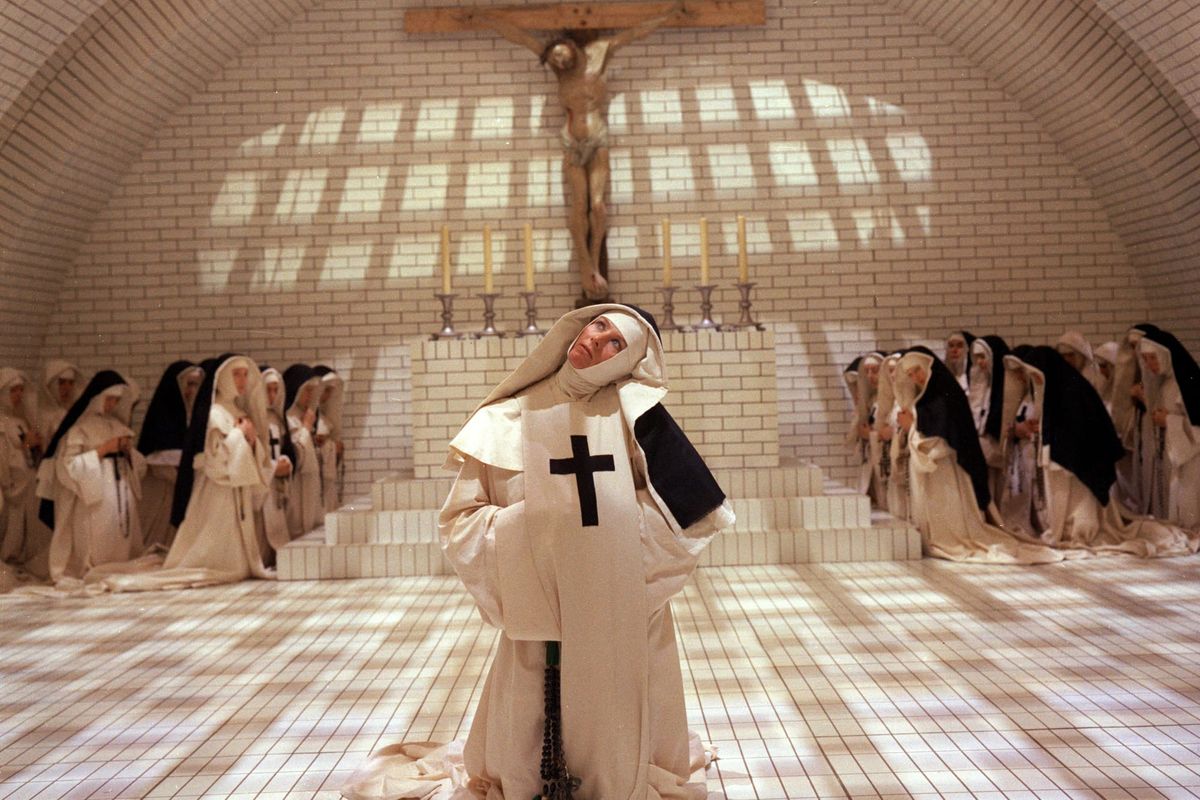
The Devils is still shocking. Just not for the reasons you think.
Plus: Robert Pattinson in Primetime, Steven Spielberg's Duel, and the dark origins of MLB mascot DJ Kitty.


Happy Monday, Episodes pals! This week, we've got takes on The Devils and Primetime, as well as our usual collection of other bibs and bobs. Remember: If you subscribe, you'll get this newsletter in your inbox every Monday!
Ken Russell's The Devils shows the grim fragility of the communities we love
If you've heard one thing about Ken Russell's The Devils — now extended beyond its initial one-week theatrical run due to popular demand — it's probably that it's a masterpiece of the taboo. The 1971 film, a relatively accurate retelling of the events leading up to the 1634 witch trial of the Rev. Urbain Grandier, was heavily censored by British authorities upon its initial release, largely due to the movie's many explicit, and explicitly blasphemous, sex scenes. Without the efforts of a single enterprising film critic, the film's centerpiece sequence, cut for theatrical release, might have been lost forever. And even after that sequence was recovered in 2002, Warner Bros. still refused to release the full, unexpurgated film; the version you might have seen on a streaming service like Shudder as recently as the late 2010s was the censored cut.
The current rerelease of the movie is the first time Russell's intended cut has been seen by anything approaching a wide audience. The animating question I've seen asked on social media and in mainstream reviews, then, is whether, 55 years later, The Devils is still capable of the kind of shock that keeps a film behind lock and key for more than half a century.
I'm just one person, but I'm here to report that it shocked me, albeit not in the ways I was warned that it might. The movie follows Father Grandier (Oliver Reed), a politically and sexually liberal Catholic priest whose walled town, Loudun, harbors a large population of Protestants living alongside Catholics. Grandier advocates for such causes as religious freedom and the right of priests to wed, and he makes good on the latter cause by secretly marrying Madeleine (Gemma Jones), a young religious searcher who'd briefly considered joining the town's Ursuline convent. Madeleine isn't the only woman with the hots for Grandier, though: Sister Jeanne (Vanessa Redgrave), the leader of that convent, is psychosexually obsessed with Grandier, tearing a hole in her palm with her crucifix as she fantasizes about him during her prayers.
When the King of France and his right-hand man Cardinal Richlieu want to seize power from Grandier and tear down the walls of Loudun, then, they go to Sister Jeanne and her nuns to stage a possession and thus frame Grandier as in cahoots with Satan. (Those nuns, the movie makes clear, are not actually terribly pious; they're the cast-off daughters of rich families, mostly sent to the convent against their will.) It's in these scenes of faux-possession that we get those once-censored scenes of nuns getting frisky with one another and an enormous wooden crucifix. These scenes are for sure quite risqué, but Russell's camera never holds on an individual action for very long; it all quickly becomes a whir of noise and color. I both understand why these scenes shocked people — like, hey, girls, get off of Jesus!! — and came away from them thoroughly unshocked.
What actually shook me, and has stayed with me in the week since I saw The Devils, is the movie's ending. Grandier is arrested, graphically tortured, and eventually burned at the stake, dying a slow death as his skin chars and curls. He never admits to witchcraft nor signs the confessions Richlieu's cronies are shoving under his nose until the very end. He is not a perfect man by any means — we see him being quite cruel to a woman he's impregnated in one of his first scenes! — but he is murdered for trying to keep his city a pluralistic place in the face of authoritarian overreach.
After he's been reduced to ashes, the authorities at last tear down Loudon's walls and, with them, the city's policy of religious tolerance. In the film's final shot, Madeleine, now widowed, climbs over the rubble of the city wall and wanders into the countryside beyond. Russell shoots that countryside as a sick and blighted place, arid and craggy, with skeleton-topped Catherine wheels sticking up like trees along the roadside. The courage of a flawed but principled man wasn't nearly enough to save Loudun, and now the boundary between the intolerant world and the safe city has dissolved.
It's hard to watch this scene without thinking of modern parallels in formerly-pluralist American institutions that are now admitting rank bigotry. The people of Loudun are not dead, of course; they, like us, can rebuild what was destroyed in the years and decades ahead. But it is still shocking, all these years after Russell shot it, to witness how cruelly and thoughtlessly something beautiful can be destroyed. —Lily Osler
Upgrade your subscription; make Emily watch whatever you want
Through November 1, we're running a new subscriber lottery. Sign up for any paid subscription – monthly or annual – and send us your choice for one thing you'd love to make Emily or Lily write about. We'll pick one topic out of a hat to write about the last Tuesday of every month between now and until whenever we run out of them! More details here.
Primetime and You're Wrong About storytelling
Did you, like me, ever get really into the podcast You're Wrong About? Hosted by Sarah Marshall since its inception in 2018 and Michael Hobbes until he left the show in 2021, You're Wrong About carved out a specific, hyper-researched niche in the fertile field of "podcasts about the recent past." For much of the Marshall/Hobbes era, the show was dedicated to debunking common misconceptions about the last quarter of the 20th century. While it has gone further afield since Hobbes left, the prototypical YWA episode is still typically about some bullshit from the 1990s you probably have misconceptions about.
Now, every generation reinvents the "Remember this thing from 20 years ago when you were a tiny baby and/or teenager?" wheel to suit its own purposes. Like when I was a teenager in the '90s, adults were getting stuff like Apollo 13, which reimagined specific events from the 1970s with the benefit of hindsight. And do I need to remind you how many O.J. Simpson projects popped up in the 2010s? "Let's recontextualize the recent past" has always been with us, and it will always be with us.
Yet I can't help but detect a hint of YWA-ish storytelling in various works as we turn our eyes to the far-off shores of the 2000s. I do not mean to claim that we're all suddenly aping a podcast; rather, I think that the kind of recontextualization YWA specialized in, often rethinking big news stories in ways that complicated the easy politics of them, is now sort of the norm within the subgenre. Yet what YWA and other great examples of this storytelling form always remembered that too many others in the space forget is that the most riveting thing is when you can find a little tie between the past and present.
Perhaps that lack of a tie is why I'm ultimately in the "thought it was good, not great" camp with Primetime, the Lance Oppenheim-directed movie about the short life of 2000s Dateline NBC segment/spinoff To Catch a Predator, a program that lured would-be pedophiles into sting operations. Primetime is incredibly beautiful to look at, utilizing format shifts among different forms of digital video and film to breathtaking effect, and the performances are all wonderful. (Oddly, Robert Pattinson's lead performance as Predator host Chris Hansen, while deeply uncanny, might lag behind some of his costars; then again, the film doesn't really give Hansen anything like an arc or even the absence of one.) And yet I could never entirely escape the feeling that the movie's central thesis was: Did you know this existed? Yes. I did. I was there.
Now, obviously, this just marks me as someone who is getting old. But there's so much fertile ground in the idea of how Predator speaks to some deep, aching need inside our body politics – or maybe humans in general – to see someone torn apart right in front of us. The men who were entrapped on Predator were not good people, but that doesn't excuse turning them into a bloodthirsty circus sideshow. Primetime gets this, then doesn't really drop any other shoes. It is, in some ways, about the pressures the media landscape places upon those who work within it to keep coming up with bigger and bigger ideas, the better to feed the content beast. It is also, to its credit, doing its best to make you live in the discomfort of the gap between Predator's stated mission (which at least seems worthwhile) and its execution (which is awful). And then at the end, it sort of just seems like it runs out of things to say, falling back on, "Huh! Kinda crazy this all happened, right? Oh, well!"
Or maybe I just found the movie a little non-revelatory because of how much I loved the documentary Predators, which tells roughly the same story as Primetime and does so in a way that uncovers all of the thorny stuff rolling around inside of Hansen's show and its many later copycats. I strongly suspect a version of me who had never seen Predators would like Primetime at least a little bit better, but, well, I've seen Predators. Its take on the material simply struck me as doing the YWA thing, tying past to present in a way that challenges the audience instead of mollifying them.
Still, Primetime is well worth seeing, if only for the cinematography, which gives certain frames the appearance of a screensaver from Hell. Yes, I mean that as a good thing. –Emily St. James
A dark prophecy of the Glee tribute to Hamilton
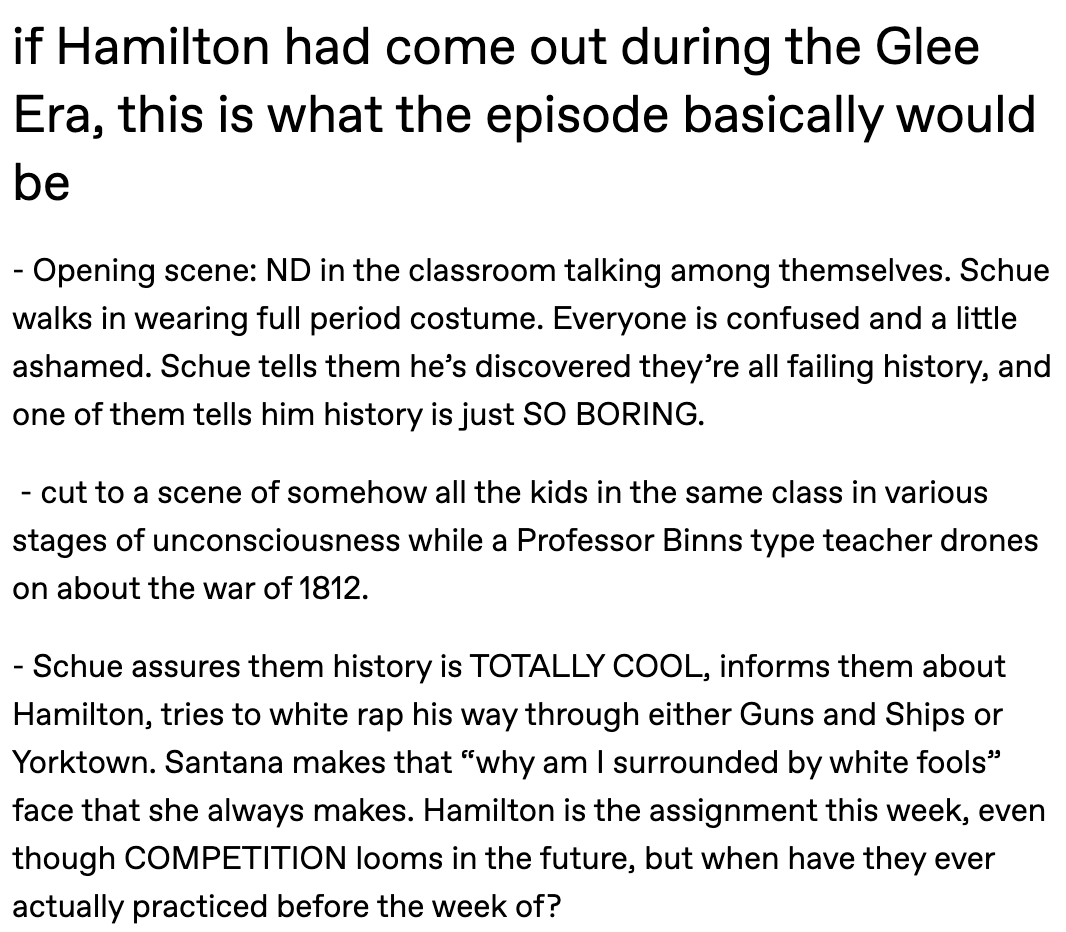
There's so much more where that came from.
Buy Emily's It's a Wonderful Life book!
Every Time a Bell Rings, the book about It's a Wonderful Life that I cowrote with Defector's Lauren Theisen, is out now! Less a making-of or a historical document, it's more an attempt to consider the film from a variety of angles, major character by major character. There are essays about World War II PTSD, whether Bedford Falls had any gays in it, and Donna Reed's impossible standard for womanhood. And it's an incredibly beautiful holiday gift, with a gold foil cover and festive seasonal endplates. Buy it today! —ESJ
Last week in Episodes...
- In our Monday Digest, Lily went long on how the different protagonists of You Can See Everything view Elizabeth Holmes as Emily pondered whether romantasy prose can, in fact, be too good:
And then Holmes goes to prison, the three-hour documentary hits its halfway point, and everything becomes clear. This is not a movie about comedy or reactions or filmmaking or craft or anything formal or technical that Fielder or Oppenheim are doing. It is about abuse, power, and misogyny — and it's one of the most disturbing films I've ever seen on those subjects, up to and including the work of David Lynch.
- In her latest edition of 26 Episodes, Emily wrote about Game of Thrones and the long tail of the pandemic:
So when I say I've come to appreciate the much-hated final season of Game of Thrones — a season I excoriated at the time — I wonder if I mean that or if I just miss the time in which I was watching it. Or when I say that, do I just mean that I've come to appreciate the show's penultimate episode, "The Bells"?
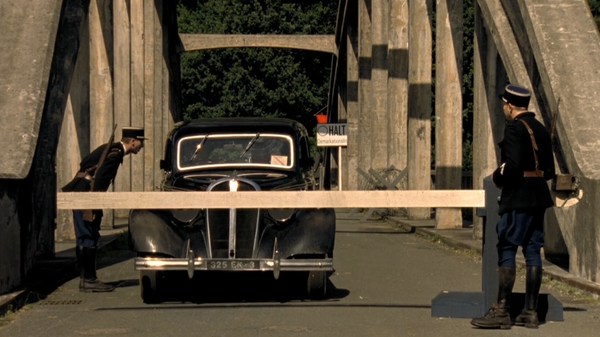
- Lily kept our A French Village recaps going with a twofer of episodes about the ways the villagers of Villeneuve are resisting — or collaborating with — their town's new fascist rulers.
- And in our October mailbag, Emily and Lily talked three-hour documentaries, novel research, and, of course, the Glee reboot.
Want to read all of that great stuff? From now until November 1, all new subscribers get a brand-new perk: the chance to force Emily (or Lily, if you want) to watch/read/play/etc. a piece of media of your choosing! Details in the link — this is a deal you don't want to miss.
Some pop culture things we're into
- My wife and I have spent the last week watching through the Criterion Channel's Made-for-TV Terror collection, which collects a handful of brand-name auteurs' TV horror movies. We started out our watch with John Carpenter's pre-Halloween feature Someone's Watching Me!, which is still pretty creepy nearly fifty years later. Come for a solid stalker-horror flick; stay for a look at how chintzy even a very fancy '70s apartment building could be. —LO
- Next on the list: Steven Spielberg's much more famous 1971 debut film Duel. Particularly in the feature-length edit, which adds in a conversation between our hapless protagonist and his wife, the movie is the kind of emasculation fantasia I often find tiresome, but the tension Spielberg can weave through the simplest shot of a car driving down the highway more than makes up for it. Did you know they shot this in 13 days?! I didn't! And I don't entirely trust it, considering that it's a Wikipedia citation to an Italian-language Spielberg biography that's not readily available online. But by God, I want it to be true. —LO
- Well, guess what, Lily? I finished Paul Fischer's The Last Kings of Hollywood, and in that book, Fischer casually tosses off that Spielberg, indeed, shot Duel in just 13 days. Given how scrupulously researched the book seems to be, I'm inclined to give ol' Steve-o (I get to call him this) the win here. What's really striking is how much the entirety of Hollywood seemed to think of Spielberg as someone who might become a great journeyman director literally right up until they screened early cuts of Jaws and realized that he was Steven Spielberg. Also, in a book centered on Spielberg, George Lucas, and Francis Ford Coppola, Spielberg ends up seeming like the only guy you might want to hang out with. Which is not nothing! –ESJ
- I am very nearly to the end of my Adults watch – I only have the Season 2 finale left – and it's striking how much better this show is in Season 2, and I already quite liked Season 1. The character writing is sharper, the actors are more dialed in, and the plotting is generally stronger. It's the rare show where I really do feel like its greatest weakness is that there simply aren't enough episodes. –ESJ
- My kid has gotten really into early chapter books – which I'm reading to her every night at bedtime – and the big winner for the moment is Paula Harrison and Jenny Løvlie's Kitty series, about a child superhero who has to overcome her fear of the dark to save cats in need. We've hit a big "it's too scary!" phase in our house, so it's nice to have a series explicitly about overcoming fear to do great things, and I always love a hero whose main power is "can talk to animals." –ESJ
Let's examine the origins of one of Major League Baseball's most unlikely mascots, shall we?
Discuss
What art made at least 30 years ago still has the power to shock you? Talk about it in comments or the Discord!
Some good links
- The World Is Still Not Ready For The Devils [Vulture]
- Catapult Elizabeth Koch Into The Sun [Defector]
- The Whitewashing of Indie Sleeze [Pigeons and Planes]
- All My Hobbies Are Getting Slopped Up, And It's Exhausting [Aftermath]
- The Three-Gender Problem [Lily Alexandre]
- Sluggo's Terrible New Hat [Nancy]
A Good Song
The free edition of Episodes is published every Monday and every other Wednesday. Premium subscribers get those newsletters, plus extra ones every Wednesday, Thursday, and Friday. Our editor-in-chief is Emily St. James, and our managing editor is Lily Osler. If you have suggested topics, please reply to the email version of this newsletter or comment (if you are a paid subscriber).