Republicans think they know Minnesota better than Minnesotans. They’re wrong
Try as they might, there is no secret conservative side of Minneapolis that Republican violence can uncover.


This post contains spoilers for Stalker, a movie released in 1979. Please use discretion if you are time-traveling.
One strange thing I've learned in the last few weeks about being under occupation by a fascist government: Even under the terrifying threat of masked government thugs in your city's streets, your existential worries don't go away. Since the government's ongoing and deadly ICE surge in the Twin Cities region began, for instance, I've spent far more time than I would have expected considering what it means to be told you do not want what you want.
The best analogy I've been able to come up with for this anxiety comes from Andrei Tarkovsky's much-acclaimed 1979 film Stalker. In that film, three men — a professor; a writer (hi); and their guide, the titular Stalker — are searching the Zone, an overgrown and highly polluted former military encampment, for something called the Room. The Room, says legend, is a concrete bunker somewhere within the Zone. Its creators (aliens, the film implies) have endowed it with a special power. By stepping within it, you make your deepest desire come true. As they journey toward the room, the men discuss the intentions of the Room's creators. They believe it must have been meant as a gift.
But it wasn't a very thoughtful gift. The Room is a place of terror for the men whom the Stalker guides. The man who led groups into the Zone before the current Stalker died by suicide a week after going into the Room. He'd entered the Room thinking that he would wish his brother back to life, but he left it to find that he had become rich and that his brother had stayed dead.
The secret his death lays bare is that the Room does not respond to volition. It does not give you what you want to want. Instead, it gives you a desire buried deep in your heart, a truth about your character that you have no power to change. That secret desire can be something you find despicable, and yet you will have no power to change it. It's embedded in your character, beyond your control. At the end of Stalker, the men sit down at the threshold of the Room and watch water fall into a pool for a while. None of them, in the end, dare to go in. There is nothing worse in this world than discovering a place where your volition no longer controls your desire.
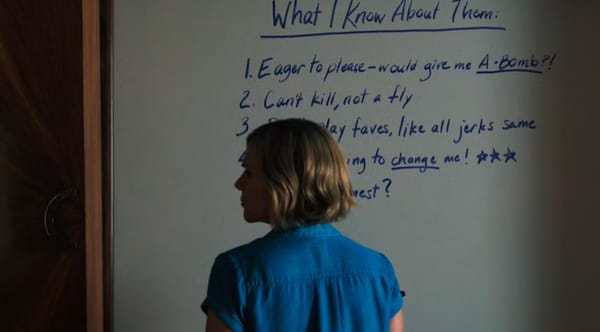
The Trump administration believes it has placed Minneapolis in the Room. It thinks it knows what we truly want. Greg Bovino, one of ICE's ghouls-in-chief, went on Fox last week to talk about how, he believes, 90 percent of people in Minneapolis want ICE to be conducting its current terror campaign against people of color* in the city. He and other administration figures talk constantly about paid agitators in Minneapolis. They have called Renee Good, whom one of their agents killed with little provocation, a domestic terrorist. The people resisting ICE in Minneapolis are ontologically false, they are saying. They simply don't count. The real people — you and me — we want this, they say. We may not want to want it, but we long for it in our secret hearts. They believe that when volition and what they call virtue signaling are stripped away, we will want to be just like them.
*ICE's ostensible targets are immigrants, and their primary goal remains the deportation of undocumented people in Minneapolis, but that hasn't stopped them from terrorizing endless numbers of American citizens in the city over the last month; the only unifying factor among the people they attack seems to be that they are not white.
There is something particular about Minnesota that I feel makes people like Bovino apt to assume they know what the people of the state want better than we ourselves do. Minnesota is, in many ways, an emblem of the American Midwest, a state with an old mill town turned metropole at its center, prairies swaying into deep northern woods in its countryside, its people reputed (correctly, for the most part) to be polite and self-effacing and community-oriented. We have so many Lutherans that the mainline branch of the denomination has split the state into six different synods. It is rare to find a place where fewer people enjoy eye contact. I am pretty sure I went to high school with two (2) different people named Thor. Assume something to be true about the Midwest, and it's likely true about Minnesota.
And yet Minnesota is an enigma. Both of our senators are Democrats. We have voted for Democratic presidential candidates since 1976, the longest ongoing streak in the country. Reproductive healthcare and gender care are as safe here as they can be anywhere in the United States. Our governor, Tim Walz, was Kamala Harris' running mate; to this day, people online debate whether Harris would have won the election if Walz had been allowed to keep mocking Republicans as vociferously as he did at the start of Harris' campaign. (I doubt it, but, well, it certainly wouldn't have hurt!) We do have a serious rural-urban political divide, with outstate Minnesota pretty red and the Twin Cities themselves navy blue, but so do states like Oregon and Washington. Minnesota – and Minneapolis and St. Paul in particular – pride themselves on being progressive, multicultural places where all kinds of people can flourish.
If you're a lifelong coastal resident, you'd be forgiven for not knowing anything from the above paragraph save maybe the stuff about Tim Walz. (You'd be shocked how many people I personally know who assumed that Walz was someone like Kentucky's Andy Beshear, a progressive governor of a deep-red state, rather than a pretty bog-standard blue-state governor.) Something about the profound (for lack of a better word) Midwestern-ness of Minnesota tends to inhibit the ability of non-Midwesterners to grasp the revealed political alignment of most Minnesotans. Republicans in particular tend to assume that we're living under some kind of false consciousness, a kind of woke fog that blinds us to the reality of what we actually, deeply want for ourselves. They think they know better than us. They think we do not want what we actually want.
In spite of all the evidence, I worried for a time that they were right. As the first year of Trump's second term wore on and the imperial boomerang began looping back around, I saw through my computer screen the terror the administration was inflicting on Washington, D.C., Los Angeles, Chicago, other cities across the country. I felt a sick certainty that this violence would soon come to Minnesota. Minneapolis and St. Paul are homes to huge immigrant and refugee populations, and many of those refugees, like the Haitian refugees Vance had targeted in the presidential campaign, are Black. The ingredients were all in place for something violent and terrible. I saw the way people in Chicago and D.C. and Los Angeles fought back against the federal presence in their own cities, and I hoped Minneapolis would do the same. But still: I worried.
It's hard to put a date on the start of the present crisis in Minnesota. Renee Good's killing on January 7 of this year is a tempting starting point, and it absolutely intensified the situation on the ground, but it's important not to forget that Good was killed while observing an in-progress ICE action. There has been a flattening of the terror in Minnesota on account of Good's murder. But the terror began before that murder, and it has continued in its original form — the state sanctioned and enabled torment of nonwhite people in Minnesota — since her murder, simply in a higher gear than before.
These days, the city is overrun with black SUVs with tinted windows and out-of-state plates. Every day, there are videos on social media of ICE agents dropping tear gas canisters in front of restaurants I go to and businesses I frequent. A few times a day, I'll rush down to the entrance of my building because I hear fervent honking outside as commuters (our local term for drivers with free time and plenty of anti-ICE energy; God bless them) chase ICE patrols onto the highway. As I type these words, my phone is buzzing with messages that Greg Bovino is at a gas station a mile south of where I live. These images may not have saturated the national media environment in the way images of Good's killing did, but make no mistake: We are still under invasion.
On the day Renee Good was killed, I cycled through emotions rapidly. First, came anger, of course, but that was chased quickly from my brain by terror and despair. It's not fair at all that the human brain is so good at looking for similarities, that our secret hearts respond so keenly to people we think are like us in some way, but pattern-searching is what the brain does best, and Renee Good was a queer woman who moved to Minneapolis from a red state in search of a safer, gentler life. I am those things, too, distorted by time and circumstance and agency, yes, but still, but still. She lived less than 20 blocks from me, and her death seemed to refract my life. I saw how the media (traditional and social) treated her in death: erasing her queerness, "partner"-ing her wife, turning her into a widow and single mother. It was a very specific kind of death without dignity that, as a queer person, I've spent so many years fearing.
But a strange feeling came over me a day or two later, one I know beyond a doubt I was not alone in. I woke up on January 8 and found that the fear was gone, washed away by something else. I was, despite it all, emboldened. If they can just kill us, then — why not go out there? Why not be loud, be obvious, be clear in what I believe? A killing meant to inspire terror reminded me that I was never safe, and thus that I have nothing to lose, or at least nothing that is worth more than the lives of my neighbors.
I am not saying this to cast myself as any kind of hero. I'm probably in the lower fiftieth percentile of Minneapolitans, if that, in terms of resisting ICE. I go out for patrols a few times a day to watch for caravans of black Escalades with Georgia plates. If I hear honking outside my building, I go downstairs with my phone to film what's going on. I'm in a few groupchats for my neighborhood (get in touch with Defend 612, endorsed by many of our city council members, to join a groupchat yourself if you'd like!) where we find out about restaurants and businesses that need warm bodies in their stores and on the streets to protect them. I am ordinary, and I can say that definitively because the group chat I am in has had to split into a half-dozen separate chats because we keep exceeding the chat size limits for our service provider. Every time I go for a walk, there are so, so many people doing the same thing I'm doing. Hundreds of people in hi-viz vests go out in a dazzling flock to protect kids and teachers and parents during school drop-offs and pick-ups.
This — a massive network of ordinary neighbors, many of whom have never before been political, working together to keep our neighbors safe — is what the news media is still trying to cast as a city and region keeping timidly quiet under siege. Jay Caspian Kang's piece in the New Yorker is egregious, but it's one of many versions of this narrative. And, yes, the streets of Minneapolis are quieter than usual right now; we are a city of immigrants, and many of those immigrants are in hiding at the moment, having their laundry done and getting their groceries delivered by their neighbors because they literally cannot leave their homes for fear of being abducted.
But quietness does not by any means suggestion complacency. There is a clarity of purpose in the groups I am in; we stay on-topic at all times, focusing our attention on finding out exactly what/where/when ICE raids are happening and dispatching people to observe and intervene. And it's working. Every time the blare of whistles forces a group of ICE agents away from a home or business, that's another neighbor protected from kidnapping. Every time a commuter chases an ICE agent all the way to goddamn Albert Lea or Will Stancil (yes, Will Stancil) goes Mad Max in his Honda Fit on a bunch of Alabamian chuds, that's a waste of time and resources for ICE that they cannot get back. We are not doing enough simply because nothing could be enough. But we are doing what we can.
Growing up in Texas in the 2000s, I resisted with all my might the idea of loving a place simply because I was told I was supposed to love it. For good or ill, my heart has always resisted the volitions of others. But love for a place and a community, I have found, is not something you can be told you must have. It is not tended, and if it's planted, it's only by accident, by the casting of seeds on the wind. Real love like this cannot be domesticated or enforced or tied to the evils of nationalism. It is a garden gone wild, a vast meadow bringing new life from the remains of a disaster zone. It creates itself through the beauty of a misty lake in late autumn as you look out the window of the city bus, the kids behind you razzing each other in Somali on their way home from school.
I love beyond measure the way a multicultural city and region and state becomes more and more itself as people from different parts of the nation and world join in creating it. I love being part of a place that is greater than you or your language or your culture, somewhere that exists beyond and above the sum of its disparate parts. I don't want to die to defend this idea I find so beautiful, this way of living that those in power vocally despise. But I'm no longer afraid of what these goons could do to me, and neither are my neighbors. I proudly sign my name to what I am doing and what I believe. There is no terror they can visit on us that will break our resolve. This is what Minnesota is.
None of this, of course, means the crisis in the Twin Cities is over. If anything, it's deepening. A Hmong man, a citizen of this country, was snatched half-dressed in the bitter cold from his house a few days ago. Immigrants, documented and undocumented, are being savaged, stolen, even murdered by these agents of the state. Even after Good's death, they have not stopped shooting people. Even in the very local sense, any vague idea of stability is likely an illusion.
What I have learned on the ground, though, is that there are, and always will be, more of us than there are of them, that many more Minnesotans want freedom than we fear. This calamity — this Zone that reveals your hidden heart, this evil that has fallen over so many places in this country — is coming to your city, too, if it isn't already there. If you are a white person in America, someone whose vulnerability depends largely on whether you choose to resist this regime, the Zone will show you what you love and what you truly want. It is a terrifying and awful thing.
But if, like me, you have spent so much of your life afraid of some secret cowardice stowed away beneath the bed of your soul, some fundamental flaw in your community that will keep it quiet in the face of fascism, I urge you to look to Minneapolis right now. You may find, as we have, that there is more courage to you than you could have ever expected.
If you are not in the Twin Cities — or if you are in the city and have the money to give — you would do a world of good by giving some money to Monarca or MIRAC. Thank you.
A Good Song
The free edition of Episodes, which (usually) covers classic TV and film, is published every other Wednesday. Premium subscribers get newsletters every Monday, Tuesday, Wednesday, and Friday. Our editor-in-chief is Emily St. James, and our managing editor is Lily Osler. If you have suggested topics, please reply to the email version of this newsletter or comment (if you are a paid subscriber).