Community is a sitcom about dissociating
Is that why I liked it so much?

This is 26 Episodes, a biweekly series tracing the history of television in the 21st century via episodes that made the medium great. The episodes are arranged chronologically, from 2000 to 2025, and they're chosen by me, Emily St. James. This is not a "best episodes of the century" list, but every episode I write about is one worth watching in my opinion. The pick for 2010 is Community's "Abed's Uncontrollable Christmas."
This series is typically only available to paid subscribers, but as part of our free preview week, this article is available to everyone. Take advantage of our Pride sale, with 20 percent off yearly subscriptions, to gain access to the other installments of this series, including articles on Mad Men, The Sopranos, and The Office, as well as upcoming pieces on Breaking Bad, Transparent, and many more. Click the button to redeem this offer!
What I like about television — no, what I miss most about television — is time.
When I watch a long-running TV series from start to finish, its rhythms will start to feel a little like real life, no matter how artificial. The only thing I've ever found remotely comparable is the newspaper comic strip, though in most of those, nothing ever changes. On TV, you cannot escape time, even when a show pretends to be timeless. (Have you heard Julie Kavner's performance of Marge Simpson lately?)
Fascinatingly, this quality of television persists even when you decouple it from the linear progression of time. If you binge-watch the entirety of a show with lots of episodes over a handful of days, you will start to internalize its seasonal rhythms. You'll know when the holiday episodes are coming, when a season is approaching its conclusion, when you've gotten deep enough into the run that everybody looks significantly older. It's a little like watching a time-lapse film of a slow-moving evolution, but that's part of the appeal.
When I was a lonely kid using television to fill in gaps in my understanding of myself, I watched a lot of Nick at Nite, and while I didn't know a thing about, say, 1970s fashion trends, in reruns of Mary Tyler Moore, I could watch those trends fly by in a way that let a near-decade pass in a few months. Characters came and went. Mary changed her hair, even got a new apartment. Nothing really changed, yet everything changed. It felt more like the dull yet comforting rhythms of life to my child brain than other artforms, and I suppose that's why I made it my life's work. After all, the recap format where I cut my TV criticism teeth is a critical extension of that relationship between medium and time. Come back week after week, and someone will be there to write about each and every episode.
Now, however, television increasingly doesn't play to this unique strength. Shows disappear for long stretches of time, then return with far too short of seasons to establish anything like internal rhythms. It's hard to observe time's passage when you look away for too long. You watch the Stranger Things kids as kids, and then just a few episodes later, they're adults. No matter how good the show, something about it feels off, decoupled from time.
Do some shows benefit from these shorter seasons? Yes. But surely not all of them! I increasingly think that the oft-stated desire for more shows with longer seasons is less a request for more episodes and more a request for TV that reorients us in time within the season, the year, our lives. What we want isn't necessarily TV that comforts us but, rather, the comfort of watching time pass in something like a familiar rhythm. We want it to feel safe.
Or maybe I'm using "we" when what I really mean is "me and Abed from Community."
Watching Community in a binge in 2026 is a very odd experience. For as much as the show excelled at the nuts and bolts of TV sitcom storytelling, it's remarkable how much of its core dramatic engine existed outside of the show proper. Late in its run, the characters would be truly awful to each other, only for some pseudo-profound dialogue about friendship and a wistful score (by three-time Academy Award winner Ludwig Göransson!) to offer the kind of closure the show would often undercut by pointing out how false it was. And yet in many ways, that false closure was the point. Perpetually low-rated and beloved by a small but very loud cult, every new episode of Community felt like something the fans had earned via their efforts. The pseudo-profundity wasn't so much for the characters as it was the folks at home. Good job, everybody! You did it!
Now, the minutiae of the behind-the-scenes turmoil surrounding Community is far enough in the past that a teenager coming to the show cold could watch all six seasons (and not yet a movie) and have no idea that, say, creator/showrunner Dan Harmon was fired after Season 3, thanks to perpetual issues with the show's budget and blown deadlines, leading to new showrunners for Season 4, who gave it a valiant try but just weren't the same, ultimately leading to the return of Harmon for Season 5. Will they know about the lengthy hiatus the show went on after the Season 3 Christmas episode, when it seemed all but certain that the show would be canceled? Would they care about the show's perpetual failure to gain recognition from awards-voting bodies, the groundswell of critical support that greeted Season 2 and partially kept the show on the air, the ongoing feud with The Big Bang Theory, the way that "paintball" became both a breath of fresh air and an albatross around the show's neck?
Perhaps most importantly, would they know about me?
It is impossible for me to write about Community without also writing about myself. For five of the show's six seasons, I reviewed nearly every episode for The A.V. Club, and for the second and third seasons, my reviews of the show were so popular that the site saw a demonstrable leap in traffic on the Friday morning after a new episode had aired. I do not know that this had anything to do with me, per se, and more with being in the right place at the right time to capture the attention of a fandom that hugged this show tightly to its chest, who routinely posted comments on those reviews that numbered in the thousands. A whole community of fast friends was formed in those comments, and that's not really anything I can take credit for.
Still, I will admit that when I revisited a few of those old pieces for this article, they struck me as pretty good, if a bit over the top in their adoration. And, like, lest you think I'm tooting my own horn a bit, a whole blog started just to make fun of my reviews of the show, before branching out into making fun of other critics (including Chuck Klosterman?), and Harmon gave several interviews during the wilderness year of Season 4 when he seemed to be subtweeting my reviews directly. Could he have been talking about anybody else? Sure. But who else was out there writing 90-page reviews "that take longer to read than it does to watch the episode, prattling endlessly in this pseudo-intellectual way, filling the next tier down’s head with this language that they can use to talk about the show over coffee"? I was avoiding myself, Dan! Okay?
To this day, I probably get more comments about my Community reviews than anything else I've written, up to and including novels and episodes of television. I have signed more than a few copies of Woodworking with "Pop pop!" when someone indicates their love of my reviews, and I'm always happy to do so. But it's also extremely weird for me. My primary memory of writing about Community is one of being stressed out and dissociated. (I've written more about this here.) That thing where the fans felt the need to perform their love of the show, lest it be taken from them? I took that to incredibly stressful extremes that were good for the website I wrote for but maybe not so great for my mental health. Ultimately, the show's fourth season, when those new showrunners took over, broke the fandom, shaking off its more casual elements. After that, Community could just be a TV show, The A.V. Club's TV section started garnering more readership for prestige dramas, and I eventually moved on to Vox.
 Emily St. James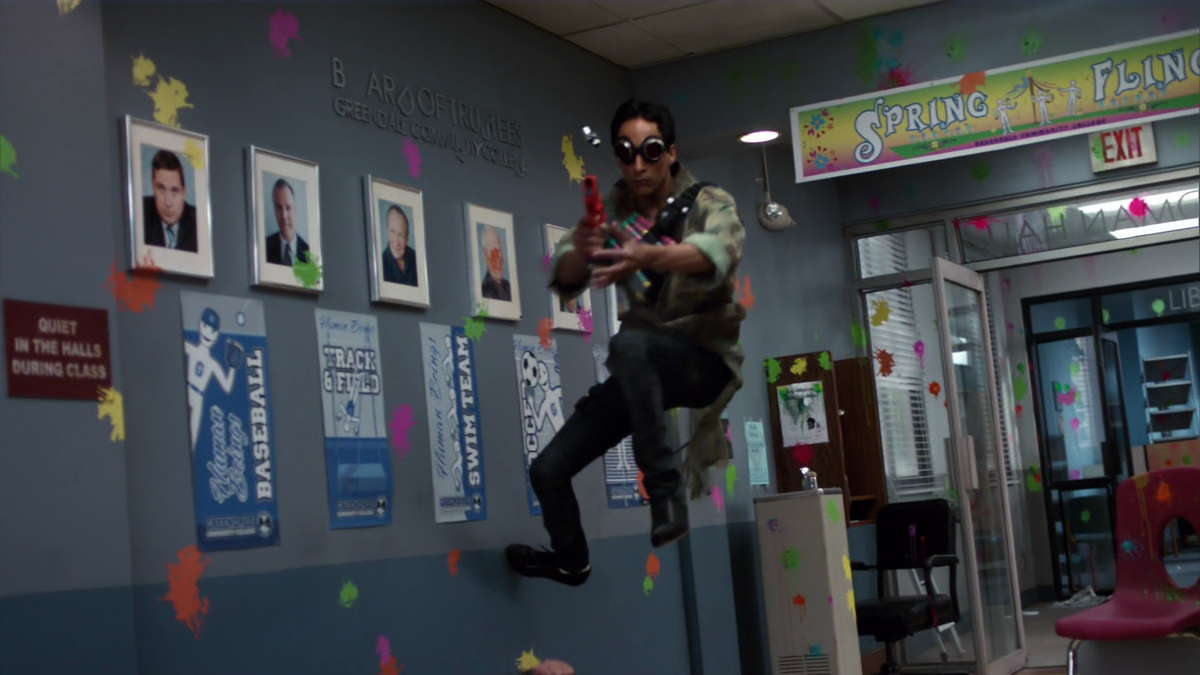
All of that was in the future, however, when "Abed's Uncontrollable Christmas" aired on December 9, 2010, and was proclaimed a triumph by nearly every TV critic who wrote about it, including me. It's a beautifully melancholy piece of television that gets at a fundamental sadness around Christmas that appeals to me now as a middle-aged woman increasingly aware of the passage of time and appealed to me then as a deeply closeted girl refusing to look at herself.
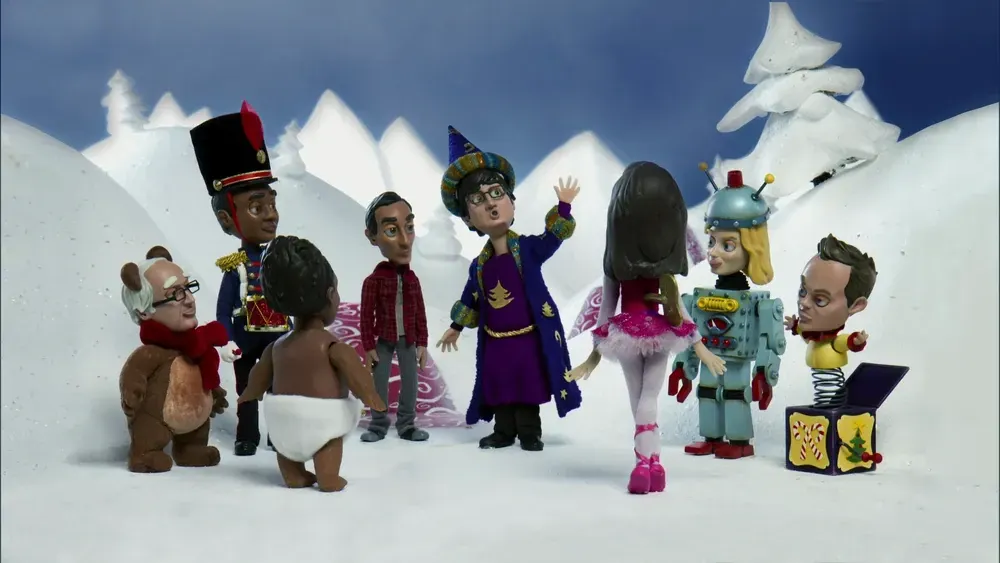
In it, the dryly earnest Abed (Danny Pudi), who seems aware he's in a TV show, has some sort of dissociative break that leads him to see the world as stop-motion animated in the style of the old Rankin-Bass specials. The other characters try to help him out of this turn toward the surreal, even as Abed imagines them all as Christmas toys. Cool kid Jeff (Joel McHale) becomes a jack in the box. Endlessly moralistic Britta (Gillian Jacobs) becomes a robot. Abed's best friend Troy (Donald Glover) becomes a toy soldier and so on. All the while, professor Duncan (John Oliver) attempts to find out just what's going on with Abed in hopes of publishing a psychological study on him. Filmed around the edges of the show's other Season 2 episodes on a meager budget supplemented by Harmon himself, the episode is like nothing else in broadcast sitcom history. It's not as funny as the show could be, but its conclusion, which argues that the meaning of Christmas is that we, collectively, have decided to give it meaning, is sad and beautiful. It remains one of my favorite episodes of the show, a thing I was relieved to realize when I revisited it for this piece.
And I'm not sure Dan Harmon liked it as much as I did.
Did we mention our Pride sale? Click the button for 20 percent off a year of Episodes, a $50 value for just $40!
In the wake of Season 2, Harmon sat down with me for an interview where we dissected the season episode by episode. He did not spare anyone's feelings, often turning his nastiest criticism on himself, and the interview was widely read and praised for his warts-and-all attitude.
When revisiting Harmon's words on "Abed's Uncontrollable Christmas," I was surprised to find that he seemed more mezzo on the episode than I would have imagined, especially given how warmly he's spoken about it in more recent interviews. He spends most of his answer lamenting that he had to do the episode in spare windows of time around the rest of the season and especially that he was only able to consult with the show's full writing staff for two hours. The staff helped him figure out why the episode would be presented in stop-motion animation, which was important, but the actual process of breaking and writing the episode was left to Harmon and Dino Stamatopoulos, something that sounds as though it drove them slightly up the wall.
Harmon's answer ends self-critically, even for him. He says:
I have a feeling that would have resulted in a fantastic piece of television if we had also been able to have [the other members of the writing staff] sitting around a table with a sad, sweet, awesome journey into Abed's dementia. It would have been a Smithsonian-worthy piece of video. As it is, it was better to do it than not do it. ... I was lamenting [to my girlfriend], going, "I'm an idiot; why do I keep doing these things just to do them? This episode's not funny. It sucks. Everyone's waiting for me to fail, and I finally did them a favor." And she told me about Charles Schulz and how hard he had to fight for the Peanuts Christmas special. ... [He] had a much harder time than I had. So it really relaxed me. "Eh, I'm no hero, and I'm no villain, and I'm nothing. I just want to make a Christmas episode that reminds me of those days."
Yes, he gets to a place of peace at the end there, but he mostly sounds a little depressed at the idea that he can only see the compromises inherent to the episode, instead of the actual quality of what exists. In a vacuum, I get it. "Abed's Uncontrollable Christmas" is whimsical and fun, but the jokes don't hit as hard as they do in other episodes, a natural consequence of the stop-motion animation allowing for a more limited range of expression. In theory, the fact that anything can happen in animation should allow for greater inventiveness on a storytelling level, but even here, Community is limited by production realities. No one would have had the time to, say, create a whole bunch of broken Christmas toys or an army of toy soldiers. The scope of the production necessarily had to be kept fairly small, and it still went significantly over-budget.
Similarly, in the interview, Harmon goes on at some length about how much more depressing the episode could have been, nodding to an idea he and Stamatopoulos had for a suicidal doll who would be heavily implied to be an actual Greendale student struggling with ideation at a difficult time of the year. It's a very dark idea that no broadcast network would ever give the okay to, and you can feel that degree of compromise around the edges of the story, which pulls fewer punches than a broadcast network animated Christmas special normally does — but still pulls a lot of punches. Comparing "Abed's Uncontrollable Christmas" to, say, Moral Orel, the dark, despairing, and quietly masterful stop-motion animated series Stamatopoulos produced for adult swim between 2005 and 2009, offers an example of just how many rough edges even the roughest-edged broadcast show has to sand off. A suicidal teenager would have been just another day on Moral Orel. On Community, it would rather break the show's reality — and this is a show that did a whole episode in stop-motion animation and more or less made that choice diegetic. (It's also notable that a version of the "we have to help someone who is suicidal" popped up just a few episodes later in the Dungeons & Dragons homage.)
Yet if I were Harmon — even drunk, embittered 2011 Harmon — I would hope I could see this episode for its best qualities. The visual inventiveness of not only reimagining the characters as stop-motion toys but also sending them through a gauntlet of Christmas-themed ordeals — including a runaway train and a "cave of frozen memories" — gives the viewer a great desire to see what happens next. Even if the conclusion of the episode, in which the study group friends discover Abed's break came because his mother decided to ditch spending time with him this Christmas, is softer than he might have hoped for, the idea that a family member might let you down at Christmastime is one most shows wouldn't indulge in. Similarly, the idea that Abed's friends return at episode's end to save the day after he locks up at the reminder of his mother's abandonment can be seen coming from a mile away, but the episode then goes beyond plot resolution to show the characters helping Abed reenact the rituals of Christmas he'll no longer share with his mother. The last shot of the episode shows the actual actors reflected in the animated television screen, and it's a subtle, poignant moment that encapsulates everything that came before almost perfectly.
Now: Did I like this episode in 2010? Or did I just say I did?
The thing that surprised me most in reading my 2010 review of "Abed's Uncontrollable Christmas" was the overwhelming sense that I had written it. I recognized within it all of my standard tricks — starting paragraphs with "Look:"; lengthy disquisitions on sadness's value as a leavening agent; dismissing a rather substantive critique with a blithe, "but I don't really care about that"; ditching the stray observations to indicate a seriousness of purpose; the overwhelming obsession with a kind of toxic nostalgia; way too many words. There's even an offhand reference to Our Town, a work that would be prominently featured in my debut novel. Often when I read my TV criticism, I have the vague sense that a different person who occupied this life wrote it, but not that recap. That recap was written by a younger version of me who was a clunkier writer but recognizably Emily St. James all the same.
What I cannot shake in reading it, however, is a sense that I can't get close to what my real opinion was. I very much enjoy "Abed's Uncontrollable Christmas" now, but in reading my piece from back then — a piece that aims to be as effusive as possible about how good the episode is — I can't escape a sense that I was being dishonest on some level. Like not really. I remember how much I loved this episode at the time, and I know that I also believed I did. But I had also gotten very good at hiding my true feelings about things from myself. If I had to bet, I would say that I really loved this episode and also that something in it deeply unsettled me.
What unsettled me was less anything to do with the show and with the thing that most united 2010 me with both Harmon and Abed: a tendency to approach life as a series of fictional narratives that were meant to conform to some sort of story structure. I've written before about how I tended to believe my life was literally a TV show, largely because of the ways in which my own dysphoric dissociation manifested itself. I had constructed a fictional character, one who existed beneath the name his parents had given him, and I piloted him like a weird golem or something. From there, it was an easy jump to "Well, my life isn't real."
When I first saw the pilot for Community, I enjoyed it, but I didn't find it particularly brilliant, and I tried to pawn off the assignment for covering it on a different A.V. Club writer. Then-editor-in-chief Keith Phipps insisted that, no, I should cover Community, and the rest is history. Now, revisiting the show, I wonder if what eventually drew me into the show was also the thing that initially unnerved me: the way in which Abed's processing of his own life via fictional contexts so closely mirrored my own, for entirely different reasons. Though this is never confirmed in-universe, it's now a generally accepted reading of the show that he's somewhere on the autism spectrum and utilizes television stories as a way to better understand how to navigate the world. I'm not on the autism spectrum, but TV and TV criticism were how I came to understand navigating the world too. If I couldn't be who I wanted to be, I could at least be someone who really loved Community.
Since Harmon has pointed out in interviews that he feels a real kinship with how Abed sees the world, it makes sense to me that creator, creation, and critic would find such a strong nexus in this one place. And given how many other fans of the show saw themselves in Abed, it's clear the character grabbed hold of lightning, offering a window into a kind of human experience TV rarely got at. Plenty of TV shows had featured characters who felt like they lived inside a TV show; only Community really dug into the psychology of what that was like.
What I most dislike about "Abed's Uncontrollable Christmas" in 2026 is a thing I didn't even remark on in 2010: its treatment of therapy. Yes, Duncan is a self-aggrandizing buffoon, someone who mostly looks at a very sad young man and sees an opportunity for his own glory. And, yes, a TV show is unlikely to offer anything like real, sustained therapeutic change because that's just not how the medium works. But there is a sense throughout "Abed's Uncontrollable Christmas" that Abed's dissociation isn't a good thing, precisely, but might be better for him than directly confronting the pain he feels around his parents' divorce and his mother's abandonment. The episode doesn't say it's good to stay in the cave of frozen memories, but you'd forgive any given viewer — me, for instance — for taking that idea away from it anyway.
Yet you cannot dissociate out of your own life forever. Time keeps passing, after all, and eventually, some version of the TV show you star in will come to its end, only to be spun off into something new.
In recent interviews, Dan Harmon comes off as a lot healthier mentally. Rick and Morty money has made him very rich indeed, and he seems to have a much better approach to work-life balance. Indeed, in the midst of #MeToo, he became one of the few men accused of horrible things who issued an apology that seemed like he'd done the work to atone for his worst moments. Abed, of course, is a fictional character, but Danny Pudi is evidently having a great time every time he pops up in some project or another. He was on DuckTales.
As for me, I didn't plan on writing about Community for this series, both because I've more than said enough about the show over the years and because the way my career became intertwined with it has always bugged me just a little bit. Yet rewatching "Abed's Uncontrollable Christmas" made me realize that after all these years, it's just another TV show for me — a good one, one that I like, but just another show. I no longer feel so tied to it, nor do I feel weighed down by it. The same goes for the medium that it's a part of. That idea of TV as a microcosm of real time that I outlined so many paragraphs above no longer feels as important to me because I am now better equipped to deal with the passage of actual time in my very real life, even if I always feel how sad I am that it is slipping away more quickly than I would like.
For such a long part of my life, I did feel like I was Abed, sealing myself away from reality in the cocoon of a fictional experience, letting the soothing rhythms of these shows insulate me from a life I was too terrified to live. With time, I spun myself off into a new show, and I shattered my own cave of frozen memories. In so doing, I really thought I would find Community even harder to watch. But I didn't. I mostly felt grateful to that girl, hunching in front of the one source of heat she'd found amid the endless dark and cold, waiting for the moment when she would be brave enough to stand up and turn on the lights.
Next time: Clear eyes, full hearts... well. We'll work on that.
Do you wanna read that? Do you want my take on the Friday Night Lights finale? Well, [Don Draper voice] that's what the button is for!
A Good Song
The free edition of Episodes, which (usually) covers classic TV and film, is published every other Wednesday. Premium subscribers get newsletters every Monday, Tuesday, Wednesday, and Friday. Our editor-in-chief is Emily St. James, and our managing editor is Lily Osler. If you have suggested topics, please reply to the email version of this newsletter or comment (if you are a paid subscriber).