A Knight of the Seven Kingdoms: Episode 4, "Seven"
Whither Tanselle?

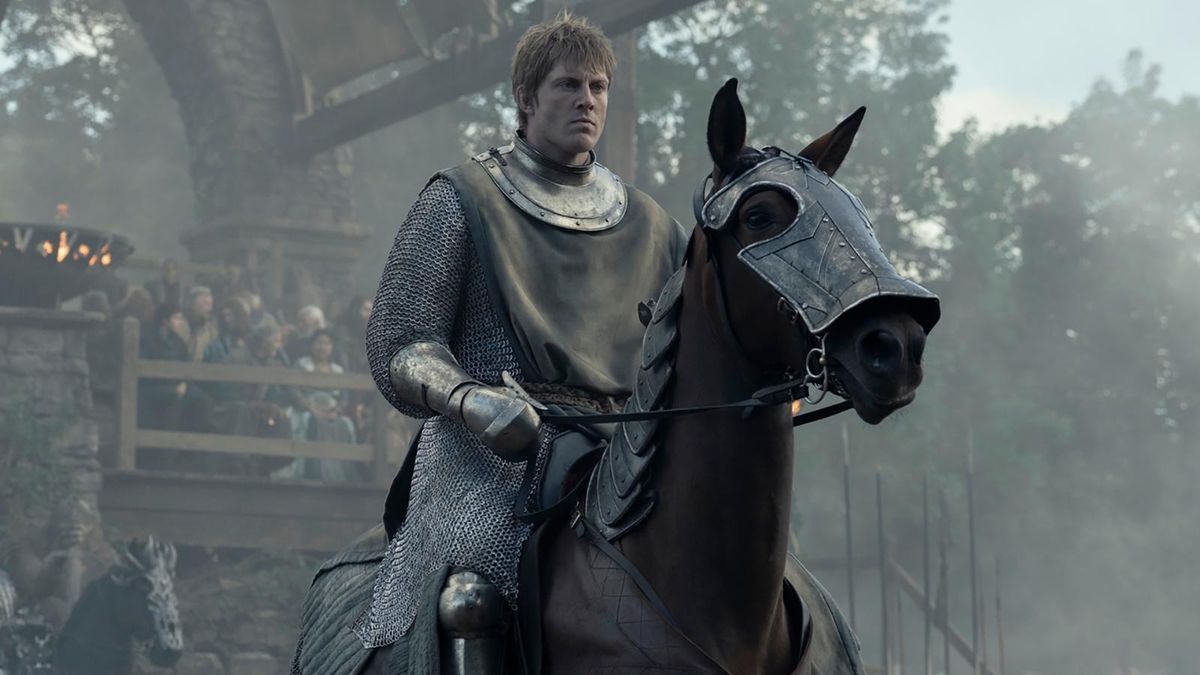
This is the fourth installment of Lily Osler's weekly recaps of A Knight of the Seven Kingdoms, HBO's comedic Game of Thrones spinoff from earlier this year. These recaps are typically only available to paid subscribers, but all Episodes pieces are free this week! If you want more writing like this in your inbox, you can pick up a premium subscription for 20% off from now until the end of the month with our Pride sale!
"Seven" is an odd episode of television to find myself mildly disappointed in. It's what A Knight of Seven Kingdoms has been building to this entire time: a grand confrontation between Dunk's humble commitment to the ideals of knighthood and the corrupt institutions that actually control the lives of hedge knights like him. But even as the careful character work of the earlier season paid off in a series of exciting moments for Dunk here, I couldn't help but feel like the whole thing was a little thin.
At first, I thought this might be a result of how Egg was treated in this episode. After revealing his true identity as a Targaryen at the end of last week's "The Squire," he shows up to Dunk's tiny prison cell in the basement of Ashford Castle in royal finery to have a moment alone with him. He apologizes for his deception: his brother Daeron, a drunken lout, was meant to fight in the tourney with Egg as his squire, but when it became clear he was going to hide in that inn for as long as it took to avoid being put on the lists, Egg took matters into his own hands, joining up with the first knight to come along. Dunk responds to the truth with anger, then resignation. When Egg insists he didn't think he was doing something wrong, Dunk scoffs. “Of course you did!" he says. "That’s why you lied.” It's a moment for Dunk that comes across as unusually abrasive, almost self-pitying. Does Egg really deserve this kind of treatment, I thought? He's just a kid!
But the more I've thought about it, the more I've liked this beat. Dunk is gentle and generous, but he's also exceptionally class-conscious. After all, he had a childhood diametrically opposed to Egg's, living on scraps in the slums around the Targaryen castle. I believe that Egg sincerely likes Dunk and that the risks he's willing to take on Dunk's behalf are born of genuine loyalty and affection, but that doesn't change how his recklessness insulates him from the consequences of his actions. He prioritized himself by asking Dunk to stop Aerion last episode when, as his uncle Baelor later points out, he could have just given up the ruse and called his family for help. Now, no punishment he could face from his family could possibly measure up to the judicial amputation or death in combat that might now befall Dunk. He's just a kid, yes, but, unlike the kid Dunk once was, he's a kid whose freedom far outstrips his responsibility. If he's ever to grow into an adult with a clear sense of what privileges his class position affords him, this is a conflict he had to have.
Dunk, for his part, gets just as much thoughtful characterization here as Egg. "Seven" is an inflection point for him between the two facets we've seen of his nature: the awkward, anxious, genuflecting person he becomes when faced with the people he's learned since childhood are meant to be his social betters versus the bone-deep sense of justice that puts him at odds with the social hierarchy of Westeros. He's still got the outward appearances of that first bit of his persona, kneeling before the Targaryens even as he's seen how vain and petty they truly are, but as he works to recruit six other knights for the archaic form of trial-by-combat Aerion's insisted on, we see just how much stronger that second side of him is. He refuses to apologize for hitting Aerion, but he also resists the urge to make himself a hero. As far as he sees it, he was just doing what any other knight would have done. He could never be like Ser Steffon, sacrificing his beliefs for the sake of material gain. What makes him unique isn't his power or skill or charisma, but, simply, his unwillingness to be swayed by power and wealth.
And "Seven" really did a great job showing precisely what is meant by that power and wealth. I've talked a bit in these reviews about my status as a total Westeros neophyte, and it's impressive just how quickly A Knight of the Seven Kingdoms gets me up to speed on what, exactly, the deal is with the Targaryens. For one thing, they're not all flat villains: Daeron is humble and generous even as he knows he's done a terrible thing to Dunk by falsely accusing him of kidnapping Egg, and Baelor appears to be legitimately wise and just (even if my money is still on him orchestrating this whole thing to rid his line of the insufferable Aerion). They are the absolute monarchs of a deeply unjust kingdom, and they are also complex people whose evil is often more systemic than individual. Knight of Seven Kingdoms shows you exactly why people like Raymon despise the Targaryens even as it makes you feel keenly for people like Daeron, Baelor, and, yes, Egg. It's an admirable commitment to nuance for any show, much less a half-hour comedy with a lot of toilet jokes.
Ultimately, what soured me on "Seven" just a bit was seeing the places where that nuance began to break down. I'm a bit skeptical of art of any kind that gives you its morals predigested, and Knight of Seven Kingdoms has never exactly been a subtle show. But, as Dunk struggles to find a sextet of knights to fight alongside him, the show's primary theme just gets more on-the-nose. Knighthood, the show repeats and repeats, is about protecting the innocent. When the moment calls for bravery, all knights are united, whatever their class or background. Honor is born from doing the right thing, no matter the consequences, and the right thing is always protecting the helpless and meek.
The helpless and meek here being, of course, Tanselle. If you've been reading these reviews, you know that this spot in them is where my Obligatory "What About Tanselle?" Paragraph goes, and this edition is no exception: The way the show's characters talk about Tanselle — as an innocent, the perfect object for a knight to save — denies her any agency. Isn't it possible that the puppet show that incurred Aerion's wrath was meant as a provocative symbolic sneer at the Targaryens? Doesn't she get to be an actor here?
And yet that's not the main issue I have with "Seven." A Knight of the Seven Kingdoms is set in a violently patriarchal world where ideals of chivalry govern the way even the most generous men see women. Of course the male characters are going to be somewhat dismissive of her ability to make her own choices. The bigger problem, as I see it, is with the boundary between what the characters believe and what the framing of the show seems to believe. We're given no space to see around the knightly insistence that Tanselle is a meek innocent woman in need of manly protection. In fact, Tanselle herself doesn't even appear in this episode, which is all about defending her honor. I'm not ruling out some sort of twist here, but this is no longer the small quibble I raised with the show a few episodes back. The stakes have gone up massively. Dunk is going to fight a sort of battle not seen in a hundred years for Tanselle's honor. If the object of that honor isn't going to get any sort of dimension or interiority... well, that's just bad storytelling.
Speaking of: That massive battle will have to wait for another episode, as we cut to black moments after Baelor agrees to fight for Dunk. The fighting Dunk came to Ashford in search of will have to wait until the season's final third. Even as "Seven" on the whole left me a bit cold, I see this as a net positive for A Knight of the Seven Kingdoms. While it's by no means impossible to have nuanced characterization in a chaotic brawl scene, it is very difficult. And, as "Seven" proves, it's deft character work that ultimately elevates A Knight of the Seven Kingdoms, that makes it far more than the sum of its occasionally uneven parts.
Other thoughts I thought:
- In a change of pace for Knight of Seven Kingdoms, this was mostly a joke-free episode of television. Still, let the record show that there was at least one extremely loud fart.
- As a modestly tall woman who spent the start of last week suffering through a trans-Atlantic flight in a basic economy seat, I found Dunk's painful lack of legroom in his dank dungeon cell quite relatable.
- I'm not sure if Dunk talking to his horses about his problems was an intentional "Oh, Ariana, we're really in it now" moment, but it did make me guffaw.
A Good Song
The free edition of Episodes, which (usually) covers classic TV and film, is published every other Wednesday. Premium subscribers get newsletters every Monday, Tuesday, Wednesday, and Friday. Our editor-in-chief is Emily St. James, and our managing editor is Lily Osler. If you have suggested topics, please reply to the email version of this newsletter or comment (if you are a paid subscriber).