A Knight of the Seven Kingdoms: Episode 1, "The Hedge Knight"
In the first edition of our new recap series, Westeros' tallest, most anxious knight decides to make a name for himself.

This is the first installment of Lily Osler's weekly recaps of the first season of A Knight of the Seven Kingdoms, HBO's comedic Game of Thrones spinoff. Future recaps will only be available to paid subscribers, but this premiere edition is available to all. Become a paid subscriber by clicking the button below:
I'll begin with a pretty sad admission for a cultural critic in the 2020s: I have, somehow, never watched Game of Thrones. The bulk of it aired while I was in undergrad, without an HBO login, and at a university where a friend of mine had gotten threatened with expulsion for torrenting a Star Trek episode on the school wi-fi network. By the time I had the space to watch the show, the final season was getting mixed reviews from critics and bitter takedowns from fans, which didn't exactly make me want to dive in. Besides, my instinctive, perhaps irrational distaste for media where a grim, gritty tone is used as a signifier of Grown-Up Entertainment didn't help matters.
I mention all of this because A Knight of the Seven Kingdoms, a Westeros-set George R.R. Martin adaptation that's been discussed almost universally in its role as a Game of Thrones spin-off, seems to be very consciously written against the cultural footprint of its parent franchise. In its high fantasy stylings, of course, it's clearly the descendant of GoT. But it's resolutely small in scale, with little that seems mythic in its world or characters. It resists, in form and function, the glamour of power. It is built on the comedy and tragedy of the bumbling, fragile, entirely material human body.
By which I mean to say: It opens with a guy taking an enormous shit.
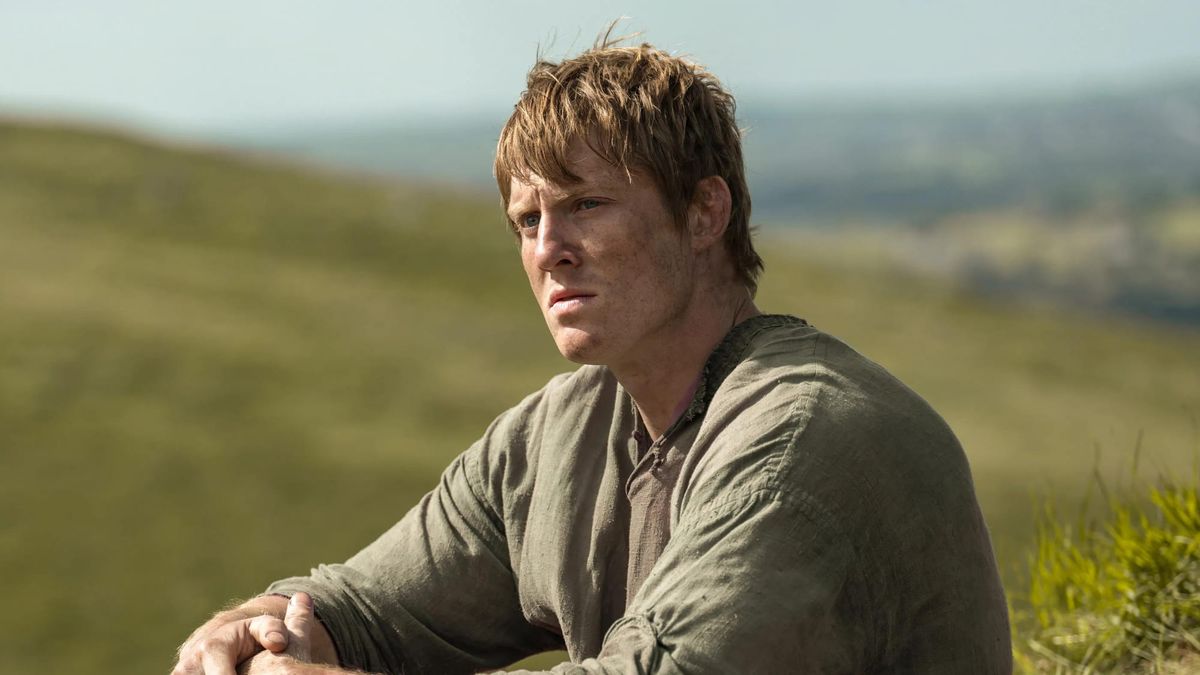
Ser Dunk (Peter Claffey), our lumbering lunk of a protagonist, has just finished burying the man for whom he served as a squire since he was a young boy. His heartfelt eulogy mostly consists of recounting the times his mentor hit him. After a nap, he briefly considers selling his horses – he's got three all to himself, which never stops being funny – to buy some food, then picks up his master's sword as he idly considers careers. There is, after all, a tourney coming up in a nearby town. Hefting the blade, he stares down the road as dramatic strings swell on the soundtrack [the opening strains of the Game of Thrones theme song! –ed.], only for the show to make a hard cut to Dunk taking a squelching poop right next to where he slept. I don't mean to belabor this moment, but it's hard to overstate how horribly wet the show's sound designers made Dunk's bowel movement.
It's a pretty basic bathroom joke, sure, but a tone-setting one, especially since the show's title card appears moments later. This contrast — between the romantic appeal of the knightly life and the soggy, stinky reality of life as a good-natured medieval oaf — is, the show just about screams, the point.
Dunk's modestly pathetic existence goes well beyond a single ill-timed shart. On both a micro and macro scale, he's constantly humiliated. More than one character in the pilot alone reminds him just how bad he smells, which is bad enough without having to adjust your baseline of "bad smell" for the average odor of pre-industrial agrarian society. He's dressed like a farmer, with a rope for a belt. He's tall and broad, attributes that might make a hero on another show but which here just mean he hits his head on every doorway he tries to enter and has to eat a truly ridiculous amount of food.
Worse for a knight, maybe, he's dealing with what we might, in modern terms, call clinical anxiety. Late in the episode, reveling in nobleman Lyonel Baratheon's swanky tent, he tells the bawdy lord that he's often unable to stop worrying. "I agonize a lot," he says. "Sometimes, I think I agonize too much, and I wind up just agonizing over that." (You and me both, Dunk!!!) He does his best to affect bravado when he needs to, but his best isn't very good. Nobles refuse to treat him with anything approximating respect, and their courtesans mock him to his face, and the whole time he sort of looks like a sad basset hound. A knight is meant to be fearless and self-abnegating; Dunk, on the other hand, is composed mostly of fears.
And, in a turn I quite like for how it sets Knight of Seven Kingdoms' tone, many of his fears are about money. When he ventures down to Ashford in hopes of entering the tourney, he's doing it for the glory and the right to call himself a knight, sure. But he's also doing it because it's the only way he knows how to make money. Winners in the tourney, after all, get the armor and riches of the knights they beat, and, from the vast skyline of high silk tents we see on the outskirts of the jousting field, it certainly seems that there's a lot of wealth to be won for someone who's willing to compete for it. Dunk, of course, will have a harder go of it than many, seeing as he'll be competing without any armor or equipment save his master's sword, but he'll do what necessity demands. It's not hard to make out the show's point of view on the well-to-do knights he'll be competing against. As Dunk rests at a countryside inn, the innkeeper tells him that she's not interested in the upcoming tourney. "Knights are built the same as other men," she says, "and I never knew a joust to change the price of eggs.” It's an on-the-nose statement of theme, sure, and a rather easy target. But I'd always rather a show wear its themes on its sleeve than have none to speak of.
Speaking of eggs, though, the inn is also where we meet A Knight of the Seven Kingdoms' second protagonist: tiny, energetic Egg (Dexter Sol Ansell). I presume that he has a more proper name, but we haven't learned it yet, and his nickname is very easy to remember, as he's bald, small, and extremely fragile. After boarding Dunk's horses in the stables, he clambers on the back of one of them to play knight, then insists that Dunk take him to the tourney as his squire. When Dunk refuses, Egg finds a way down to Ashford anyway and sets up camp for the man he's certain he will make into his mentor. Despite Dunk's idle threats, Egg succeeds, and, after a long day of being denied entry to the tourney, they share some roasted fish and watch the stars.
I've got good reason to believe that Egg is more than the penniless moppet he appears to be, since (a) he has a very posh English accent, which I suspect corresponds to something in the Westeros class system; (b) he briefly mentions being from one of the non-impoverished parts of King's Landing, and (c) I have a passing grasp of how these kinds of stories work. Still, for now, he's just a kid desperate enough for glory that he's attached himself, barnacle-like, to the most pathetic knight on the continent. And good for him, since his relationship with Dunk is by far the most intriguing thing on the show so far. Both Claffey and Ansell give their line reads plenty of pathos even in the most broadly comedic moments, and they serve as one another's foils just enough to offer their relationship some nice tension. I'm sure I'll come to care about the show's broader stakes soon enough, but, for now, I'm mostly in this to watch the enormous man and the tiny child bicker.
Those broader stakes, incidentally, are the source of one of the few gnawing worries I have about A Knight of the Seven Kingdoms. Just about everything that makes the show engaging thus far emerges from its commitment to telling a small, silly, empathetic story in a grandiose world. There are a few signs in this episode, though, that hint that Dunk's place in Westeros is more significant than he might ever expect. A wealthy-looking drunkard at the inn seems to be oddly afraid of Dunk, and Lyonel Baratheon (hey, that's one of the last names I recognize through cultural osmosis!) immediately takes a shine to him. I'm enjoying down-on-his-luck, clinically anxious Dunk enough that I'm mildly uncomfortable with the idea of him being the subject of some grand prophecy, even as I already trust this show to handle an escalation in stakes with care.
For now, though, what makes Dunk special and what makes him a bit of a joke are one and the same. As they lie on the grass, waiting for sleep to take them, Egg points out that all the well-off knights of the kingdom are sleeping down below under elaborate tents. They may be better equipped, fed, and rested than Dunk, less clumsy and more socially adept. But their wealth puts blinders on them just as their tents close off the night sky from their gaze. Maybe only a hedge knight can see a falling star.
Other thoughts I thought:
- I really cannot overstate how funny it is that Dunk has three horses. Three! For one guy!
- Flagging that we see a lot of brief flashbacks here, but we don't explicitly see a flashback to Dunk's mentor knighting him. Feels like it may be important.
- I have learned from some light Googling that the dragon puppet was meant to diegetically be a very impressive puppet, which I guess is nice but which also spoils my hope of there being actual living dragons in this that are also played by puppets.
A Good Song
The free edition of Episodes, which (usually) covers classic TV and film, is published every other Wednesday. Premium subscribers get newsletters every Monday, Tuesday, Wednesday, and Friday. Our editor-in-chief is Emily St. James, and our managing editor is Lily Osler. If you have suggested topics, please reply to the email version of this newsletter or comment (if you are a paid subscriber).