The first time The Simpsons could have ended
Our new series on great TV episodes of the 21st century begins with a would-be series finale.

Welcome to 26 Episodes, a biweekly series here at Episodes tracing the history of television in the 21st century via some of the episodes that made the medium great. The episodes are arranged chronologically, with one for every year between 2000 and 2025, and they're chosen by me, Emily St. James. They are by no means meant to be the best episodes of the century, but all of them are at least good, and they're all worth watching in my opinion.
I've chosen them with one eye toward writing about episodes I haven't covered extensively before — though, c'mon, I'm going to write about The Sopranos at some point — and one eye toward writing about the larger narratives that drove TV in this century. Every piece after this one will only be available to paid subscribers, so if you want to follow along with them, well, click the button below and take advantage of the last few days of our January sale.
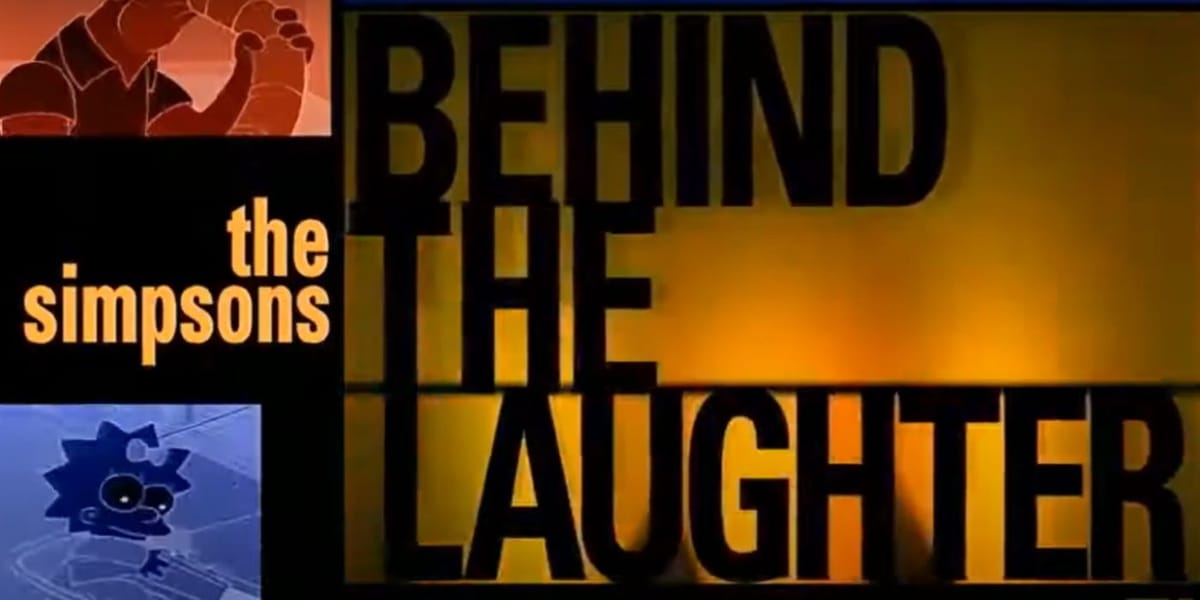
We begin this series with the show that could lay a claim to completely remaking TV in the 1990s, yet one that was still going strong in the 2000s – and, indeed, to this day. Let's chat about The Simpsons Season 11 finale, "Behind the Laughter."
There are a small handful of Simpsons episodes across the series' nearly 40-year run that have been singled out here and there as episodes that might have been "the last one," had the show been forced to choose. The Season 23 episode "Holidays of Future Passed" — which will have its 15th anniversary this upcoming December — was actually written as a potential series finale at a point when negotiations with the show's cast seemed like they might be at an impasse. Similarly, the Season 19 episode "Eternal Moonshine of the Simpson Mind" has been cited by longtime showrunner Al Jean as one that could have been the finale, had the show chosen to wrap things up.
Both "Holidays" and "Eternal" suggest themselves as finales because of how they take the endlessly elastic world of The Simpsons and stretch it in the one dimension it is most reticent to explore: time. "Holidays" skips liberally ahead into the future, revealing possible landing points for the Simpsons that make as much sense as anything else might, while "Eternal" loops backward recursively, revealing memories that seem like they might blow up the carefully controlled world of Springfield, until the episode's end reveals the truth. The Simpsons long allowed itself room for flashbacks and flash-forwards, but the scenes depicted in these two episodes have more gravity to them and thus more finality.
It feels sort of obvious to say this now, as the show proceeds through its 37th season, but The Simpsons was never really built to end. The second it let go of any sense of grounded reality and embraced its cartoonishness — a thing it was doing as early as Season 2! — it became a series that could run forever, or at least as long as one could find actors who could do reasonable facsimiles of the original voices should the original cast become unavailable for any reason.
Across all those years, it has so thoroughly poked and prodded at the limits of its own reality that if it tried to do an episode where, say, the Simpson family had to move to the moon, it would have no real sense of finality. We'd just be expecting them to move back to Springfield a week later. The show can't even really do a "life goes on; the viewer just doesn't see it" ending in the manner of sitcoms like Everybody Loves Raymond because it would feel false on some level. Nothing ever really changes in Springfield, so of course life would go on. Thus, any given Simpsons finale has to grapple with the fact that no viewer who's seen enough episodes of The Simpsons will ever believe that the show can end. This pure countercultural object became the culture so much that it no longer has anything to push back against. I still enjoy The Simpsons when I check in on it, but I won't lie and say I watch it every week. The most enjoyable thing about it now is its constancy, the fact that it is a verified American institution when such things are in short supply.
The question becomes, then, at what point could The Simpsons have ended with a few shreds of its countercultural status left intact while still preserving as many of the classic episodes from the golden age as possible. The answer that many have landed on, however accidentally, is "Behind the Laughter," the show's 11th season finale. It's another episode Jean has cited as a potential series ender, and when the BBC lost the rights to broadcast the show to Channel 4, it chose "Laughter" as the final episode it aired. It has the added benefit of being the only episode listed here to air as an actual season finale. You don't have to work too hard to simply end any given Simpsons rewatch right here, and you'll have seen so much of what makes this one of the greatest TV shows ever made.
"Behind the Laughter" is a very funny episode of television. The main thing holding it back from being held up as an eternal classic is the fact that it's based on VH1's venerable Behind the Music docuseries, which ended in 2014. If you came to this episode at any point after, say, 2010, its central parody wouldn't be lost on you exactly — overwrought pop culture documentaries will always be with us — but the precision with which it skewers BTM would escape you, at least a little bit. Still, you would surely be able to enjoy the many solid gags — I'm partial to the cheap Bart Simpson T-shirt featuring the catchphrase "Life Begins at Conception, Man!" — and parodies of formulaic television, oddball variety shows, and troubled showbiz families.
None of this explains why this funny episode of all funny Simpsons episodes might credibly serve as the show's finale, however! Nor does the fact that the episode feints at saying the family is from Kentucky, the kind of answer that would feel like it had more weight behind it in an actual series finale. No, to think about that question, we need to think a bit about where The Simpsons had been and where it already could sense it was going.
I alluded to The Simpsons as a "countercultural" object above, and if you are any sort of scholar of TV — or just have watched a lot of it — then you'll know that The Simpsons served as one of the primary forebears of a movement that turned the American sitcom inside out and pocketed everything found there. The Simpsons was by no means the only program in this movement, nor was it the first. Versions of this sort of storytelling have been around essentially as long as television itself has. But by virtue of being in the right place at the right time – and being the sort of brightly colored cartoon that would prove endlessly exportable – The Simpsons became the foremost example of the movement nonetheless.
Its core promise was simple: Nothing would be sacrosanct. Every sacred cow you could think of would be vivisected with comedic precision. As so often happens with "nothing is sacred" projects, occasional hints of arch-conservatism creeped in here and there — in "Behind the Laughter," there's a scene featuring Gloria Allred, identified as a "shrill feminist" — but The Simpsons was less drawn to this sort of joking than South Park or even Family Guy. No, the foremost sacred cow The Simpsons took aim at was the stark artificiality of the television medium itself. Every episode offered an opportunity to melt down TV into its constituent parts, make fun of the parts as they melted, then try to mold something new out of them.
The Simpsons was not consistently metatextual in the manner of many of its children, but it was certainly a show that found it amusing to be self-aware about its existence as a television show. The form of the animated TV show, the tropes of family sitcoms, and especially the network the show aired on were all frequent targets of the show's humor. (In "Laughter," for instance, Marge says the Simpson family got a show on the air because her hairdresser also happened to be the president of Fox.) The longer the series ran, the more it also made fun of itself for its own longevity, even setting aside full episodes like "The Simpsons Spin-Off Showcase" that existed largely to poke fun at the improbability of the show that skewered the institutions of television becoming an institution of television.
Yet The Simpsons maintained its quality for far longer than many other shows that have taken aim at the medium airing them so consistently. Some of that surely stems from its writers room, cast, and team of directors, all of whom have become legends within the industry. However, what has always kept The Simpsons from collapsing into itself — even today — is its insistence on treating the Simpson family as complicated, psychologically rich people. Homer, Marge, Bart, and Lisa are characters in the way even a lot of live-action comedies don't allow their ensembles to become, and the longer the show ran, the more that streak of empathy extended outward to a vast cast of supporting players. Though Matt Groening created the series and deserves credit for the level of anti-institutional humor he brought to it from the world of indie comics, James L. Brooks and Sam Simon, who developed the series with Groening, both brought a sense of how to turn the little people in your TV into folks who felt real. The show's success continues to live in the tug-of-war between those two impulses.
Thus, "Behind the Laughter" would work perfectly as a series closer because it is one of the few episodes of the show that turns the show's anti-institutional lens not just on The Simpsons but on the Simpsons. It situates them as a family of showbiz novices who become immensely famous because a fame-hungry father forced them all to star in his TV show, then immediately began roping everybody else in his town into the act. The episode seems like it's mocking Simpsons mania, what with its gags about the Simpsons spawning a merchandising empire and several hit singles, but by situating people who are meant to be the "real" Simpsons who play the Simpsons at its center, it's doing something subtly different. We are so fully on the flipside of what the show normally does that the effect is discombobulating. You can imagine this as a series finale because it's not immediately clear how we would get back to the show from here, even if we know in our heart of hearts that the series will simply ignore everything that happened in this episode and proceed as planned.
But even here, in a world where the Simpsons themselves are meant to be vivisected in the manner of other institutions, the show cannot entirely let go of the idea that they are stronger together, as a family, than they ever could be apart. Yes, some of that is the pitch-perfect recreation of the Behind the Music "rise and fall and reunion" arc, but the scenes where Willie Nelson reunites the family (presumably riffing on his role in Farm Aid) play with just a hint of pathos, a reminder that we care about these characters as people. In the end, all institutions were grist for The Simpsons' mill — except the Simpsons themselves. Somewhere deep in this show's heart, it needs to believe they will figure out a way to be okay in the end. It's a secret that has helped the show run for nearly four decades; it's also made it that much harder to figure out a way to ever bring things to an end, assuming all involved would ever want to do such a thing.
When did the 20th century end? The "correct" answer is "January 1, 2000" (or "January 1, 2001," if you want to be an asshole), while the usual metaphorical answer — at least in the United States — is September 11, 2001. Yet as I worked on this piece, I started to wonder if, perversely, May 21, 2000, the airdate of "Behind the Laughter," would work as well as anything else. The episode serves as almost a perfect capstone for the series that was perhaps the definitive TV show of the century's final decade, and that show so thoroughly remixed the entirety of 20th century culture that it seemed at times to be a summary statement for 100 years just passed.
We all know The Simpsons kept going. It's still running right now, every Sunday night on Fox, just where it always has, with episodes streaming on both Hulu and Disney+. I watch it rarely now, but when I do, I typically find something to appreciate even in episodes that don't completely work. The real enemy that finally dragged The Simpsons down from "possibly the best TV show ever" to "just another show" wasn't anything inherent to the show but to the medium itself. Television breeds familiarity, and the more familiar something is, the less it can surprise you. There really isn't anything the show can say that will feel new.
But maybe that's fine. Another thing we all know is that the 20th century never really ended, at least insofar as our pop culture is concerned. We continue to wring dry many of the popular properties of the last 25 years of that century, up to and including The Simpsons, because the friendly gloss of nostalgia allows us to confuse that time for being simpler and less terrifying, which it was in some ways and wasn't in others. History moves on; the 20th century is long gone, except for the pockets in which it survives, lumbering onward.
I think sometimes about how I will feel if The Simpsons ever ends. It began when I was a child, and if it runs 50 or 60 years, it will end when I am well into late middle age, if not my later years. I think I will feel strangely devastated, even if it's a show I haven't watched consistently since the early 2010s (and at that point, I was getting paid to review it). There is something comforting in the idea that this show that has already run an exceedingly long time will always be there with new episodes, holding down one corner of the past, only grudgingly being dragged forward into the future. I don't need The Simpsons to be good, but I think some part of me will always need it to exist.
Next time: Joyce will never have any more fruit punch. Ever.
A Good Song
The free edition of Episodes, which (usually) covers classic TV and film, is published every other Wednesday. Premium subscribers get newsletters every Monday, Tuesday, Wednesday, and Friday. Our editor-in-chief is Emily St. James, and our managing editor is Lily Osler. If you have suggested topics, please reply to the email version of this newsletter or comment (if you are a paid subscriber).