Kissin' on the big screen: 12 great love stories that deserve an adaptation ASAP
Get ready for Valentine's Day with a dozen romantic tales that would make great movies!


It's less than a fortnight to Valentine's Day, Heated Rivalry is on everyone's television screen (and in our newsletters every Tuesday morning!), and Emily's working on a romance-adjacent novel — is it any shock that love is on the minds of Episodes' staff right now? With the way Heated Rivalry in particular has been showing the world that adaptations of romance novels can be not just good but great, we've been thinking a lot about which other favorite romance novels and/or books that are absolutely not romances (Lily's apologies for not reading enough in the genre!) would best be able to go from page to screen.
Below, we've compiled a list of 12 books, stories, series, and doorstopper historical epics about love we think screenwriters and directors ought to take a crack at. They range from sports romance to romantasy to historical romance to Kristin Lavransdatter, which Emily promises would make a GREAT movie about love. Settle in and get in the holiday spirit with us! And don't forget to share your own suggestions for romances that need the screen treatment, either in the comments or on our premium subscriber Discord server.
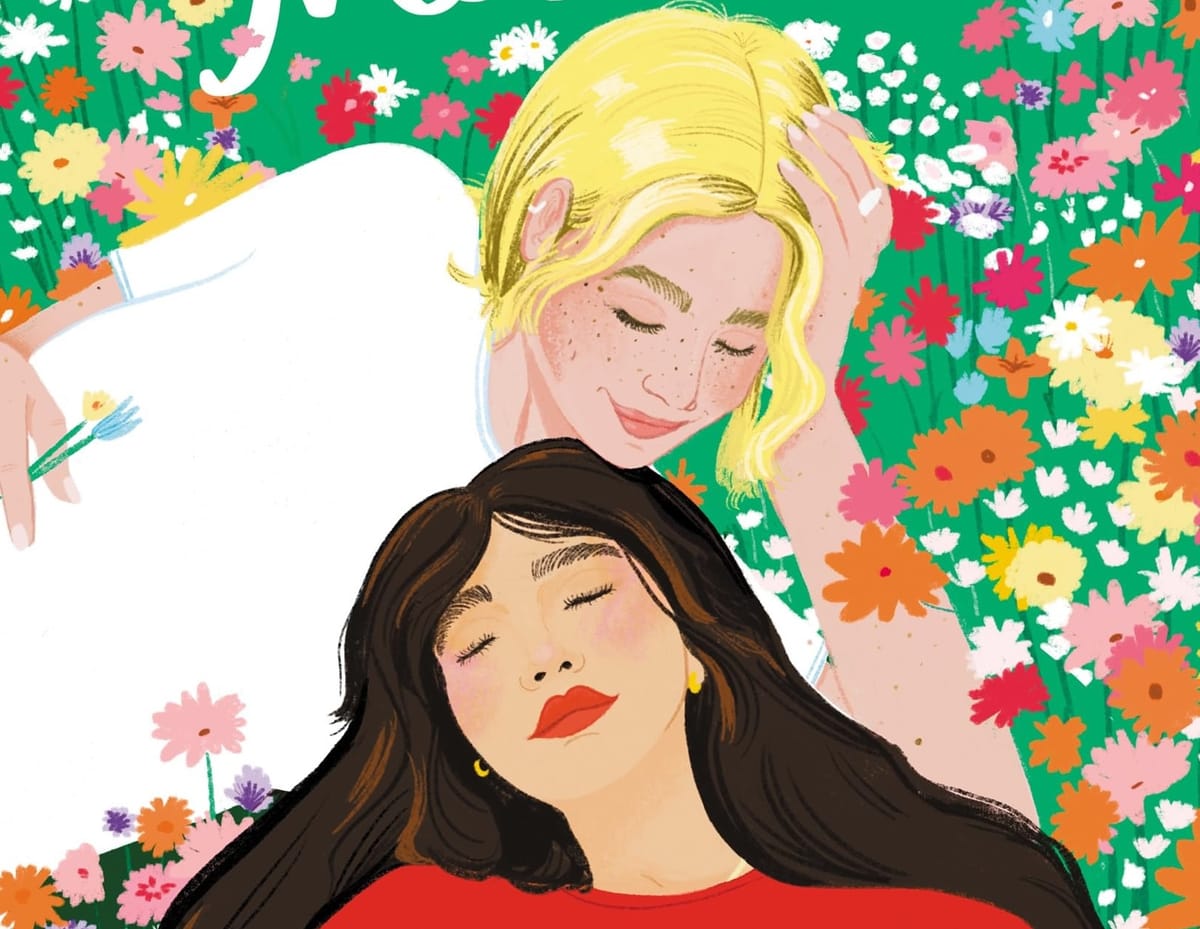
Forget Me Not (Alyson Derrick, 2023): Bring! Back! The! Weepy! Two teen girls who are very much in love confront the ultimate test when one of them nearly dies from a traumatic head injury... and when she recovers, she's forgotten the last two years of her life. Which also means she's forgotten her girlfriend and the slow process that was her coming out to herself in a very cloistered, religious environment. Is this kind of a wild high concept? Yes. Does Derrick execute it to perfection? Also, yes, to the degree that she was longlisted for the National Book Award for young people's literature. The nostalgic, small-town vibes straight out of a Nicholas Sparks novel will give this one a lot of its power on a big screen, as will the forthright portrayal of two people who very much belong together having to overcome something absolutely enormous. It's been a second since anybody let Desiree Akhavan make anything, and she would be perfect for this, bringing it in for an ending filled with well-earned happy tears. —Emily St. James
Lila (Marilynne Robinson, 2014): This is possibly my favorite of Robinson's Gilead novels, and certainly the most romantic of them. Its plot is simple enough — John Ames, an aging Iowan minister, falls in love with a young irreligious drifter — but, as with so much of Robinson's work, it's the telling that makes it special, with the whole thing grounded by Lila's voice even as it flits across a lifetime in the span of a sentence. So much of the novel is focused on minute physical details, from the splintered floorboards of the abandoned shack that Lila shelters in to the stones just below the surface of the creek on the outskirts of town, and it's that attention to sensory detail that makes me think Chloé Zhao — a director I'm still mad at on account of Hamnet! — could do an absurdly good adaptation of this book. (I love Todd Field, who's attached to direct an adaptation of Robinson's Home, but I feel pretty strongly that Lila needs a female director.) No idea who would play Lila herself (sound off in the comments!), but I am sure Focus Features could cough up enough money to get a newly un-retired Daniel Day-Lewis to play Ames. — Lily Osler
How to End a Love Story (Yulin Kuang, 2024): Kuang's work adapting Emily Henry novels for the streaming screen has just started to bear fruit with the very successful People We Meet on Vacation. Hopefully, that means Hollywood takes another look at her debut novel, a book that is smart about the ways that trauma can knit people together and the, uh, class dynamics of TV writers' rooms. A woman's dark academia YA book series gets optioned to be adapted for television, and when she gets to her first day on the job, she learns the number two in the room is... the man who accidentally killed her sister in a car accident all the way back in high school. Except they're obviously attracted to each other? All romance needs to have Some Other Thing going on in the background for the love story to truly hit, and the ways in which our main duo slowly start to tease out all the threads of the tragedy uniting them give this one some real heft. Plus, there's an incisive look at how the TV sausage gets made — even if I gasped in horror when the lovers did it on the writers' room table. Kuang has said she'd love to see this one adapted for TV, and since she's written for the screen, she should get first crack at this one. It's only right! —ESJ
Peaces (Helen Oyeyemi, 2021): I'm typically a fan of Helen Oyeyemi's books, even the goofier ones, but Peaces is a cut above even for her, with every frenetic detail — the magical train! the mongooses that I think kind of function like daemons in His Dark Materials! — somehow unexpectedly cohering into one of the more gorgeous books about love that I've read in years. (My best, but still inept, attempt at summary: two guys in love with each other but uncertain about the future of their relationship find that a train trip getaway is far more trouble than they'd expected.) It probably feels too on-the-nose to say Wes Anderson should adapt this one, but he should, dammit! I'm a passionate defender of his 2020s work, especially Asteroid City and The Phoenician Scheme; even as his premises and mise-en-scene keep getting fussier, I feel like he's remembered recently how to make a screwball, over-the-top movie where every zany element is just another way the characters are trying to wrap their heads around the impossibility of love (romantic, familial, whatever) and the finality of death. It's an attitude that rhymes perfectly with what Oyeyemi's doing here. Bonus points if they use a real mongoose. —LO
Kristin Lavransdatter (Sigrid Undset, 1922): NOW, LISTEN. Is this story of a medieval Norwegian woman who blows up her life — and a perfectly reasonable engagement — to pursue a hot guy she happens upon one day the world's most conventional fit for a romance film? No. A large portion of its midsection is about, like, the politics of 14th-century Norwegian kings, and it ends with a borderline hallucinatory portion set during the Black Death. What's more, a lot of the book is about Kristin loudly trying to convince her original love, God the Father, that she doesn't suck and deserves a second chance. (God remains noncommittal.) But the central love triangle is beautifully executed, and the ways Kristin's romantic choices reverberate through the rest of her life, no matter how much she might not want them to, keep you going through the bits where Undset is just showing off that she did a lot of research into medieval farming. I'm not going to say this is The Worst Person in the World set in medieval Scandinavia, but I'm also not not going to say that, you know? Renate Reinsve is Kristin Lavransdatter??? A film by Joachim Trier??? Eh??? Ehhhhhh???????! —ESJ
House of Leaves (Mark Z. Danielewski, 2000): To quote directly from Emily's instructions for this article, "the lift [in writing an entry] gets higher if it's, like... House of Leaves, which has famously been almost adapted and then abandoned dozens of times." Well, hear me out, Emily: I am ready to make that heavy lift! My take on adapting House of Leaves is and has always been that trying to use the visual medium of film to adapt the novel's metatextual and typographical elements is an absolute fool's errand. Like, no one but a true genius is making a watchable movie that tries to go through the entire Navidson Record and the stuff with Zampanó and Johnny Truant and the section where Karen interviews Camille Paglia or whatever.
Danielewski's novel is a fractal, each story containing so many others nested within it, and you can actually use that to your advantage by stripping away everything else about the story and just making an emotionally charged horror film about Will Navidson and Karen Green. The book focuses more than you might remember on their fraught relationship; the house brings their longstanding issues as a couple to the fore and, in fact, leads to their separation, which makes Karen's decision to grit her teeth through her claustrophobia long enough to rescue Will from the house's clutches all the more beautiful. Shoot it on an iPhone or camcorder (no Skinamarink-style fake video grain, please!) on location in southwestern Virginia, rescue Leigh Janiak from Netflix jail and get her to direct it the way she did Honeymoon, cast Maika Monroe as Karen and maybe Steven Yeun as Will, keep the whole thing to a tight 105 minutes, make Will bisexual and have him cheat on Karen with a guy in Holloway's crew instead of the other way around just to reduce the implicit sexism a bit (and to emphasize the degree to which he's psychosexually fixated on the house), and, boom, you've got a great indie horror film that actually does justice to the emotional impact of the Karen/Will plot! Simple as. —LO
"Prince Hat Underground" (Kelly Link, from White Cat Black Dog, 2023): This is a sweet, genuinely romantic, and (as always from Link) somewhat disconcerting queer love story, and (unlike some of Link's other great love stories) it's episodic in a way that I think would suit a film perfectly. I strongly doubt they would want to direct it, but I think Jane Schoenbrun should at least be offered the chance to make this their first visual-effects-driven feature; it's about the most contemplative and melancholic "big magical quest" story you can find. —LO
The Shepherd King duology (Rachel Gillig, 2022-23): Somebody's going to figure out how to adapt romantasy one of these days, and they're going to realize that the trick is to pick a series where the fantasy elements are going to feel fresh and new onscreen. Gillig's first two novels hit all of the tropes you'd expect — they're about a bookish young woman who's Secretly Special being guarded by a Supposed Rival Who Can't Stop Thinking About Her, for goodness sake — but the fantasy setting and magic system are relatively novel and (bonus!) very cinematic. A kingdom deep in the forest, surrounded by a deadly mist? Magic of very limited effect that is powered by tarot-like cards? A monstrous entity who haunts the edges of the story, slowly moving toward its center, and who functions a bit like Pazuzu in The Exorcist? All would be fun to see onscreen! Unfortunately, this one needs to be a TV series, I think, and I would love to see what Ron Moore, who keeps attempting romantasy series and being thwarted, would do with it. —ESJ
The Idiot (Elif Batuman, 2017): This is, at best, a pseudo-love story — Harvard freshman Selin, eager to experience life and everything that comes with it, convinces herself that she's falling for her weirdo classmate Ivan even as Batuman implies that Selin may not even be into guys, period. But I am not a huge romance reader and so you're all just going to have to bear with my entries on this list!! Anyway, it's a novel that takes place over a single year, it features a number of visually-interesting setpieces and a bunch of highly filmable quips, it's set in a part of the Nineties people are very nostalgic for right now, and if you really squint you could maybe put some of those "dark academia" aesthetics children like in there; I can't understand why the film adaptation is evidently seven years deep in development hell. I doubt he would accept the offer, but if Sandi Tan's no longer interested, I think Yorgos Lanthimos should give this a shot, if only because Batuman's bone-dry cringe humor often reads like a Lanthimos film in prose. I think he probably should not cast Emma Stone as Selin, owing to she is not Turkish and is 37 years old, but, hey, whatever gets the movie made. —LO
A Lady for a Duke (Alexis Hall, 2022): I don't particularly like historical romance, but I did like this tale of a duke who can't help but feel a strange stir of recognition when a woman unexpectedly enters his life and spurs some amount of heat. See, she's his childhood best friend, who took the occasion of narrowly surviving a battle in the Napoleonic Wars to fake her own death and begin living as a woman, as she always knew she must. There are a handful of trans romances out there, but I like this one for just how much it has thought about how to tell a romantic story featuring a trans woman in a historical period when medical transition was not yet possible. I'd also like to see how Eve Lindley would be in it, provided she can do some sort of British accent. For director, we'll need to find someone who can get that swoon going. Why not Steve McQueen? He'd keep the queerness and also prevent the thing from tipping over into David Lean pastiche, which we don't want. Unless we do?? —ESJ
My Education (Susan Choi, 2013): God, I hope no one lets Luca Guadagnino near this book! It's exactly the kind of thing that's up his alley — a campus satire/sex romp in which a disaffected and kind of shitty graduate student has an affair with the wife of one of her professors — but I think he'd focus too much on the campus politics of it all and neglect what a messy, interesting character our protagonist Regina is. The book works in large part because of your ambiguous relationship as a reader to Regina — the lush narrative voice draws you so close to her psyche and libido even as another part of you keeps screaming "no! stop! don't do that!" — and as such I think this movie needs a director who's better than Guadagnino at showing interiority in a visual medium, someone more like Celine Song. As far as casting for Regina goes, I'd consider Patti Harrison even though she's a bit old for the role. She's able to do vulnerability (see: Together Together) just as well as she can do brashness (see: every other Patti Harrison role), and she deserves the chance to be a romantic lead! —LO
Playing for Keeps (Alexandria Bellefleur, 2026): Readers of my contributions to the Heated Rivalry recaps most weeks will know how much I love the romance writing of Bellefleur, and readers of Heated Rivalry discourse in general will know "When will we get Heated Rivalry but sapphic??" is a question very much on people's minds. If I had my druthers as a Hollywood screenwriter, then Bellefleur's latest would be precisely that – a queer romance set in and around the world of sports that uses copious amounts of sex to tell an interesting character story. Very clearly written as part of the enormous glut of romances inspired by Taylor Swift and Travis Kelce's coupling, Bellefleur smartly places the pop star and football player falling for each other in the background of a story about their publicists falling into deep lust, then a sort of professional friendship, then something like love? Maybe? It's a fun arc, and it captures something ineffable about the very lesbian desire to learn the girl who was mean to you in high school simply had a crush on you. Anyway, the story here is compact enough to support a movie, but I do think a six-episode series might be a way to tell this story to its best ability. And who should adapt it? Me? Obviously? (Caveat: I haven't quite finished this yet. Maybe I will hate it in the end! But that, alas, will just make me want to adapt it more.) —ESJ
A Good Song
The free edition of Episodes, which (usually) covers classic TV and film, is published every other Wednesday. Premium subscribers get newsletters every Monday, Tuesday, Wednesday, and Friday. Our editor-in-chief is Emily St. James, and our managing editor is Lily Osler. If you have suggested topics, please reply to the email version of this newsletter or comment (if you are a paid subscriber).